
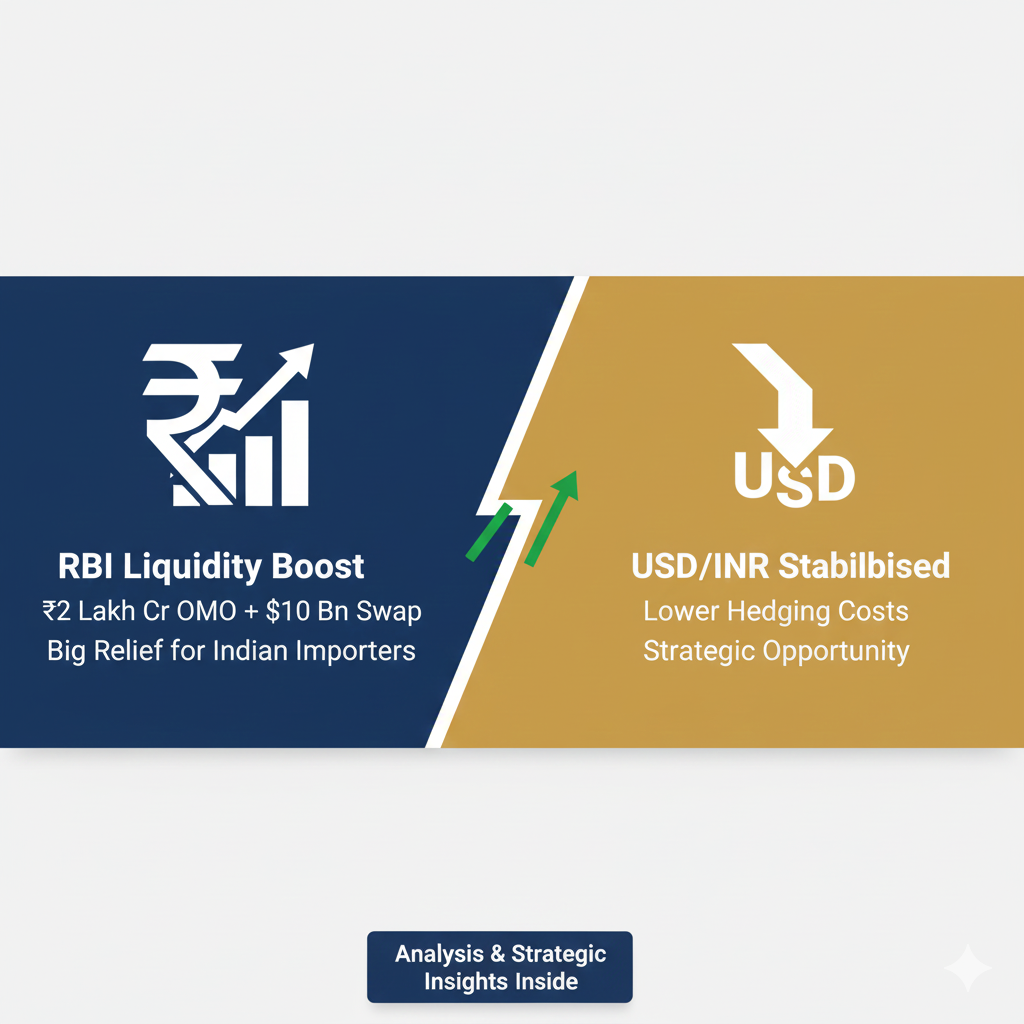
In a decisive move to stabilise the Indian Rupee and ease liquidity conditions, the Reserve Bank of India (RBI) announced a powerful set of measures on 23rd December 2025. These steps come at a critical time when global currency volatility and tight dollar liquidity were increasing pressure on Indian importers.
For businesses dependent on imports, this RBI action could be a game-changer.
Let’s break down what RBI has done, why it matters, and how importers can strategically benefit.
RBI’s Big Announcement: Liquidity Injection & Dollar Support
💰 ₹2,00,000 Crore Liquidity Injection via OMO
The RBI will conduct Open Market Operations (OMO) by purchasing government bonds worth ₹2 lakh crore, spread across four tranches:
📅 29 December 2025 – ₹50,000 crore
📅 05 January 2026 – ₹50,000 crore
📅 12 January 2026 – ₹50,000 crore
📅 22 January 2026 – ₹50,000 crore
👉 What this does:
When RBI buys bonds, it injects fresh rupee liquidity into the banking system, improving credit availability and easing funding pressure for businesses.
💵 USD 10 Billion Dollar Swap (3-Year Tenure)
In another strong signal, RBI announced a USD/INR Buy–Sell Swap to be conducted on 13 January 2026.
- Banks receive immediate dollar liquidity
- RBI absorbs rupees temporarily
- Swap tenure: 3 years
👉 Why this is important:
This move ensures ample USD availability in the domestic market, directly supporting the rupee and calming forex markets.
What Happens to USD/INR After This?
📉 Simple economics at play:
More USD supply in the system
⬇
Dollar scarcity reduces
⬇
USD/INR pressure eases
⬇
Rupee stabilises
RBI’s intervention clearly signals that sharp or disorderly depreciation of INR will not be tolerated.
Direct Impact on Indian Importers
These RBI measures offer immediate and practical benefits to import-driven businesses:
✅ Easier Access to USD
Banks will have better dollar liquidity, reducing delays and allocation issues.
✅ Improved Exchange Rates
With reduced panic demand, USD/INR spreads are likely to tighten.
✅ Lower Forward Premiums
Cheaper forward contracts mean lower hedging costs.
✅ Reduced Working Capital Stress
Lower forex volatility improves cash flow planning.
✅ Better Cost Predictability
Stable currency allows more accurate pricing and margin protection.
Why This Is a Golden Opportunity for Importers
Historically, the best time to hedge currency exposure is when volatility is low and RBI is proactive—not when the dollar is already surging.
📌 Key Strategic Takeaway:
RBI is clearly saying:
“We will not allow disorderly rupee weakness.”
This creates a 3–6 month window where importers can:
- Lock forward contracts
- Optimise dollar exposure
- Reduce forex-related surprises
Smart importers hedge before panic sets in, not after USD/INR spikes.
Broader Market & Economic Impact
Beyond importers, these measures also:
- Support overall financial system liquidity
- Improve confidence among foreign investors
- Reduce speculative pressure on INR
- Strengthen India’s macroeconomic stability
Such decisive central bank action reinforces trust in India’s currency management framework.
Final Thoughts: What Importers Should Do Now
If your business involves regular dollar payments, this is the moment to:
✔ Review your forex exposure
✔ Speak with your banker or treasury advisor
✔ Lock forwards for near-term imports
✔ Avoid unhedged dollar risk
RBI has done its part. The next move is yours.
Stay Updated with Us
Follow our website for:
- Daily RBI & currency updates
- USD/INR outlook & hedging strategies
- Import–export finance insights
- Market-moving policy analysis
Disclaimer:
Riddhi Siddhi Share Brokers is a SEBI-registered intermediary and an authorized person of NSE & BSE.
All information provided above is purely for educational, informational, and learning purposes only and should not be construed as investment advice or a solicitation to buy/sell securities.
Stock market investments are subject to market risks. Past performance is not indicative of future results.
Clients and readers are advised to consult their registered financial advisor before making any investment or trading decisions.
Registration with SEBI, NSE, or BSE and certification from NISM does not guarantee returns nor assure performance.
Riddhi Siddhi Share Brokers, its associates, or employees shall not be liable for any losses arising from the use of this information.