
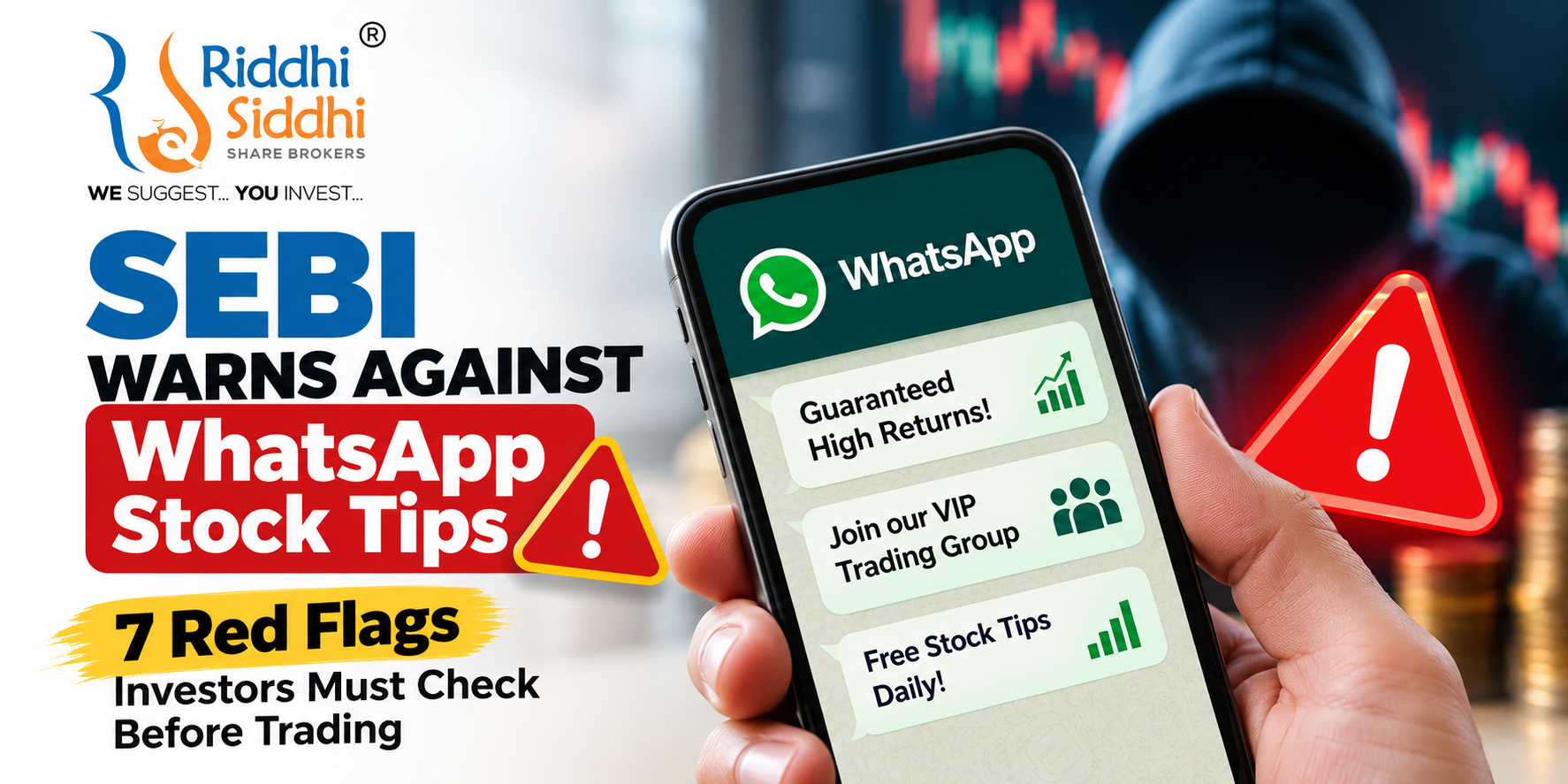
23 October 2026 | Riddhi Siddhi Share Brokers | Investor Education & Fraud Prevention
A WhatsApp group promises extraordinary stock market profits. Members share screenshots of successful trades. An administrator claims to have access to exclusive recommendations, and dozens of participants appear to be making money.
Then comes the invitation: join a VIP group, download a trading application or follow the next stock recommendation.
But who is actually behind the group? Are those profits genuine? And is the person providing recommendations authorised to do so?
On 22 October 2026, the Securities and Exchange Board of India (SEBI) issued Press Release No. 65/2026, cautioning investors against stock tips offered through invitation-only WhatsApp groups.
The warning highlights a growing concern for Indian investors: financial fraud can be disguised as market education, professional trading expertise or an exclusive investment opportunity.
At Riddhi Siddhi Share Brokers (RSSB), we believe investors must understand how such schemes operate, how to verify financial intermediaries and, equally importantly, how to distinguish suspicious operators from legitimate market-related communities.
What Did SEBI Warn Investors About on 22 October 2026?
SEBI’s latest investor caution addresses stock tips offered through invitation-only WhatsApp groups, particularly where operators use questionable practices to establish credibility and encourage trading activity.
The practices identified in reporting around the warning include fabricated trading profits, coordinated testimonials, unfamiliar international numbers, unauthorised trading recommendations and suspicious trading applications.
Some groups may initially present themselves as free educational communities before encouraging members to act on specific stock recommendations.
Investors should understand that the existence of a professional-looking group, a large membership or apparently successful traders does not establish regulatory legitimacy.
Official regulatory reference
- Regulator: Securities and Exchange Board of India
- Date: 22 October 2026
- Press Release: 65/2026
- Subject: Caution to Investors against Stock Tips offered through Invitation-only WhatsApp Groups
- Read SEBI’s official announcement
This warning is particularly relevant as more retail investors receive market information through messaging platforms, social media and online trading communities.
What Are the 7 Red Flags of Fake WhatsApp Trading Groups?
The following checklist combines the practices associated with SEBI’s latest warning with broader investor-protection precautions.
| Warning sign | What investors should check |
|---|---|
| 1. Unverified administrators or overseas numbers | An unfamiliar number is not proof of fraud, but administrators who cannot provide independently verifiable credentials deserve scrutiny. |
| 2. Free education followed by aggressive stock tips | Be cautious when general market education turns into repeated buy-and-sell instructions from an unverified provider. |
| 3. Extraordinary profit screenshots | Screenshots showing unusually high profits may be edited, selectively presented or fabricated. |
| 4. Repeated success stories from group members | Coordinated testimonials can create an artificial impression of credibility and trading success. |
| 5. Invitations to replacement VIP groups | Repeatedly shifting members between groups, particularly with claims that earlier groups were banned, can warrant investigation. |
| 6. Unfamiliar trading apps or payment links | Avoid downloading unverified applications or transferring money through payment channels that cannot be independently authenticated. |
| 7. Guaranteed returns or pressure to act immediately | Promises of assured profits, risk-free trading or urgent investment deadlines are serious warning signs. |
Important: These are indicators of potential risk, not automatic proof of fraud. Investors should evaluate the overall circumstances and independently verify the service provider.
Can WhatsApp Trading Profit Screenshots and Testimonials Be Fake?
Yes. A screenshot is not an independently audited trading record.
Imagine a WhatsApp group displaying messages such as:
- “₹65,000 profit booked today!”
- “Another successful recommendation from our expert.”
- “Our VIP members have never missed a profitable trade.”
Such claims can influence new investors because they appear to demonstrate consistent success.
However, screenshots do not necessarily establish whether a transaction occurred, whether losses were omitted, whether the account belongs to the person making the claim or whether the results are representative.
What is astroturfing in stock market groups?
Astroturfing refers to creating the appearance of independent public support when the endorsements are actually coordinated or manufactured.
In a trading group, accounts connected to an operator might repeatedly post favourable testimonials, exaggerated profit statements or messages encouraging others to participate.
The resulting impression of popularity can influence investors who might otherwise question the legitimacy of the recommendations.
How can investors recognise misleading performance claims?
Look beyond isolated screenshots.
Ask whether the provider has disclosed losses, trading costs, risks and the basis of any performance statements.
Be especially cautious when someone claims consistent returns without drawdowns or presents trading as a predictable source of income.
A genuine profitable trade does not prove that a strategy will remain profitable.
For a related explanation of market surveillance and misleading social-media recommendations, read RSSB’s earlier article: How SEBI Uses AI to Detect Stock Market Fraud and Manipulation.
How Do WhatsApp Stock-Tip Scams Work?
Although fraudulent schemes differ, many follow a recognisable sequence.
Stage 1: Attract investors through free information
An operator creates a group offering market news, educational discussions or supposedly exclusive trading insights.
Stage 2: Establish credibility
Members begin posting testimonials, profit screenshots and messages praising the administrator.
Some early recommendations may even perform well, increasing confidence among participants.
Stage 3: Encourage larger financial commitments
The group may introduce premium membership, specific stock recommendations or access to a supposedly specialised trading platform.
Stage 4: Create urgency
Investors may be told that an opportunity is available only briefly or that immediate action is necessary to capture a large return.
Stage 5: Extract money or influence trading
Depending on the scheme, fraudsters may attempt to obtain money through fake applications, misuse credentials or encourage purchases in securities that benefit other participants.
Not every suspicious group follows this sequence. Nevertheless, understanding these techniques helps investors recognise attempts to manipulate their decisions.
SEBI’s investor education material separately explains how pump-and-dump scams can use WhatsApp and Telegram to create artificial excitement around securities.
How Can You Verify Whether a Stockbroker or Trading Expert Is Genuine?
Before opening an account, paying for a financial service or acting on recommendations, investors should complete three checks.
Step 1: Verify SEBI registration
Visit the official SEBI Intermediaries Directory.
Check the legal name, registration category and current status of the relevant entity.
Do not rely solely on a registration number displayed in a WhatsApp description, promotional graphic or website.
Step 2: Understand what the registration permits
Different financial-market participants have different regulatory responsibilities.
| Participant | General role |
|---|---|
| Registered stockbroker | Provides permitted securities trading and execution services. |
| Authorised Person (AP) | Operates on behalf of a registered stockbroker within the applicable stock-exchange framework. |
| SEBI-registered Research Analyst (RA) | Provides securities research and recommendations within the applicable regulatory framework. |
| SEBI-registered Investment Adviser (IA) | Provides investment advice under the applicable investment advisory regulations. |
A critical distinction is that being associated with a registered stockbroker does not automatically authorise an individual to independently provide regulated investment advice or research recommendations.
The relevant authorisation must match the actual service being offered.
Step 3: Verify the trading platform and payment instructions
Use the official website or independently verified communication channels of the registered intermediary.
Before transferring funds, verify the designated payment process and beneficiary details.
Do not assume that a trading app is legitimate merely because it resembles a recognised brokerage platform.
Investors can also learn about legitimate market participation through RSSB’s Equity Trading Services and broader Investment and Trading Services.
Are All WhatsApp Stock Market Groups Fraudulent?
No. WhatsApp is a communication platform, not a regulatory classification.
This distinction is essential.
WhatsApp communities can be used for financial education, market news, general discussion, client servicing and other lawful communications.
The important question is not whether a group exists on WhatsApp, but what activities are being conducted through it and whether the operator has the required authorisation.
Educational WhatsApp groups versus regulated advisory services
A community sharing market news, general financial education or publicly available information is not necessarily performing the same function as a provider issuing personalised investment recommendations.
However, describing a group as educational does not automatically exempt its actual activities from applicable securities regulations.
If an operator provides regulated research or investment advisory services, the relevant regulatory requirements may apply regardless of whether those services are delivered through WhatsApp, Telegram, email or a website.
Similarly, charging a membership fee does not by itself establish fraud, while offering a service free of charge does not establish legitimacy.
What should investors check before joining a market community?
Investors should understand:
- Who operates the community and whether its identity is verifiable.
- Whether the information is educational, general market commentary or a regulated recommendation.
- Whether any paid service is being offered and on what terms.
- Whether claims about registration, performance or expertise can be independently verified.
- Whether members are being asked to transfer money or share confidential account information.
The objective is informed participation, not blanket distrust of every financial discussion group.
What Should You Do If You Have Already Shared Money or Trading Credentials?
If you suspect a fraudulent trading scheme, speed matters.
If you have shared your trading password or OTP
Immediately secure the affected account through the official broker’s website or application.
Change compromised credentials and contact the registered intermediary through independently verified channels.
Review recent transactions and account access for suspicious activity.
Never share OTPs, passwords, TPINs or remote-access permissions with unknown individuals.
If you have transferred money
Contact your bank or payment provider immediately and report the suspected transaction.
You can report suspected financial cybercrime through the National Cyber Crime Reporting Portal or the 1930 cybercrime helpline.
Preserve payment receipts, transaction references and communication records.
Prompt reporting is important, although recovery of money cannot be guaranteed.
If you have received suspicious stock recommendations
Save the relevant WhatsApp messages, phone numbers, group links, screenshots and promotional material.
For complaints involving regulated securities-market intermediaries, investors may use SEBI SCORES where applicable.
Suspected cybercrime should be reported through the appropriate cybercrime channels.
How Can Investors Protect Their Demat and Trading Accounts?
At Riddhi Siddhi Share Brokers, investor awareness is an important part of responsible market participation.
The following practices can reduce exposure to avoidable risks.
Keep control of your account. Use verified trading applications and regularly review holdings, orders, contract notes and account statements.
Verify financial service providers. Confirm the legal entity and its regulatory status before engaging.
Avoid unverified payment requests. Never transfer trading funds to an unrelated personal account simply because a group administrator provides payment instructions.
Treat extraordinary returns cautiously. High-return promises are not substitutes for risk disclosures, credible records and appropriate authorisation.
Understand derivatives risk. Futures and options can produce substantial losses, and leverage can amplify risk.
Maintain independent judgement. Do not trade merely because other members claim to have earned profits.
These precautions are relevant whether an investor trades independently or uses permitted brokerage assistance.
Can Assisted Trading Help Investors Maintain Better Oversight?
Investors who find it difficult to monitor the markets continuously may prefer to explore structured brokerage support instead of relying on anonymous trading groups.
Riddhi Siddhi Share Brokers offers SAMRiddhi — Strategic Account Management with Riddhi Siddhi, its assisted trading service.
The service information describes account access through mobile and web platforms, transaction confirmations and contract-note visibility.
Investors considering assisted trading should understand the exact service scope, applicable brokerage arrangements, charges, risks, account controls and authorisations before proceeding.
Assisted trading should not be confused with a promise of returns or unrestricted discretionary management of client funds.
Explore: SAMRiddhi — Assisted Trading Services by Riddhi Siddhi Share Brokers.
Frequently Asked Questions About SEBI’s WhatsApp Stock-Tip Warning
1. Has SEBI banned all WhatsApp stock market groups?
No. SEBI’s 22 October 2026 warning concerns stock tips offered through invitation-only WhatsApp groups and associated investor-protection risks. It should not be interpreted as a blanket ban on all market-related WhatsApp communities.
2. Is it illegal to share stock market information on WhatsApp?
Not necessarily. Sharing general market information and providing regulated investment recommendations are different activities. Applicable requirements depend on the actual service, conduct and regulatory framework.
3. How do I check whether a trading expert is SEBI registered?
Use SEBI’s official intermediaries directory to verify the provider’s identity, registration category and status. Ensure the registration is appropriate for the service offered.
4. Are trading profit screenshots reliable evidence?
No. Screenshots can be manipulated or selectively presented. Even genuine screenshots may omit losses, transaction costs and other important information.
5. Is a paid VIP trading group automatically fraudulent?
No. A fee alone does not determine legality. Investors must verify the provider’s identity, activities, regulatory authorisation and payment arrangements.
6. Can fraudulent trading applications display fake profits?
Yes. A suspicious application may display figures that do not represent genuine securities holdings or withdrawable funds. Always verify the trading platform independently.
7. Where should I report a suspected WhatsApp trading scam?
For suspected financial cybercrime in India, use cybercrime.gov.in or call 1930. Contact your bank and registered broker immediately if money or account credentials may have been compromised.
8. What is the difference between an Authorised Person and a SEBI-registered Investment Adviser?
An Authorised Person acts on behalf of a stockbroker under the applicable exchange framework. A SEBI-registered Investment Adviser operates under a separate regulatory framework governing investment advice. One status does not automatically confer the permissions of the other.
Final Takeaway: Verify Before You Trade
SEBI’s 22 October 2026 warning is a reminder that stock market fraud does not always begin with an obvious demand for money.
Sometimes it begins with a friendly WhatsApp invitation, an apparently knowledgeable administrator, a convincing profit screenshot or a group full of enthusiastic testimonials.
The strongest protection is independent verification.
Check who operates the group, what service is being offered, whether the provider has the necessary authorisation and whether the trading platform and payment process are genuine.
At Riddhi Siddhi Share Brokers, we encourage investors to make informed decisions, maintain control over their trading accounts and understand the risks associated with securities-market participation.
Trust should be earned through transparency and verifiable credentials—not manufactured through screenshots and testimonials.
Connect with Riddhi Siddhi Share Brokers
Interested in market education, general market updates or exploring brokerage services?
Message +91 99875 53455 to request access to our exclusive WhatsApp community for daily prices, opportunities and market updates.
Community participation does not constitute personalised investment advice or a guarantee of returns. Any regulated recommendations or advisory services must be provided only under the applicable authorisations and requirements.
For investors seeking structured trading assistance, explore SAMRiddhi Assisted Trading Services.
You can also explore Equity Trading, Derivatives and other services through the Riddhi Siddhi Share Brokers website.
Contact / WhatsApp: +91 99875 53455
Official Sources and Further Reading
- SEBI Press Release 65/2026 — Caution to Investors against Stock Tips offered through Invitation-only WhatsApp Groups
- SEBI Registered Intermediaries
- SEBI Investor Education — Pump and Dump Scam
- National Cyber Crime Reporting Portal
- SEBI SCORES Investor Grievance Portal
Disclaimer
Riddhi Siddhi Share Brokers operates as an Authorised Person associated with a registered stockbroker under the applicable stock-exchange framework. This article is intended solely for general education and investor awareness. It does not constitute personalised investment advice, a research recommendation, an offer to buy or sell securities, or a guarantee of returns.
Any trading assistance or other service is subject to applicable regulatory permissions, broker arrangements and service terms. Investors should independently verify the relevant registered intermediary and authorisations.
Investments in securities markets are subject to market risks. Equity and derivatives trading may result in financial losses, including substantial losses in leveraged products. Past performance is not indicative of future results. Consult an appropriately registered professional where necessary.