
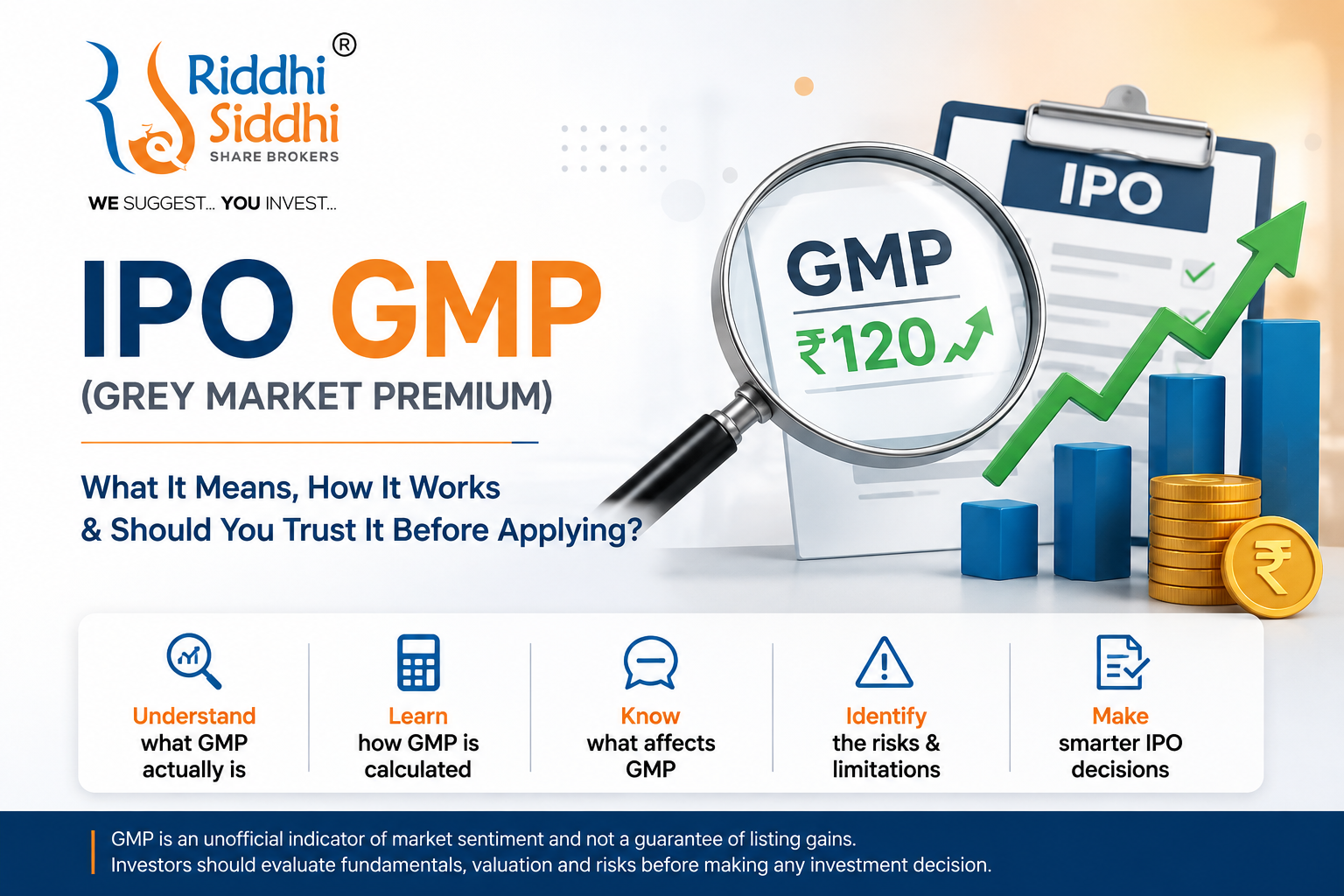
Whenever a popular IPO opens for subscription, one question starts circulating almost immediately:
“What is the GMP?”
For many retail investors, the Grey Market Premium (GMP) has almost become the first number they check before deciding whether to apply for an IPO.
A strong GMP creates excitement.
A falling GMP creates nervousness.
A negative GMP can make investors reconsider their application altogether.
But does GMP really tell us whether an IPO is good or bad?
Not necessarily.
GMP can provide an indication of market sentiment and expected listing demand, but understanding what it represents—and what it does not represent—is extremely important before using it as part of an IPO decision.
At Riddhi Siddhi Share Brokers, we believe investors should understand the numbers behind the excitement.
What Is Grey Market Premium (GMP) in an IPO?
The Grey Market Premium, commonly called GMP, is the premium or discount at which shares of an upcoming IPO are informally indicated to trade before they are officially listed on the stock exchange.
The IPO grey market is an unofficial and unregulated market.
Transactions or indications in this market take place outside the recognised stock exchanges and should therefore not be confused with normal NSE or BSE trading.
Simple Example
Suppose a company launches an IPO at:
Issue Price: ₹500 per share
Before listing, the reported GMP is:
₹100 per share
The market may interpret this as an indicative listing expectation of:
₹500 + ₹100 = ₹600
That represents an indicative premium of:
20%
However, this does not mean the stock will necessarily list at ₹600.
The actual listing price is determined by market demand and supply when the shares officially begin trading.
Why Do IPO Investors Track GMP?
GMP attracts attention because it can provide an early indication of how market participants perceive an upcoming IPO.
A rising GMP may indicate:
- Strong demand expectations
- Positive market sentiment
- Expectations of listing gains
- Increased interest from investors
- Strong momentum around the IPO
A declining or negative GMP may indicate:
- Weakening sentiment
- Concerns regarding valuation
- Reduced expectations of listing gains
- Changing market conditions
- Lower speculative demand
But there is an important distinction:
GMP measures sentiment. It does not measure business quality.
A company with excellent fundamentals can have a weak GMP.
Similarly, an aggressively valued or fundamentally average company can temporarily have a very strong GMP because of market excitement.
How Is GMP Calculated?
There is no official exchange mechanism that calculates GMP.
It emerges from informal demand and supply in the IPO grey market.
For investors trying to understand the numbers, a simple calculation can be useful.
Indicative Listing Price
IPO Price + GMP = Indicative Grey Market Listing Price
For example:
IPO Price: ₹400
GMP: ₹80
Indicative Price:
₹400 + ₹80 = ₹480
GMP Percentage
GMP can also be expressed as a percentage of the IPO price.
GMP % = GMP ÷ IPO Price × 100
In this example:
₹80 ÷ ₹400 × 100 = 20%
This gives investors a quick way to compare the relative grey market enthusiasm around different IPOs.
What Is Negative GMP?
GMP does not always have to be positive.
Suppose an IPO is priced at ₹500 but its grey market indication is minus ₹25.
The implied grey market value would be approximately:
₹475
A negative GMP indicates that grey market participants may currently expect the shares to trade below the IPO price.
Again, this remains only an informal indication.
Sentiment can change dramatically before listing.
Why Does GMP Keep Changing?
One of the biggest mistakes investors make is looking at GMP once and assuming it will remain unchanged until listing.
It can change frequently.
Several factors can influence GMP:
1. IPO Subscription
Strong subscription numbers—particularly from institutional investors—can improve market sentiment.
2. Market Conditions
If Nifty or the broader market falls sharply during the IPO period, GMP can weaken even when nothing has changed fundamentally with the company.
3. Institutional Demand
Strong participation from Qualified Institutional Buyers (QIBs) can influence sentiment.
4. IPO Valuation
If investors believe the IPO is attractively priced compared with listed peers, demand expectations may improve.
5. Company Fundamentals
Revenue growth, profitability, margins, debt and return ratios can influence investor perception.
6. News and Market Sentiment
Sector-specific developments, regulatory changes or broader economic events can quickly alter expectations.
7. Speculation
The grey market is informal. Speculative activity itself can sometimes push premiums higher or lower.
This is why investors should watch the trend in GMP, rather than becoming obsessed with one particular number.
₹20 GMP Doesn’t Always Mean the Same Thing
Another important concept is that the absolute GMP number can be misleading.
Consider two IPOs:
IPO A
Issue Price: ₹100
GMP: ₹20
GMP = 20%
IPO B
Issue Price: ₹1,000
GMP: ₹20
GMP = 2%
Both have a ₹20 GMP, but the market indication is completely different in percentage terms.
Therefore, investors should ideally look at GMP as a percentage of the issue price, not merely the rupee amount.
What Are Kostak Rate and Subject to Sauda?
Investors following IPO grey market discussions may frequently encounter two additional terms.
Kostak Rate
The Kostak rate refers to an informal premium associated with an IPO application, irrespective of whether shares are ultimately allotted, subject to the terms agreed between participants.
Subject to Sauda
“Subject to Sauda” generally refers to an informal transaction where the agreed payment becomes applicable if the IPO application receives allotment.
Both operate in the unofficial grey market ecosystem and should not be confused with regulated stock-exchange transactions.
Can GMP Predict IPO Listing Gains?
Sometimes it comes close.
Sometimes it does not.
That is precisely why investors need to be careful.
If an IPO has an issue price of ₹300 and GMP suggests ₹390, investors may start expecting a 30% listing gain.
But between the IPO closing date and listing day, several things can change:
- Overall stock market sentiment
- Global markets
- Institutional flows
- Sector sentiment
- News regarding the company
- Demand-supply conditions
- Investor risk appetite
A strong GMP can collapse before listing.
A modest GMP can also strengthen significantly.
Therefore:
GMP is an expectation—not a guarantee.
The Biggest Mistake: Applying Only Because GMP Is High
This is where retail investors need to exercise maximum caution.
Imagine an IPO showing a 40% GMP.
Social media discussions become extremely bullish.
Everyone starts talking about listing gains.
Applications surge.
But an investor should still ask:
What am I actually buying?
Before applying, look beyond GMP.
7 Things to Check Along With IPO GMP
1. Company Financials
Study revenue, profitability, margins and cash flows.
Is the company consistently growing?
Is profitability improving?
2. IPO Valuation
A good company can still be an expensive investment.
Compare valuation multiples with relevant listed peers.
3. Debt Position
Check whether the company carries significant debt and how IPO proceeds may affect its balance sheet.
4. Use of IPO Proceeds
Understand why the company is raising money.
Is it funding expansion?
Reducing debt?
Investing in the business?
Or is a significant portion simply an Offer for Sale by existing shareholders?
5. Promoter Background
Management quality and corporate governance are extremely important for long-term investors.
6. Subscription Data
Look beyond total subscription.
Investor categories can provide additional information:
QIB: Qualified Institutional Buyers
NII/HNI: Non-Institutional Investors
Retail: Individual retail investors
Strong institutional participation can sometimes provide a more meaningful sentiment indicator than social-media excitement alone.
7. Grey Market Premium
Finally, look at GMP.
Not as the first and only filter—but as one additional sentiment indicator.
GMP vs Fundamentals: What Matters More?
It depends on why you are applying.
If your objective is listing gains:
GMP, subscription trends, market conditions and demand can become more relevant.
If your objective is long-term investing:
Business fundamentals, valuation, management quality, industry opportunity and future growth prospects should carry substantially greater weight.
This distinction is extremely important.
A company can deliver a strong listing gain and subsequently fall.
Another company can have an ordinary listing but create significant wealth over several years.
Listing performance and long-term investment performance are two different things.
A Better Way to Read IPO GMP
Instead of asking only:
“What is today’s GMP?”
Try asking:
Is GMP rising or falling?
How has GMP moved since the price band was announced?
Did GMP change after subscription data came in?
How does the implied valuation compare with listed peers?
Is the broader market supporting new listings?
Are fundamentals supporting the excitement?
These questions provide much better context.
The Riddhi Siddhi IPO Checklist
Before applying for your next IPO, consider this simple framework:
Business Quality → Financials → Valuation → Promoters → Use of Funds → Subscription → Market Conditions → GMP
GMP belongs in the framework.
It should not become the entire framework.
Final Takeaway
Grey Market Premium has become an important part of IPO discussions in India because it provides investors with an early indication of market sentiment before listing.
It can be useful.
It can help investors understand expectations.
It can also provide insight into changing demand around an IPO.
But it remains an unofficial, unregulated and sentiment-driven indicator.
So the next time someone tells you:
“GMP is 50%, just apply!”
Don’t stop at the GMP.
Check the company.
Check the valuation.
Check the financials.
Check the subscription.
Check the market.
And then make an informed decision.
Remember:
A high GMP can create excitement. A good investment still requires understanding what you are buying.
About Riddhi Siddhi Share Brokers
Riddhi Siddhi Share Brokers is an NSE & BSE Authorised Person of a leading broker, helping investors with equity markets, derivatives, mutual funds and assisted trade execution support.
We Suggest… You Invest.
Disclaimer
This content is intended solely for educational and informational purposes and should not be construed as investment advice, an IPO recommendation or an assurance of returns or listing gains. Grey Market Premium is an unofficial and unregulated market indicator and may change significantly or differ from actual listing performance. Riddhi Siddhi Share Brokers is not a SEBI-registered Investment Adviser. Investors should independently evaluate IPO documents, risks, financials and valuations and consult a SEBI-registered Investment Adviser where appropriate before making investment decisions. Investments in securities markets are subject to market risks.