
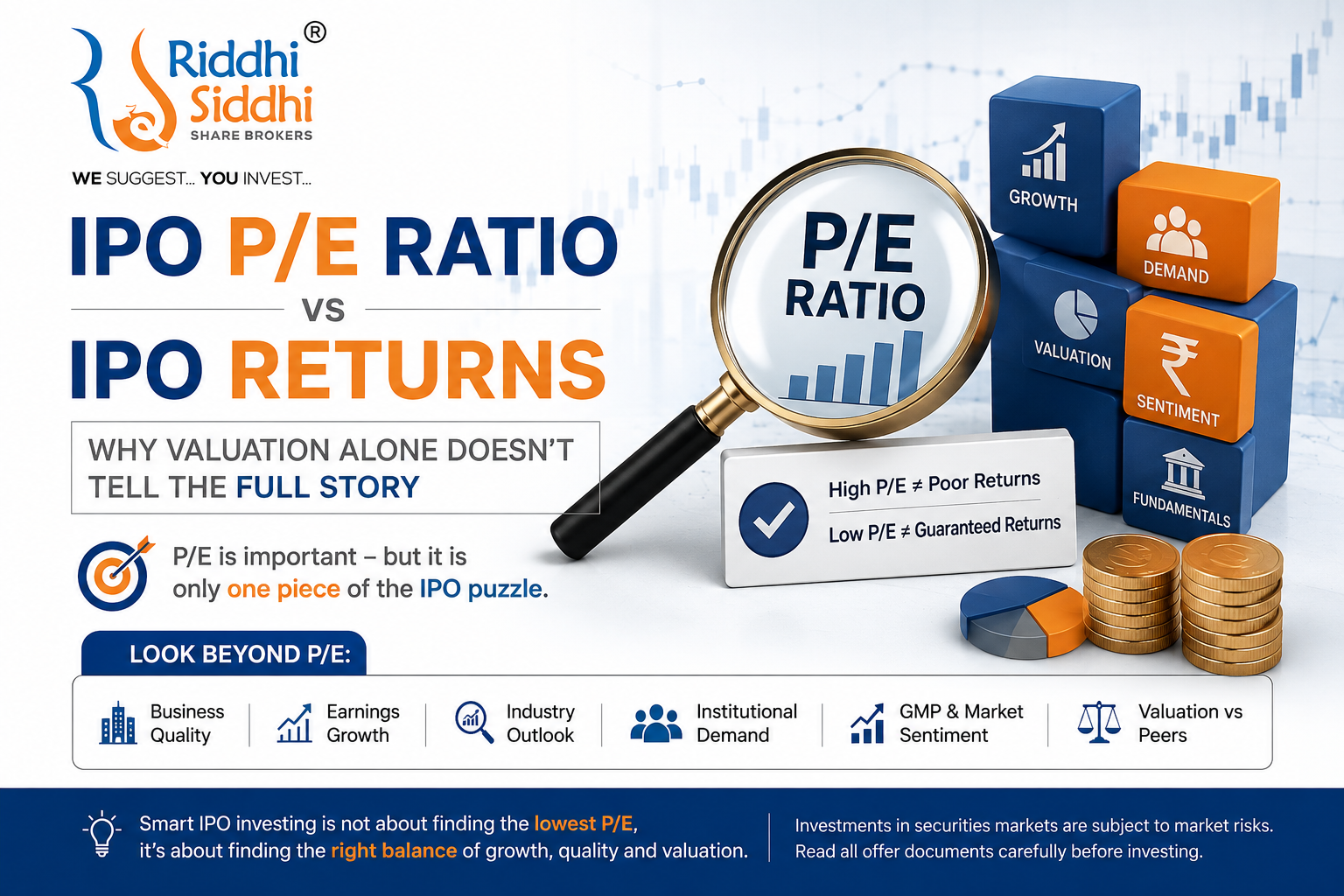
When analysing an IPO, one number often gets disproportionate attention:
The P/E ratio.
“80x P/E? Too expensive.”
“40x P/E? Looks reasonable.”
“300x P/E? How can anyone buy this?”
These reactions are understandable. The Price-to-Earnings (P/E) ratio is an important valuation metric and should certainly be considered before investing in an IPO.
But recent IPO performance also highlights an important lesson:
P/E alone cannot predict IPO listing gains or post-listing performance.
Some companies commanding apparently expensive valuations have still delivered positive returns after listing, while a seemingly reasonable P/E does not automatically translate into superior stock performance.
So, what are investors missing?
Let us understand.
What Is the P/E Ratio in an IPO?
The Price-to-Earnings ratio tells us how much investors are paying for every rupee of a company’s earnings.
In simple terms:
P/E Ratio = Share Price ÷ Earnings Per Share (EPS)
For example, if a company’s share price is ₹500 and its EPS is ₹10:
P/E = 50x
This means investors are effectively paying ₹50 for every ₹1 of current annual earnings.
Generally, a higher P/E suggests that investors are willing to pay more for the company’s earnings, often because they expect stronger future growth.
But this is exactly where IPO analysis becomes more complicated.
IPO P/E vs Returns: An Interesting Picture
Consider the following examples:
| Company | Post-IPO P/E | Return from Issue Price* |
|---|---|---|
| Manipal Health | 85x | +23.7% |
| Juniper Green | 316x | +8% |
| Milky Mist | 85x | +30% |
| Indo MIM | 45x | +96% |
| Dhoot Transmission | 45x | +37% |
| Molbio Diagnostics | 56x | +29% |
*Returns are based on the CMP used for this comparison and will change with market prices. P/E ratios may also change with earnings and market price. Investors should verify the latest figures before making investment decisions.
The numbers illustrate something interesting.
A high P/E has not automatically prevented positive returns.
At the same time, companies with comparatively lower P/E multiples have produced very different levels of returns.
So clearly, the market is looking at more than just P/E.
Why Can a High-P/E IPO Still Perform Well?
A P/E ratio tells us what investors are paying relative to current earnings.
But stock markets frequently value businesses based on future earnings expectations, not merely their historical profits.
Suppose two companies both earn ₹100 crore today.
Company A is expected to grow profits by 10% annually.
Company B is expected to grow profits by 40% annually.
Should both companies necessarily command the same P/E?
Probably not.
Investors may be willing to pay a substantially higher valuation for Company B because they expect its earnings to grow much faster.
That is why simply saying:
“This IPO has a high P/E, therefore it is expensive”
may sometimes be an incomplete analysis.
The better question is:
Is the company’s growth potential sufficient to justify the valuation being demanded?
What Else Drives IPO Returns?
IPO performance is influenced by several interconnected factors.
1. Earnings Growth
Markets often pay premium valuations for businesses expected to grow rapidly.
If earnings grow strongly after listing, today’s apparently expensive P/E can moderate over time.
This is sometimes called earnings catching up with valuation.
2. Industry Opportunity
A company operating in a rapidly expanding sector may command a premium compared with a company in a mature industry.
Investors may assign higher valuations to businesses benefiting from structural themes such as:
- Renewable energy
- Healthcare
- Digital businesses
- Financial technology
- Manufacturing
- Defence
- Consumer brands
- Technology-led businesses
However, a popular sector does not automatically make every company within it a good investment.
3. Scarcity Premium
Sometimes an IPO represents a business model or industry with very few comparable listed companies.
Investors seeking exposure to that particular theme may be willing to pay a higher valuation.
This can create what is commonly called a scarcity premium.
4. Institutional Demand
Institutional participation can significantly influence IPO sentiment.
Strong demand from Qualified Institutional Buyers (QIBs) can improve market confidence around an issue.
This is why investors should look beyond headline subscription numbers and understand which investor categories are driving demand.
5. Market Sentiment
Even a fundamentally strong IPO can struggle when the broader market environment is weak.
Conversely, bullish markets can support aggressive valuations for longer periods.
IPO performance therefore cannot be analysed completely in isolation from:
- Nifty and broader market trends
- Sector sentiment
- Global markets
- Institutional flows
- Investor risk appetite
The Difference Between “Expensive” and “Overvalued”
These two words are often used interchangeably, but they are not necessarily the same.
A stock trading at 80x earnings is certainly more expensive on a P/E basis than one trading at 30x.
But that does not automatically mean the 80x company is overvalued.
Suppose:
Company A: P/E 30x, earnings growth 5%
Company B: P/E 60x, earnings growth 35%
Company B is more expensive based purely on P/E.
But if it can sustain significantly higher growth, investors may consider the premium justified.
Therefore:
Valuation should always be viewed in the context of growth.
Compare IPO Valuation With Listed Peers
One of the most useful ways to evaluate an IPO P/E is through peer comparison.
Instead of asking:
“Is 50x P/E expensive?”
Ask:
“How does 50x compare with similar listed companies?”
For example, if comparable companies trade around 25–30x while an IPO asks for 60x without significantly better growth or profitability, investors should investigate why such a premium is justified.
On the other hand, if comparable companies already command 60–70x and the IPO company offers superior growth prospects, a 50x valuation could look very different.
P/E has meaning only when there is context.
Historical P/E vs Forward P/E
Another important distinction is often overlooked.
Historical P/E
This uses earnings already reported by the company.
Forward P/E
This uses estimated future earnings.
A rapidly growing business can look extremely expensive based on historical earnings but considerably less expensive if profits grow sharply over the following year or two.
However, investors must remember:
Historical earnings are known. Future earnings are estimates.
The greater the growth expectations built into the IPO price, the greater the risk if the company fails to deliver.
What About IPO Listing Gains?
This requires another distinction.
Listing gains and long-term investment returns are not the same thing.
An IPO can list strongly because of:
- High demand
- Limited supply
- Strong subscription
- Positive Grey Market Premium (GMP)
- Institutional participation
- Market momentum
- Investor excitement
None of these necessarily guarantees that the company will continue delivering strong returns over the next three or five years.
Similarly, an IPO can have a modest listing but subsequently perform strongly as earnings improve.
Therefore, investors should clearly identify their objective:
Are you applying primarily for a potential listing gain?
or
Are you investing because you want to own the business for the long term?
The analytical approach can be different.
P/E and GMP: Two Indicators, Two Different Stories
In our earlier discussion on IPO Grey Market Premium (GMP), we highlighted that GMP can provide an indication of market sentiment but should not become the sole reason for applying to an IPO.
The same principle applies to P/E.
GMP tells you:
What is the current market sentiment around the IPO?
P/E tells you:
What valuation are investors being asked to pay relative to earnings?
Neither tells the complete story independently.
This is why IPO investing should never become:
High GMP = Apply
or
High P/E = Avoid
Both are oversimplifications.
What Should Investors Analyse Before Applying for an IPO?
A more comprehensive IPO framework should include:
1. Business Model
Do you understand how the company makes money?
2. Revenue Growth
Is growth consistent and sustainable?
3. Profitability
Are profits increasing along with revenue?
4. Margins
Are operating and net margins improving or deteriorating?
5. Debt
How leveraged is the company?
6. Cash Flow
Are reported profits translating into actual operating cash flows?
7. Return Ratios
Look at metrics such as ROE and ROCE where relevant.
8. Valuation
Compare P/E and other appropriate valuation metrics with listed peers.
9. Growth Potential
Can future earnings reasonably justify the valuation?
10. Promoter & Management Quality
Understand the background, experience and governance record of management.
11. Use of IPO Proceeds
Is the money being used for growth, debt repayment, working capital or primarily providing an exit to existing shareholders?
12. Subscription Data
Understand QIB, NII/HNI and retail participation.
13. Grey Market Premium
Use GMP as a sentiment indicator—not as a guarantee.
14. Overall Market Conditions
Finally, consider the environment in which the IPO is coming to market.
The Riddhi Siddhi IPO Framework
Instead of analysing an IPO using one number, consider this broader sequence:
Business Quality → Financials → Growth → Valuation → Peer Comparison → Management → Use of Funds → Subscription → GMP → Market Conditions
Only after considering these factors together does the IPO picture become clearer.
So, Is P/E Important?
Absolutely.
P/E remains one of the most widely used valuation tools in equity investing.
The mistake is not using P/E.
The mistake is using P/E alone.
A 100x P/E deserves investigation.
A 300x P/E deserves even more investigation.
But simply rejecting an IPO because its P/E looks high—or applying because its P/E looks low—can also lead to poor investment decisions.
The right question is not:
“Is the P/E high?”
The better question is:
“What growth, quality and future earnings are already being priced into this valuation—and are those expectations realistic?”
Final Takeaway
IPO investing is a different game. 🎯
The examples above demonstrate why P/E alone cannot determine listing gains or post-listing stock movement.
Valuation matters.
But so do growth, earnings visibility, industry opportunity, management quality, institutional demand, market sentiment and future expectations.
A high-P/E IPO can perform well.
A low-P/E IPO can disappoint.
And an excellent company purchased at an unreasonable valuation can still become a poor investment.
The objective should therefore not be to find the lowest P/E IPO.
It should be to determine whether the price being paid is reasonable for the quality and growth being offered.
P/E tells you the price of current earnings. The investment decision requires understanding the future of those earnings.
About Riddhi Siddhi Share Brokers
Riddhi Siddhi Share Brokers is an NSE & BSE Authorised Person of a leading broker, helping investors with equity markets, derivatives, mutual funds and assisted trade execution support.
We Suggest… You Invest.
Disclaimer
This article is for educational and informational purposes only and should not be construed as investment advice, an IPO recommendation, research advice, or an assurance of listing gains or future returns. The P/E ratios, CMP-based returns and other market-related figures referred to in this article can change and should be independently verified as of the relevant date. Past or post-listing performance does not guarantee future returns. Riddhi Siddhi Share Brokers is not a SEBI-registered Investment Adviser. Investors should study the relevant offer documents, financials, valuations and risks and consult a SEBI-registered Investment Adviser where appropriate before making investment decisions. Investments in securities markets are subject to market risks.