
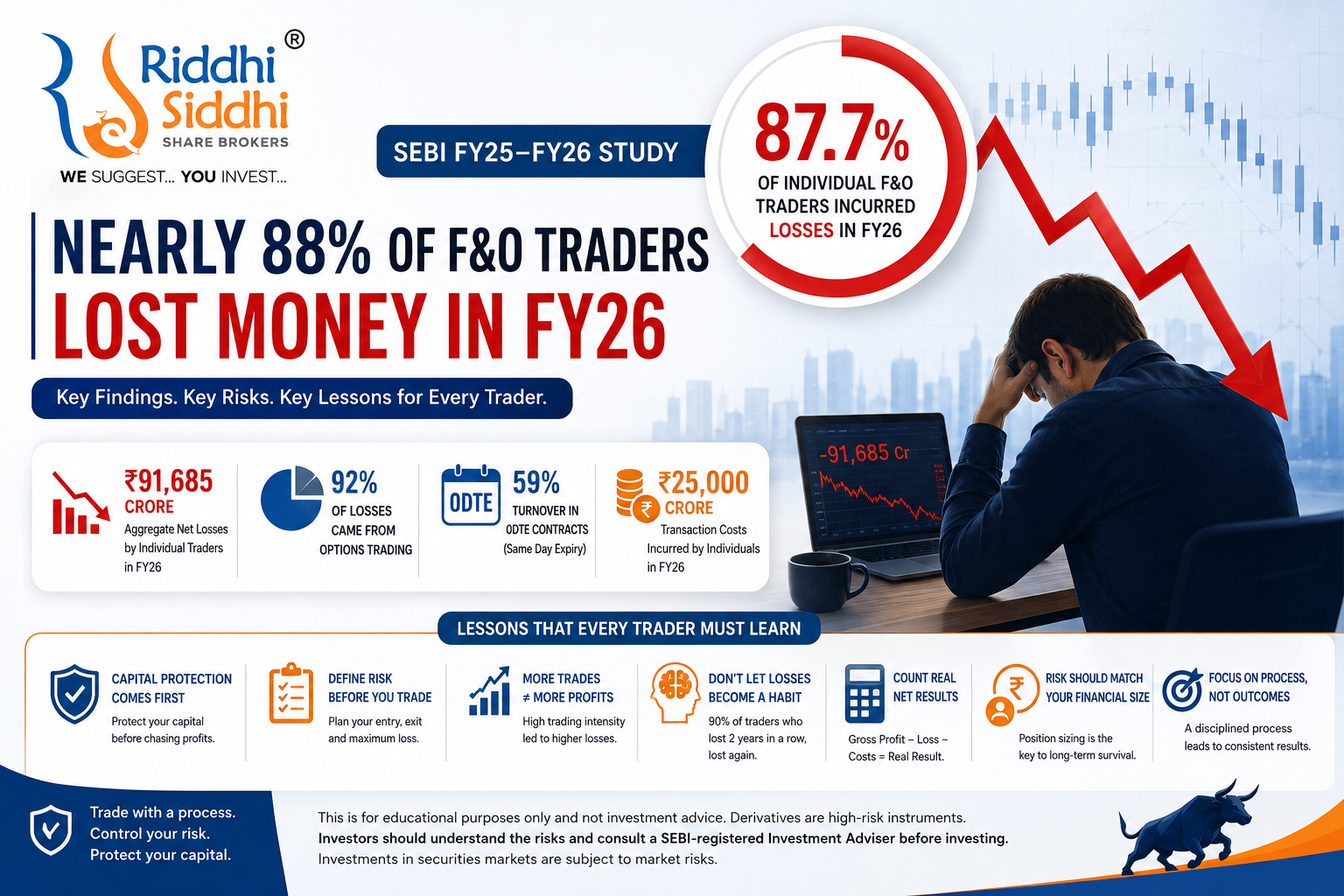
₹91,685 crore.
That is approximately how much individual traders collectively lost in India’s equity derivatives segment in FY26, according to SEBI’s latest study.
But perhaps the more important number is:
87.7%
That is the proportion of individual equity derivatives traders who incurred losses during FY26.
In simple terms, nearly 9 out of every 10 individual traders lost money.
For anyone trading Futures & Options (F&O)—or considering entering derivatives—these findings deserve serious attention.
At Riddhi Siddhi Share Brokers, we believe the biggest lesson from the study is not that derivatives are inherently good or bad. The lesson is that F&O trading requires a very different approach to risk, capital, trading frequency and discipline than many individual traders appear to follow.
Let us understand what SEBI’s FY25–FY26 studies reveal and, more importantly, what individual traders can learn from them.
What Did SEBI Study?
On 20 August 2026, the Securities and Exchange Board of India (SEBI) published two important studies examining individual participation in India’s Equity Derivatives Segment:
1. Profitability of Individual Traders in the Equity Derivatives Segment (FY25–FY26)
2. Trading Behaviour of Individual Traders in the Equity Derivatives Segment (FY25–FY26)
The studies examine actual trading outcomes and behaviour, including profitability, transaction costs, demographics, participation patterns and trading intensity.
This distinction is important.
These findings are based on actual market and trading data—not simply on a survey asking traders whether they believed they made or lost money.
Readers who want to examine the detailed methodology and findings can refer to the original studies published on the SEBI website.
SEBI F&O Study FY26: The Numbers Every Trader Should Know
Some of the findings are striking:
Individual traders making losses: 87.7%
Aggregate net losses: ₹91,685 crore
Average loss per trader: Approximately ₹1.17 lakh
Share of individual losses arising from options: Approximately 92%
Predominantly option-buying traders: Approximately 97%
Predominantly option sellers: Approximately 2%
Individual transaction costs during FY26: Approximately ₹25,000 crore
Cumulative transaction costs during FY22–FY26: Approximately ₹1 lakh crore
Index-option turnover on 0DTE: Approximately 59%
Index-option turnover within seven days of expiry: Approximately 97%
The numbers tell an important story about how individual traders are participating in India’s derivatives market.
1. Nearly 88% of Individual F&O Traders Lost Money
This is the statistic that deserves the most attention.
87.7% of individual traders incurred losses in FY26.
For every 100 individual traders participating in the equity derivatives market, approximately 88 ended up on the losing side.
This is particularly important because social media can create a very different impression.
We frequently see posts such as:
“₹25,000 profit today.”
“₹1 lakh made on expiry.”
“Option bought at ₹20 and sold at ₹100.”
What we rarely see with the same enthusiasm are accumulated losses.
This can create survivorship bias—successful trades become highly visible while unsuccessful traders and losing trades remain largely invisible.
SEBI’s data provides a much broader picture.
2. Individual Traders Lost ₹91,685 Crore
Individual traders collectively recorded net losses of approximately:
₹91,685 crore in FY26.
Aggregate losses were lower than the approximately ₹1.12 lakh crore recorded in FY25.
At first glance, that may appear encouraging.
However, the number of active individual traders also declined significantly during the period.
Therefore, lower aggregate losses should not automatically be interpreted as individual traders suddenly becoming substantially better at F&O trading.
Participation itself changed.
The more meaningful statistic remains that 87.7% of individual traders were loss-making during FY26.
3. Options Accounted for Around 92% of Individual Losses
This is one of the most important findings of the SEBI study.
Approximately:
92% of aggregate losses incurred by individuals came from options trading.
At the same time, nearly:
97% of traders predominantly followed option-buying strategies.
Only around 2% were predominantly option sellers.
Why does this matter?
Option buying can appear deceptively simple.
The premium is known.
The capital required may look relatively small.
Potential returns can appear extremely large.
But an option buyer is dealing with several variables simultaneously:
Direction + Time + Volatility + Premium Decay
You can therefore be correct about the eventual direction of an index or stock and still lose money on the option.
Being right about where the market will move may not be enough.
You may also need to be right about when it will move.
4. F&O Trading Is Heavily Concentrated Near Expiry
SEBI’s findings on index options are particularly revealing.
Approximately:
59% of index-option turnover occurred on the day of expiry.
And around:
97% of index-option turnover occurred within seven days of expiry.
What Is 0DTE?
0DTE means Zero Days to Expiry.
These are options being traded on the same day on which the contract expires.
Near-expiry options can react extremely rapidly to changes in the underlying index, volatility and time decay.
A relatively small movement in the underlying index can produce a much larger percentage movement in the option premium.
That can create opportunity.
But it can also create substantial risk.
5. Transaction Costs: The ₹25,000 Crore Lesson
Trading profit and loss is only one part of the equation.
Individual traders incurred approximately:
₹25,000 crore in transaction costs during FY26.
Across FY22–FY26, cumulative transaction costs incurred by individuals were approximately:
₹1 lakh crore.
This deserves far more attention than it normally receives.
Depending on the transaction, trading costs can include brokerage, Securities Transaction Tax, exchange charges, GST, stamp duty and other applicable charges.
A trader’s actual result therefore needs to consider:
Gross Profits – Gross Losses – Transaction Costs = Net Trading Result
The number that ultimately matters is not the size of the winning trades.
It is the final net result after losses and costs.
6. More Trading Does Not Automatically Mean Better Trading
A common belief among new traders is:
“The more I trade, the faster I will learn.”
SEBI’s behavioural findings deserve consideration here.
Higher trading intensity was associated with higher loss incidence.
This leads to an important distinction:
Market experience and market activity are not necessarily the same thing.
More trades can mean:
- More transaction costs
- More emotional decisions
- More opportunities for mistakes
- Greater temptation to revenge trade
- Greater exposure to short-term volatility
The objective should therefore not be to trade more.
The objective should be to trade better.
7. Experience Alone May Not Solve the Problem
Another interesting finding from SEBI’s research is that high loss rates persisted even among traders with multiple years of derivatives-market participation.
This challenges the assumption:
“Once I have traded for a few years, I will automatically become profitable.”
Experience certainly matters.
But simply repeating the same behaviour for four years is not necessarily four years of learning.
Real experience requires:
- Reviewing unsuccessful trades
- Measuring net profitability
- Understanding drawdowns
- Controlling position size
- Analysing trading mistakes
- Changing strategies that repeatedly fail
- Maintaining risk discipline
There is a difference between four years of experience and one year of experience repeated four times.
8. Losing Repeatedly Should Trigger a Strategy Review
One of the most valuable findings in SEBI’s behavioural analysis concerns traders who continued participating despite repeated losses.
Among traders who lost money for two consecutive years and continued trading, around:
90% lost money again in the following year.
This is a powerful risk-management lesson.
Suppose someone has lost money consistently for two years.
The answer may not be:
Increase capital.
It may not be:
Increase lot size.
And it certainly should not automatically be:
Take more trades to recover the losses.
The better question is:
Does my trading strategy actually have a demonstrable edge?
Sometimes the most important trading decision is deciding when not to trade.
9. One Good Month Does Not Make a Profitable Trader
Trading psychology can distort our perception of performance.
Imagine the following results:
January: +₹80,000
February: –₹35,000
March: –₹40,000
April: –₹30,000
The trader may continue remembering:
“I made ₹80,000 in January.”
But the four-month result is:
–₹25,000 before considering transaction costs.
This is why traders should measure performance over a meaningful period.
Do not judge your trading ability by:
- Your best trade
- Your best expiry
- Your best week
- Your best month
Judge it by your net result after all losses and costs.
10. Smaller Investors Need to Be Especially Careful
SEBI’s findings also indicate substantial derivatives participation among individuals with relatively small equity portfolios.
This raises an important question:
How much risk are you taking relative to your financial capacity?
A ₹50,000 derivatives loss means very different things to two people.
For someone with a ₹50 lakh investment portfolio, it represents 1%.
For someone whose investible capital is ₹1 lakh, it represents 50%.
The amount of the loss is therefore only part of the story.
Loss relative to capital matters.
This is why position sizing is fundamental to risk management.
11. Younger Traders Should Pay Particular Attention
Technology has made market access easier than ever.
A smartphone and trading account are sufficient to participate in sophisticated derivative instruments that once required considerable infrastructure.
That convenience is valuable.
But ease of execution should not be confused with ease of profitability.
Buying an option may take three seconds.
Understanding its risk can take considerably longer.
Derivatives should therefore not be viewed as a shortcut for converting small capital into large wealth quickly.
The leverage that creates the possibility of high returns also magnifies risk.
12. Who Was Making Money in the Derivatives Market?
The other side of SEBI’s data is equally interesting.
Proprietary traders, Foreign Portfolio Investors and some other institutional categories collectively recorded substantial gross trading profits.
SEBI also observed that an overwhelming proportion of profits among FPIs and proprietary traders came from entities classified as algorithmic entities in the study.
That provides an important perspective.
An individual trader sitting with a mobile phone may be participating in the same market as:
- Institutional investors
- Proprietary trading desks
- Algorithmic trading systems
- Professional market participants
- Sophisticated quantitative strategies
These participants may have very different infrastructure, technology, execution capabilities, data and risk-management systems.
That does not mean individuals cannot participate.
It means individuals should understand the environment in which they are participating.
Does SEBI’s Study Mean Retail Investors Should Stop Trading F&O?
No.
That would be an incorrect interpretation.
Derivatives perform legitimate and important functions in financial markets, including:
Hedging, price discovery and risk management.
The more appropriate lesson from SEBI’s findings is:
F&O should be treated as a high-risk financial instrument—not as easy income.
A trader should understand the product, capital requirement and potential loss before entering the trade.
7 Practical Lessons Every F&O Trader Can Take From the SEBI Study
1. Don’t Treat Options Like Lottery Tickets
A ₹10 or ₹20 option may look inexpensive, but repeatedly losing small premiums can create a large cumulative loss.
Low premium does not necessarily mean low risk.
2. Capital Protection Comes First
Before asking “How much can I make?”, ask:
“How much can I afford to lose?”
3. Define Risk Before Entering the Trade
Know your:
Entry → Stop Loss → Maximum Permitted Loss → Exit
Risk management should be decided before entering—not after the trade moves against you.
4. Avoid Revenge Trading
A losing trade should not automatically lead to a larger trade to “recover” the loss.
Markets do not know how much money you lost previously.
5. Measure Net Performance
Your real trading result is:
Gross Profits – Gross Losses – Transaction Costs = Net Trading Result
Your trading statement is more reliable than your memory.
6. More Trades Are Not Necessarily Better
Trading activity should not be confused with productivity.
Sometimes the best trade available is no trade.
7. Separate Trading Capital From Investment Capital
Long-term wealth-building capital and high-risk derivatives capital serve different purposes.
They should not automatically be treated as one pool of money.
Riddhi Siddhi Share Brokers F&O Discipline Checklist
Before placing your next F&O trade, ask yourself:
Do I understand the instrument I am trading?
Why am I taking this trade?
What is my maximum acceptable loss?
What percentage of my trading capital am I risking?
Where will I exit if I am wrong?
Am I following a strategy or reacting to FOMO?
Am I increasing quantity because my previous trade lost money?
Have I included transaction costs when calculating my actual performance?
If these questions cannot be answered clearly, reconsidering the trade may itself be good risk management.
The Biggest Lesson From SEBI’s F&O Study: Survival Before Returns
The attraction of derivatives is understandable.
Relatively small capital can create exposure to a much larger market value.
Profits can happen quickly.
Markets provide opportunities almost every trading day.
And social media constantly displays screenshots of successful trades.
But SEBI’s FY25–FY26 studies show the other side:
87.7% of individual traders lost money.
₹91,685 crore in aggregate net losses.
Around 92% of individual losses came from options.
Around ₹25,000 crore was incurred in transaction costs.
Nearly 97% of traders predominantly followed option-buying strategies.
These numbers should not frighten investors away from markets.
They should encourage traders to respect risk.
Instead of beginning every trading day by asking:
“How much can I make today?”
Perhaps the better question is:
“How do I protect my capital so that I remain in the market tomorrow?”
Frequently Asked Questions About SEBI’s F&O Study
What percentage of F&O traders lost money in FY26?
According to SEBI’s FY25–FY26 study, 87.7% of individual traders incurred losses in the equity derivatives segment during FY26.
How much money did individual F&O traders lose in FY26?
Individual traders collectively recorded approximately ₹91,685 crore in net losses during FY26.
Are most F&O losses coming from options?
SEBI’s findings indicate that approximately 92% of aggregate losses incurred by individuals arose from options trading.
Do most individual F&O traders buy or sell options?
Nearly 97% predominantly followed option-buying strategies, while only around 2% were predominantly option sellers.
What is 0DTE option trading?
0DTE means Zero Days to Expiry. It refers to trading an option on the same day that the contract expires.
SEBI found that approximately 59% of index-options turnover occurred on 0DTE contracts during FY26.
Does more F&O experience guarantee profitability?
No. SEBI’s behavioural findings indicate that loss rates remained high even among traders with multiple years of derivatives participation.
Experience can be valuable, but experience without performance measurement, learning and risk management does not guarantee profitability.
Is F&O trading the same as investing?
No.
Equity investing generally involves owning shares of businesses, whereas futures and options are derivative contracts whose value is linked to an underlying security or index.
Their objectives, risks, leverage and time horizons can be very different.
Final Thoughts from Riddhi Siddhi Share Brokers
SEBI’s FY25–FY26 findings should not merely become another headline saying:
“Most F&O traders lose money.”
There is a much more valuable lesson underneath the statistic.
Markets offer opportunity.
But opportunity without discipline can become speculation, and leverage without risk management can magnify mistakes very quickly.
At Riddhi Siddhi Share Brokers, our message is simple:
Trade with a process. Control your risk. Protect your capital. Never confuse leverage with easy money.
Riddhi Siddhi Share Brokers
We Suggest… You Invest.
Sources
SEBI – Profitability of Individual Traders in the Equity Derivatives Segment (FY25–FY26)
Published: 20 August 2026
SEBI – Trading Behaviour of Individual Traders in the Equity Derivatives Segment (FY25–FY26)
Published: 20 August 2026
Disclaimer
This article is intended solely for educational and informational purposes and should not be construed as investment advice, research advice, a trading recommendation or an assurance of returns. Futures and options and other derivative instruments involve significant risk and may not be suitable for every investor.
Statistics attributed to SEBI in this article are based on SEBI’s FY25–FY26 studies on individual traders in the Equity Derivatives Segment and have been simplified or rounded in places for reader understanding. Readers should refer to the original SEBI studies for complete methodology, definitions and findings.
Riddhi Siddhi Share Brokers is an NSE & BSE Authorised Person and is not a SEBI-registered Investment Adviser. Investors should understand the product and associated risks and consult a SEBI-registered Investment Adviser where appropriate before making investment decisions. Investments in securities markets are subject to market risks.