
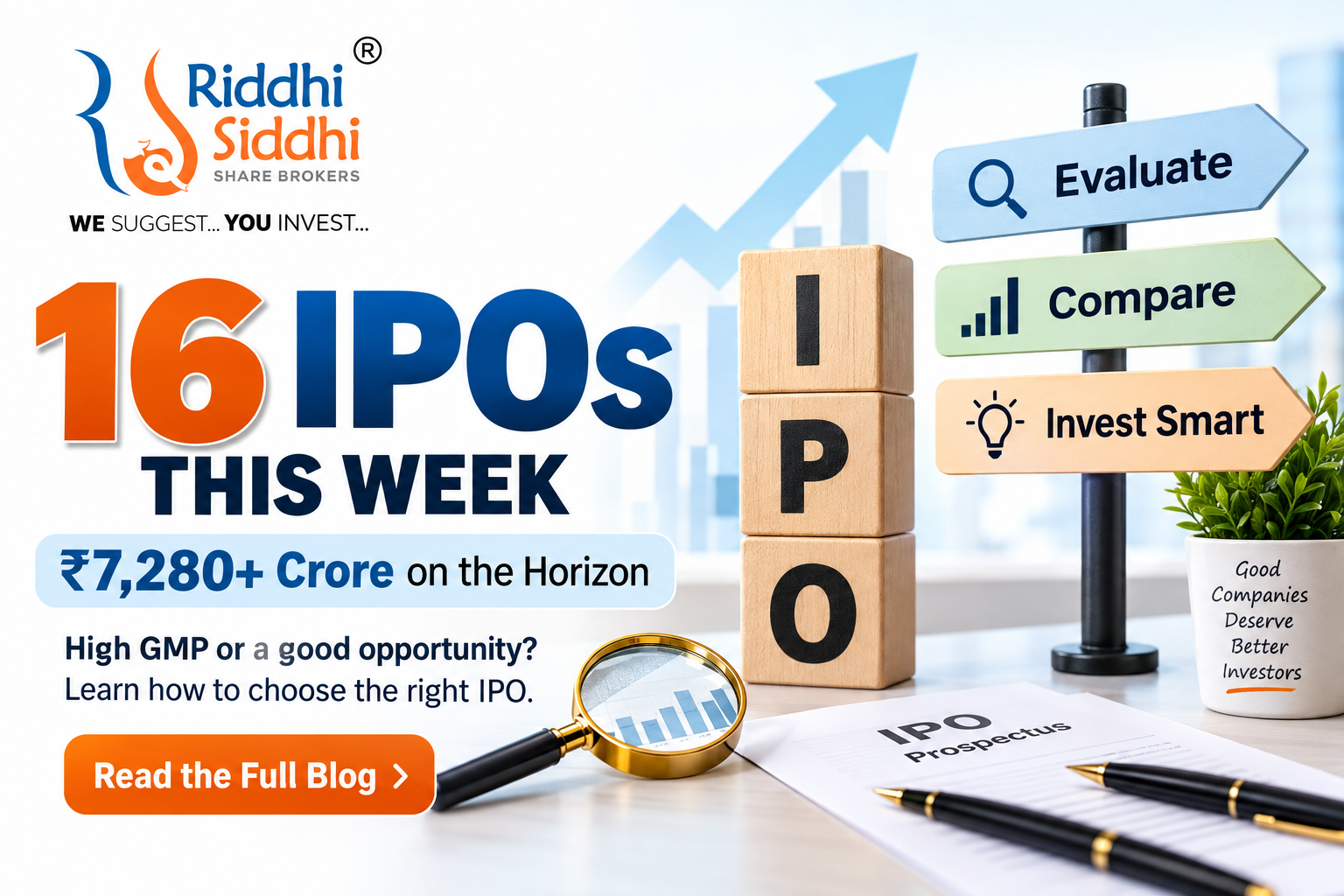
India’s primary market is entering one of its busiest weeks of 2026.
Between September 7 and September 11, 2026, as many as 16 IPOs across mainboard and SME segments are lined up, collectively targeting more than ₹7,280 crore.
For retail investors, however, a busy IPO calendar creates an important question:
How do you decide which IPO deserves your money?
Whenever several IPOs open together, attention naturally shifts towards IPO GMP, subscription numbers and expected listing gains.
But Grey Market Premium (GMP) should not become a substitute for analysing the company.
At Riddhi Siddhi Share Brokers, we believe an IPO should first be evaluated on its business, financial performance, valuation, offer structure, use of funds and risks.
GMP and subscription data can provide additional market context — but ideally they should come towards the end of the evaluation process, not at the beginning.
Why September 7–11 Is Such a Busy IPO Week
India’s IPO market has a packed calendar this week, with issues spanning sectors such as real estate, electrical equipment, specialty chemicals, financial services, payments, engineering and consumer businesses.
Some of the prominent names in this week’s IPO pipeline include:
- Pranav Constructions
- Kanohar Electricals
- Prasol Chemicals
- Glass Wall Systems (India)
- Rentomojo
- Asset Reconstruction Company (India)
- Manipal Payment & Identity Solutions
- Steamhouse India
- LCC Projects
- Karamtara Engineering
- Veegaland Developers
Along with SME issues, the total number of public offerings lined up during the week reaches 16.
The numbers are impressive.
But more IPOs do not automatically mean more good investment opportunities.
A crowded calendar actually makes disciplined comparison more important because retail investors have limited capital and may have to choose between multiple companies competing for their attention.
Why GMP Should Not Be Your First Filter
What Does IPO GMP Mean?
Grey Market Premium (GMP) refers to the unofficial premium or discount associated with an IPO’s shares in the grey market before their stock-exchange listing.
For example, if an IPO has an issue price of ₹500 and a reported GMP of ₹100, the grey-market indication may suggest an expected price around ₹600.
But ₹600 is not a guaranteed listing price.
GMP essentially reflects unofficial market expectations at a particular point in time.
Why Can GMP Change So Quickly?
GMP can move significantly because of factors such as:
- Overall stock-market sentiment
- Institutional demand
- IPO subscription levels
- Anchor-investor participation
- News surrounding the company or sector
- Global-market movements
- Demand and supply in the unofficial market
A strong GMP several days before listing can weaken.
Likewise, an IPO showing limited initial grey-market interest can attract stronger demand later.
GMP Is Not an Official Stock-Exchange Indicator
This distinction is extremely important.
GMP is not an official NSE or BSE price and is not an exchange-based price-discovery mechanism.
It should therefore be treated, at best, as an additional sentiment indicator rather than the foundation of an investment decision.
Instead of beginning your IPO research with GMP, consider following this 7-point IPO checklist.
The 7-Point IPO Checklist Every Retail Investor Should Use
1. Understand the Business
Start with the simplest question:
Can I explain how this company makes money?
Understand:
- What products or services does it sell?
- Who are its customers?
- What gives it an advantage over competitors?
- Is demand recurring or cyclical?
- How competitive is the industry?
- Is the business dependent on one customer, geography or product?
- Can the company continue growing after the IPO?
If you cannot understand the basic business model, it becomes difficult to properly assess its risks.
A popular IPO does not necessarily mean a strong business.
2. Check Revenue, Profit AND Cash Flow
Rapid revenue growth can look impressive in an IPO presentation.
But revenue alone tells only part of the story.
Look at:
Revenue Growth: Is the company consistently expanding?
Profitability: Are profits growing along with revenue?
Margins: Are operating margins improving, stable or declining?
Cash Flow: Are accounting profits translating into operating cash flows?
Debt: How leveraged is the company?
Return Ratios: Where relevant, examine ROE and ROCE.
An important warning sign can emerge when reported profits increase substantially while operating cash flow remains weak for extended periods.
The objective is not simply to find the fastest-growing company.
It is to understand the quality and sustainability of that growth.
3. Study the IPO Valuation
A good company and a good IPO investment are not always the same thing.
Price matters.
Depending on the industry, investors can consider valuation measures such as:
- Price-to-Earnings (P/E)
- Price-to-Book (P/B)
- EV/EBITDA
- Market capitalisation relative to revenue
- Valuation relative to comparable listed companies
Suppose Company A earns ₹10 per share and its IPO is priced at ₹500.
Its P/E would be:
₹500 ÷ ₹10 = 50x
If comparable listed companies trade around 25–30x earnings, investors should understand why Company A deserves a substantially higher valuation.
Perhaps it has superior growth, margins or competitive advantages.
Or perhaps investors are simply being asked to pay too much.
That distinction matters.
👉 Related Reading – Riddhi Siddhi Share Brokers:
IPO P/E Ratio vs IPO Returns: Why Valuation Alone Doesn’t Tell the Full Story
4. Check Fresh Issue vs Offer for Sale (OFS)
This is one of the most overlooked parts of IPO analysis.
An IPO can broadly contain:
Fresh Issue
The company issues new shares and receives the money raised.
The proceeds could be used for:
- Capacity expansion
- Debt repayment
- Working capital
- Acquisitions
- Technology investment
- New facilities
- Other corporate requirements
Offer for Sale (OFS)
Existing shareholders sell some of their shares.
The money raised through the OFS goes to the selling shareholders, not to the company.
An OFS is not automatically negative.
Promoters, private-equity funds or institutional shareholders may legitimately seek partial liquidity after holding their investments for years.
But investors should understand:
Who is selling?
How much are they selling?
Why are they selling?
And importantly:
How much fresh capital is actually entering the company?
This distinction is particularly relevant when analysing large and highly anticipated IPOs.
For example, the proposed NSE public issue is structured as an Offer for Sale rather than a fresh issue of shares.
👉 Related Reading – VaultStreet Advisors:
NSE Unlisted Shares Before the IPO: Opportunity, Valuation or FOMO?
5. Understand the Use of IPO Proceeds
If the company is raising fresh capital, find out exactly where that money is going.
Debt Repayment
Reducing expensive debt can lower finance costs and strengthen the balance sheet.
Capital Expenditure
New factories, machinery or infrastructure may increase future capacity — provided sufficient demand exists.
Working Capital
Some businesses require substantial funds to finance inventory and receivables.
Acquisitions
Understand what the company intends to acquire and whether management has a credible acquisition strategy.
General Corporate Purposes
This is common, but investors should see what proportion of the fresh issue falls into this broad category.
The important question is:
Will the money raised through the IPO potentially make the business stronger?
6. Read the Risk Factors
The risk-factor section of an IPO document may not be exciting reading, but it can be one of its most useful sections.
Pay particular attention to:
Customer Concentration: Does one customer contribute a significant portion of revenue?
Supplier Concentration: Is the company dependent on a small number of suppliers?
Debt: Could rising interest costs hurt profitability?
Litigation: Are there material legal or tax proceedings?
Regulatory Risk: Could government or regulatory changes affect the business?
Promoter Dependence: Is the business heavily dependent on one individual or family?
Cyclicality: Does demand fluctuate sharply with economic conditions?
Related-Party Transactions: Are these unusually high or complex?
A company’s strengths tell you why you might invest.
Its risk factors help you understand what could go wrong.
Both matter.
Investors interested in understanding similar risks in companies before they reach the IPO stage can also read:
👉 Related Reading – VaultStreet Advisors:
Pre-IPO Doesn’t Always Mean Pre-Profit: 7 Risks Investors Ignore When Buying Unlisted Shares
7. Look at Subscription and GMP — Last
Only after studying the first six factors should investors consider market-demand indicators such as subscription data and GMP.
Subscription figures can help show how different investor categories are responding to an issue.
Investors often watch:
- Qualified Institutional Buyers (QIBs)
- Non-Institutional Investors (NIIs)
- Retail Individual Investors (RIIs)
Strong institutional participation may indicate investor interest following professional analysis.
But even this does not guarantee future returns.
Institutions can be wrong.
Markets can change.
Valuations can compress.
And listing-day sentiment can be very different from subscription-day sentiment.
Use subscription and GMP as additional information — not as your entire investment thesis.
Can a Good Company Still Be an Expensive IPO?
Absolutely.
This is one of the most important concepts for IPO investors.
Consider two hypothetical companies.
Company A
- Excellent brand
- Strong growth
- Profitable
- Industry leader
- Extremely demanding IPO valuation
Company B
- Good business
- Moderate growth
- Profitable
- Reasonable balance sheet
- More reasonable IPO valuation
Which one is the better investment?
There is no automatic answer.
The quality of a company and the price investors pay for that quality are two separate questions.
Even an outstanding business can deliver disappointing investment returns if investors enter at a valuation that already assumes years of exceptional future growth.
Good Company ≠ Automatically Good IPO Price
Does Heavy IPO Oversubscription Guarantee Listing Gains?
No.
An IPO being subscribed many times can certainly indicate strong demand.
But oversubscription does not guarantee listing gains.
The listing price can also be affected by:
- Overall market conditions
- Sector sentiment
- Institutional flows
- Global developments
- Valuation concerns
- Changes in investor risk appetite
- Supply of shares after listing
Subscription data tells you about demand during the IPO.
It does not tell you with certainty what investors will be willing to pay after listing.
Listing-Gain Investor vs Long-Term Investor: Should the Checklist Be Different?
Yes.
If Your Objective Is Listing Gains
You may give relatively greater importance to:
- Market sentiment
- Subscription momentum
- QIB participation
- Issue size and supply
- Recent IPO listing performance
- GMP trends
However, listing gains remain uncertain.
If Your Objective Is Long-Term Investing
Your focus should shift much more strongly towards:
- Business quality
- Competitive advantages
- Management
- Revenue and earnings growth
- Cash-flow generation
- Balance-sheet strength
- Valuation
- Industry opportunity
- Long-term risks
A long-term investor should ask:
“Would I still want to own this company if there were no GMP and no listing-day excitement?”
That question can remove a lot of IPO noise.
Two IPOs Have the Same GMP — Which One Is Better?
Consider this purely hypothetical comparison:
| Factor | IPO A | IPO B |
|---|---|---|
| Issue Price | ₹500 | ₹250 |
| GMP | ₹100 | ₹50 |
| GMP % | 20% | 20% |
| Revenue Growth | 30% | 12% |
| Profitability | Profitable | Volatile |
| Debt | Low | High |
| P/E | 32x | 65x |
| Fresh Issue | 70% | 20% |
| OFS | 30% | 80% |
| Fresh Proceeds | Capacity Expansion | Limited |
Both have the same hypothetical 20% GMP.
Are they therefore equally attractive?
Clearly not.
Once investors move beyond GMP, the differences in business quality, financial strength, valuation and offer structure become visible.
This is precisely why GMP should not be the first filter for choosing an IPO.
Riddhi Siddhi Share Brokers IPO Checklist
Before applying for an IPO, consider checking all seven:
☑ BUSINESS
Do I understand how the company makes money?
☑ FINANCIALS
Are revenue, profitability and cash flows healthy?
☑ VALUATION
Is the IPO reasonably valued compared with its growth and peers?
☑ FRESH ISSUE vs OFS
Is the company raising capital, or are existing shareholders primarily selling?
☑ USE OF PROCEEDS
How will the fresh capital be deployed?
☑ RISKS
What could materially affect the business?
☑ SUBSCRIPTION & GMP
What does current market demand indicate?
The sequence matters:
Business → Financials → Valuation → Offer Structure → Use of Funds → Risks → Subscription/GMP
Not simply:
GMP → Apply.
Riddhi Siddhi Share Brokers View
A crowded IPO calendar creates more choice — not necessarily more opportunity.
With 16 IPOs across mainboard and SME segments lined up during one of the busiest weeks of 2026, retail investors may naturally be tempted to chase whichever issue has the highest reported GMP or fastest-growing subscription numbers.
A more disciplined approach is to reverse that process.
Study the business first.
Then examine its financial performance.
Understand the valuation.
Check how much of the IPO is fresh issue versus OFS.
Find out where the fresh capital will be deployed.
Read the important risks.
And only then look at subscription figures and GMP as additional indicators of market sentiment.
An IPO is ultimately an opportunity to become a shareholder in a business.
The objective should therefore be to understand what you are buying — and the price you are paying for it — rather than simply guessing where the share might list.
Frequently Asked Questions
1. Which IPOs are opening this week in India in September 2026?
The September 7–11, 2026 period is one of the busiest IPO windows of the year, with 16 public issues across mainboard and SME segments lined up and more than ₹7,280 crore targeted collectively.
Prominent names include Pranav Constructions, Kanohar Electricals, Prasol Chemicals, Glass Wall Systems (India), Rentomojo, Asset Reconstruction Company (India), Manipal Payment & Identity Solutions, Steamhouse India, LCC Projects, Karamtara Engineering and Veegaland Developers.
IPO schedules can change, so investors should verify the latest exchange announcements and offer documents before applying.
2. Should I apply for an IPO just because its GMP is high?
No.
GMP is an unofficial indicator of grey-market sentiment and does not guarantee an IPO’s listing price or future performance.
Investors should first study the company’s business, financials, valuation, offer structure, use of proceeds and risk factors.
GMP can then be considered as supplementary market-sentiment information.
3. How can a retail investor compare two IPOs before applying?
Compare companies using the same framework:
Business model → Financial performance → Cash flows → Debt → Valuation → Fresh Issue/OFS → Use of proceeds → Risks → Subscription/GMP
Using the same checklist for competing IPOs can provide a much clearer picture than simply comparing their GMPs.
Stay Updated on IPOs & Indian Markets
IPO opportunities can move quickly — but informed investing starts with understanding the business, valuation and risks.
Follow Riddhi Siddhi Share Brokers for IPO updates, market insights, educational analysis and important developments from Indian equity markets.
📲 Want to join our exclusive market community?
WhatsApp +91 99875 53455 to get added to our community for market updates and insights.
🌐 Riddhi Siddhi Share Brokers
We Suggest… You Invest.
Important Disclaimer
Riddhi Siddhi Share Brokers is an NSE & BSE Authorised Person and is not a SEBI-registered Investment Adviser.
This article is published solely for educational and informational purposes and should not be construed as investment advice, a recommendation, solicitation or an offer to buy or sell any security or apply for any IPO.
IPO investments are subject to market risks. Grey Market Premium (GMP) is unofficial and may change significantly. Investors should read the Red Herring Prospectus/offer documents carefully, conduct their own research and/or consult a qualified financial adviser before making investment decisions.
Past performance, subscription levels, GMP or market demand do not guarantee future returns.
Riddhi Siddhi Share Brokers
We Suggest… You Invest.