
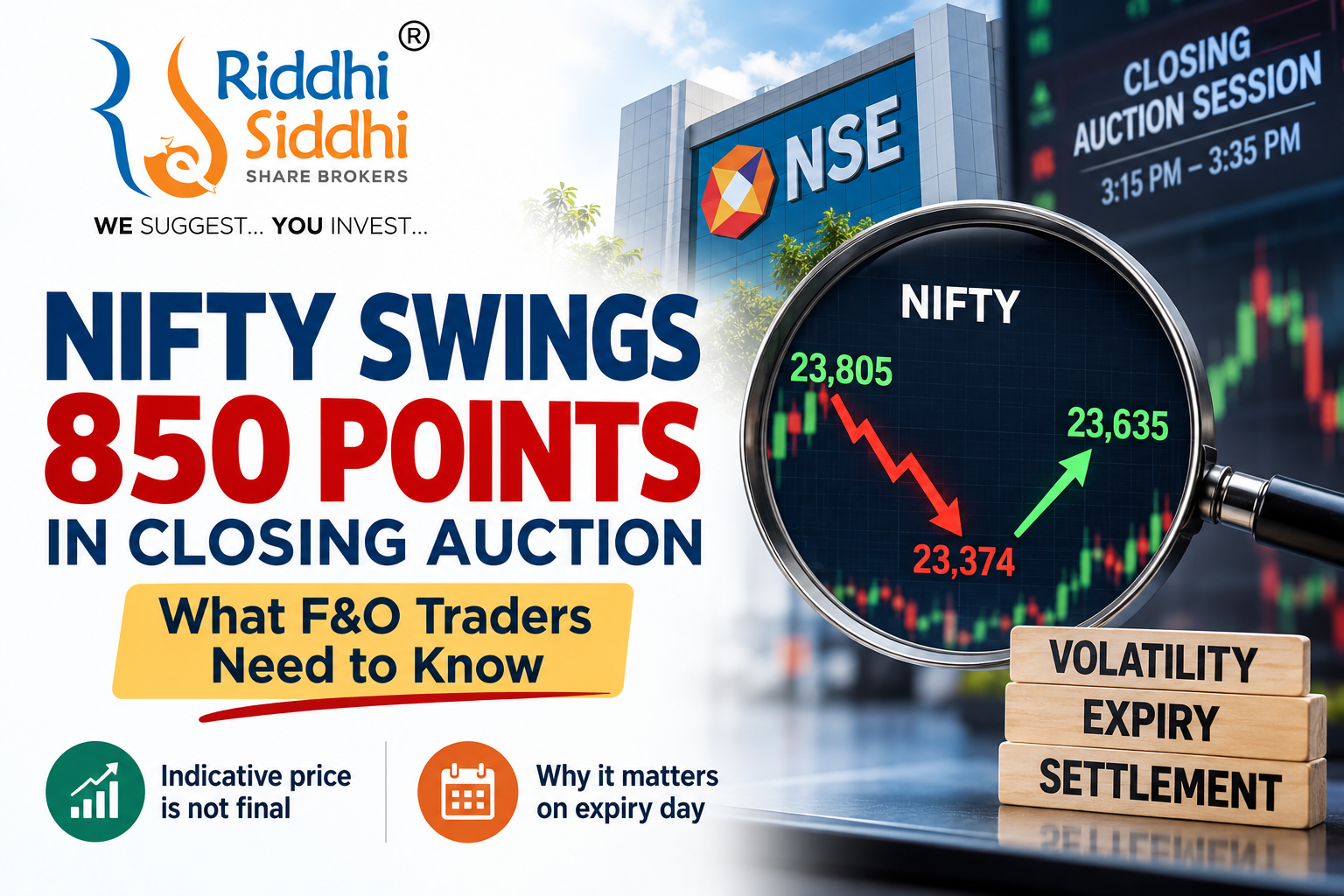
An extraordinary 850-point swing in Nifty’s indicative levels during the Closing Auction Session (CAS) on September 8, 2026 has put India’s new closing-price mechanism firmly in the spotlight.
The episode was particularly significant because it occurred on Nifty’s weekly F&O expiry day, when even relatively small changes in the expected settlement level can cause sharp movements in expiring option premiums.
But did Nifty really crash 850 points in normal trading?
No.
That distinction is perhaps the most important lesson from the September 8 episode.
The dramatic movements occurred in indicative levels during the Closing Auction Session, where prices are discovered through an auction mechanism. They should not be interpreted in exactly the same way as an 850-point movement during normal continuous trading.
For F&O traders, however, CAS volatility still matters enormously because the closing price of the underlying index is relevant for final settlement of expiring derivative contracts.
What Happened to Nifty on September 8, 2026?
September 8 was already a difficult session for Indian equities, with global uncertainty and elevated crude-oil prices weighing on sentiment.
At around 3:15 PM, Nifty stood near 23,640.05, down about 139 points.
Then came the Closing Auction Session.
During CAS, the indicative Nifty level initially moved sharply higher to approximately 23,805.65.
It subsequently dropped to around 23,374.70, before recovering.
The final Nifty closing level was 23,635.10, down 144.05 points, or 0.61%, for the day.
Taken across the changing indicative auction levels, the movement was reported as an approximately 850-point swing.
NSE also recorded around ₹2,099 crore of turnover during the CAS session, more than double the previous day’s level.
The important takeaway is:
Continuous-market level → Indicative CAS movements → Final closing level
These are not interchangeable concepts.
An indicative CAS level can change as orders enter, are modified or cancelled and the auction system recalculates the equilibrium price.
Therefore, saying simply that “Nifty crashed 850 points” would give investors an incomplete picture of what actually happened.
What Is the Closing Auction Session or CAS?
The Closing Auction Session (CAS) is an end-of-day auction mechanism designed to improve closing-price discovery in India’s equity market.
Instead of determining the closing price purely through the earlier continuous-market mechanism, eligible securities participate in a separate auction near the end of the trading day.
NSE’s CAS operates from 3:15 PM to 3:35 PM.
The mechanism was introduced in India’s equity cash market from August 3, 2026.
Why Did NSE Introduce CAS?
A reliable closing price is extremely important to modern financial markets.
Closing prices are used for purposes including:
- Index calculation
- Portfolio valuation
- Mutual fund and institutional benchmarking
- Passive fund execution
- Derivatives settlement
- Mark-to-market calculations
- Performance measurement
Closing auctions are already used in several major global markets.
The objective is therefore straightforward: create a structured price-discovery mechanism where buy and sell interest can come together to establish a representative closing price.
Which Securities Currently Participate in CAS?
Under the current Phase 1 framework, CAS applies to cash-market stocks on which derivative contracts are available.
NSE calculates a reference price for an eligible stock based on its volume-weighted average price (VWAP) between 3:00 PM and 3:15 PM.
A price band of ±3% around the reference price currently applies during CAS.
How Does the Closing Auction Session Work?
CAS is fundamentally different from normal continuous trading.
During normal trading, buyers and sellers continuously interact and trades occur as matching orders become available.
CAS works through an auction-based equilibrium-price discovery mechanism.
The system looks for the price at which the maximum quantity can be executed.
If multiple prices satisfy that condition, the mechanism considers factors including the level of unmatched order imbalance and proximity to the reference price.
During the auction, market participants can therefore see an indicative equilibrium price.
And this is the critical word:
Indicative.
The displayed equilibrium price can change as the order book changes.
Why Can Nifty’s Indicative Price Move Hundreds of Points During CAS?
Nifty consists of multiple constituent stocks.
If influential index constituents show large indicative price movements during CAS, the indicative index level can also move substantially.
Several factors can contribute:
1. Order Imbalance
If there are substantially more sell orders than matching buy orders — or vice versa — the equilibrium price required to maximise executable quantity can change.
2. Limited Auction Liquidity
If participation in the auction is relatively thin, individual large orders can potentially have a greater influence on indicative equilibrium prices.
3. Large Institutional Orders
Index funds, ETFs, foreign investors and other institutional participants may need to execute substantial quantities close to official closing prices.
4. Continuous Equilibrium-Price Recalculation
As orders are added, modified or cancelled during the permitted auction window, the equilibrium calculation can change.
That means the indicative price seen at one moment need not be the price ultimately used to close the security.
Indicative CAS Price vs Final Closing Price: The Most Important Difference
This is the distinction every trader should understand.
Indicative CAS Price
An indicative price represents the equilibrium price calculated from the auction order book at that particular point in time.
It can change before the auction is completed.
Final Closing Price
The final closing price is established after the auction process and order matching are completed according to the exchange mechanism.
Therefore:
Indicative CAS Price ≠ Guaranteed Final Closing Price
On September 8, the dramatic movement in Nifty’s indicative levels did not ultimately result in the index closing hundreds of points below its pre-auction level.
Nifty finally closed at 23,635.10.
For anyone watching expiry-day option premiums, however, rapidly changing expectations about the eventual settlement level can still create substantial volatility.
Why CAS Becomes Particularly Important on F&O Expiry
This is where CAS moves from being merely a market-structure topic to something derivatives traders need to understand.
According to NSE’s settlement framework, the final settlement price for index futures is based on the closing price of the relevant underlying index on the final trading day of the contract.
Similarly, final exercise settlement for index options uses the closing price of the relevant underlying index on the last trading day.
Therefore, on expiry day, the final closing level isn’t merely a number displayed at the end of the session.
It can determine the settlement outcome of expiring derivatives contracts.
This explains why sudden changes in the expected closing level during CAS can become extremely important to F&O participants.
How Can CAS Affect Option Premiums Near Expiry?
Options behave very differently when only minutes remain before expiry.
Time value is rapidly disappearing, while the relationship between the underlying index and the strike price becomes increasingly important.
Consider an option strike sitting close to the expected settlement level.
A sharp change in the indicative index level can suddenly change market expectations about whether that option may finish in-the-money or out-of-the-money.
That can lead to unusually sharp changes in premiums.
This sensitivity can be particularly severe for options close to the settlement level.
The September 8 Nifty episode was not the first warning.
What Happened During Recent Sensex Expiries?
CAS-related volatility has already appeared during other derivatives expiry sessions.
On September 3, Sensex’s indicative closing level reportedly fell from approximately 76,510 at 3:18 PM to 74,373 around 3:20 PM — a drop of more than 2,100 points — before recovering sharply.
The eventual Sensex close was 76,153.
During the episode, premiums on some Sensex put options reportedly surged by around 400%–500% within minutes.
Similar concerns had emerged during earlier expiry sessions as well.
The pattern has attracted regulatory attention.
SEBI announced on September 3 that it would review the methodology used to determine derivatives settlement prices following feedback about CAS, volatile option pricing and other market-structure concerns.
That makes CAS one of the most important evolving issues for Indian derivatives traders to follow.
CAS vs NSE Pre-Open Session
CAS may sound unfamiliar, but conceptually it has similarities with another auction mechanism traders already know: the pre-open session.
| NSE Pre-Open Session | Closing Auction Session |
|---|---|
| Happens before regular trading | Happens near market close |
| Opening-price discovery | Closing-price discovery |
| Prepares market for normal trading | Establishes end-of-day closing prices |
| Uses auction-based price discovery | Uses auction-based price discovery |
| Helps determine opening price | Helps determine closing price |
The basic principle is similar: rather than relying solely on continuous order matching, an auction is used to discover an equilibrium price.
The difference is when the mechanism operates and what price it is trying to discover.
Related Reading: Understanding the New Market Structure
CAS is not the only auction-based mechanism traders need to understand. From September 7, 2026, NSE also revised the structure of the pre-open session for eligible index and stock futures.
👉 Read: New Stock Market Rules From September 7, 2026: NSE F&O Pre-Open Session & SEBI ETF Changes Explained
For the broader market context and important domestic and global triggers:
👉 Read: Nifty Outlook September 7–11, 2026
These developments reinforce an important point: traders increasingly need to understand not only where the market may move but also how prices are discovered at the opening, during continuous trading and at the closing auction.
Does an 850-Point CAS Swing Mean Nifty Actually Crashed 850 Points?
No.
This deserves repeating because headlines can easily create the wrong impression.
The reported 850-point swing represents the movement across indicative Nifty levels generated during the closing-auction price-discovery process.
It does not mean Nifty continuously traded through an 850-point range in the conventional market.
The index was approximately 23,640 at 3:15 PM and ultimately closed at 23,635.10.
However, this does not mean the volatility was irrelevant.
The changing indicative levels can influence expectations surrounding the final settlement price and consequently affect derivative pricing — particularly options approaching expiry.
The correct conclusion is therefore neither:
“Nifty crashed 850 points.”
Nor:
“The 850-point movement didn’t matter.”
A more accurate interpretation is:
Nifty’s indicative closing level experienced extraordinary volatility during the CAS price-discovery process, creating significant uncertainty for expiry-day derivatives participants even though the final closing level was close to the pre-auction level.
5 CAS Myths F&O Traders Should Avoid
Myth 1: The Indicative CAS Price Is the Final Price
False.
It is an evolving equilibrium price calculated from the auction order book. It can change before the final matching process.
Myth 2: Every Displayed CAS Level Is Equivalent to a Normally Traded Nifty Level
False.
CAS is an auction mechanism. An indicative index value should not automatically be interpreted as though the index travelled normally through every intermediate level in continuous trading.
Myth 3: CAS Matters Only to Institutions
False.
Institutional investors may account for significant auction flows, but the resulting closing prices can matter to retail investors and especially F&O traders holding positions near expiry.
Myth 4: Expiry Settlement Can Always Be Predicted From the 3:15 PM Nifty Level
False.
Once CAS begins, closing-price discovery continues. The final closing level can therefore differ from the level visible immediately before the auction.
Myth 5: A Closing Auction Eliminates Volatility
False.
The objective of an auction is improved closing-price discovery — not the elimination of price movement.
If the auction order book contains substantial imbalances, indicative prices themselves can move sharply.
What Should F&O Traders Watch on Expiry Day?
The recent episodes underline why derivatives traders need to understand market structure in addition to market direction.
Important concepts include:
- How the Closing Auction Session works
- Difference between indicative and final prices
- Auction order imbalances
- Relevant derivatives settlement rules
- Option sensitivity close to expiry
- Liquidity during the auction
- Position sizing
- Leverage risk
- Changes announced by NSE or SEBI
An option position that appears manageable earlier in the session can behave very differently when time to expiry approaches zero and expectations around the settlement price change rapidly.
This is particularly important because leverage can magnify both profits and losses.
Why Is SEBI Reviewing the Derivatives Settlement Methodology?
The recent volatility has already attracted regulatory attention.
SEBI said on September 3 that it would review the methodology used for determining derivatives settlement prices after receiving stakeholder feedback following the introduction of CAS.
Concerns have included sharp movements in indicative closing levels, volatile option pricing, differences in closing levels across exchanges and potential market-structure vulnerabilities.
For traders, this means the current framework should not simply be assumed to remain unchanged indefinitely.
Any subsequent SEBI or exchange circular affecting the relationship between CAS and derivatives settlement could become extremely important.
What Does CAS Tell Us About NSE’s Changing Market Infrastructure?
CAS is also part of the broader evolution of India’s market infrastructure.
For investors following NSE itself as an unlisted company, changes in trading, clearing, indices and derivatives are worth understanding because these businesses form an important part of the exchange ecosystem.
👉 Also Read on VaultStreet Advisors: NSE Unlisted Shares Before the IPO: Opportunity, Valuation or FOMO?
Riddhi Siddhi Share Brokers View
The unusual movements seen during recent Closing Auction Sessions underline an important lesson for derivatives traders:
Understanding market structure can be just as important as predicting market direction.
An indicative auction price is not necessarily the final closing price, and expiry-day derivatives can react sharply as expectations about settlement values change.
The September 8 Nifty episode demonstrated this clearly.
An approximately 850-point swing in indicative levels sounds extraordinary — and it was — but it should not be confused with an 850-point crash during ordinary continuous trading.
At the same time, traders should not dismiss CAS volatility simply because the final index close eventually normalised.
When highly leveraged derivatives are approaching expiry, rapidly changing expectations around the final settlement level can have a disproportionate impact on option premiums.
Traders should therefore understand the relevant exchange mechanism, settlement rules and leverage risks before carrying significant F&O positions into expiry.
Frequently Asked Questions
1. Why did Nifty swing nearly 850 points during the Closing Auction Session on September 8, 2026?
The reported swing reflected large changes in Nifty’s indicative closing level during CAS as the auction mechanism recalculated equilibrium prices based on changing orders and imbalances in constituent stocks.
Nifty was around 23,640 immediately before CAS, while indicative levels moved between approximately 23,806 and 23,375 before the index ultimately closed at 23,635.10.
Therefore, the 850-point figure should not be interpreted as an ordinary 850-point intraday Nifty crash.
2. Does the NSE Closing Auction Session affect F&O expiry and option settlement?
CAS can be particularly relevant on expiry because the final settlement of index derivatives is linked to the closing price of the relevant underlying index on the last trading day.
Rapid changes in expected closing levels can therefore affect option premiums as traders reassess potential settlement outcomes.
3. Is the Indicative Nifty CAS Price the Same as the Final Closing Price?
No.
The indicative price is a changing equilibrium calculation during the auction. The final closing price is established after completion of the relevant closing-price discovery process.
That distinction is essential when interpreting dramatic CAS movements.
Final Takeaway
The September 8 session provided a powerful lesson for India’s derivatives community.
An 850-point indicative CAS swing does not mean Nifty actually crashed 850 points — but it does show how dramatically closing-price expectations can change during an auction.
For F&O traders, especially those carrying leveraged positions into expiry, understanding concepts such as CAS, equilibrium price, indicative index levels and final settlement methodology is becoming increasingly important.
The market isn’t only about predicting where Nifty will go.
Sometimes, understanding how the final Nifty price is determined can be equally important.
Looking for Assisted Trading Support in Equity or Derivatives?
Trading involves more than identifying market direction. Execution, risk management, position sizing and understanding changing market mechanisms can be equally important.
Riddhi Siddhi Share Brokers provides Assisted Trading / Trade Execution Support for investors and traders participating in:
- Equity Delivery
- Index Futures
- Stock Futures
- Index Options
- Derivatives
If you are looking for Assisted Trading / Trade Execution Support in Equity or Derivatives, connect with us to understand how our dealing and execution-support framework works.
📲 WhatsApp / Call: +91 91379 69859
🌐 www.riddhisiddhisharebrokers.com
Riddhi Siddhi Share Brokers
We Suggest… You Invest!
Disclaimer
Riddhi Siddhi Share Brokers is an NSE & BSE Authorised Person and does not provide investment advisory services. Assisted Trading / Trade Execution Support does not constitute investment advice or assurance of returns. Trading and investing are subject to market risks, and derivatives can result in significant losses. This article is intended solely for educational and informational purposes and should not be considered investment or trading advice. Past performance is not a guarantee of future results. Please consult a SEBI-registered investment adviser before making investment decisions.