
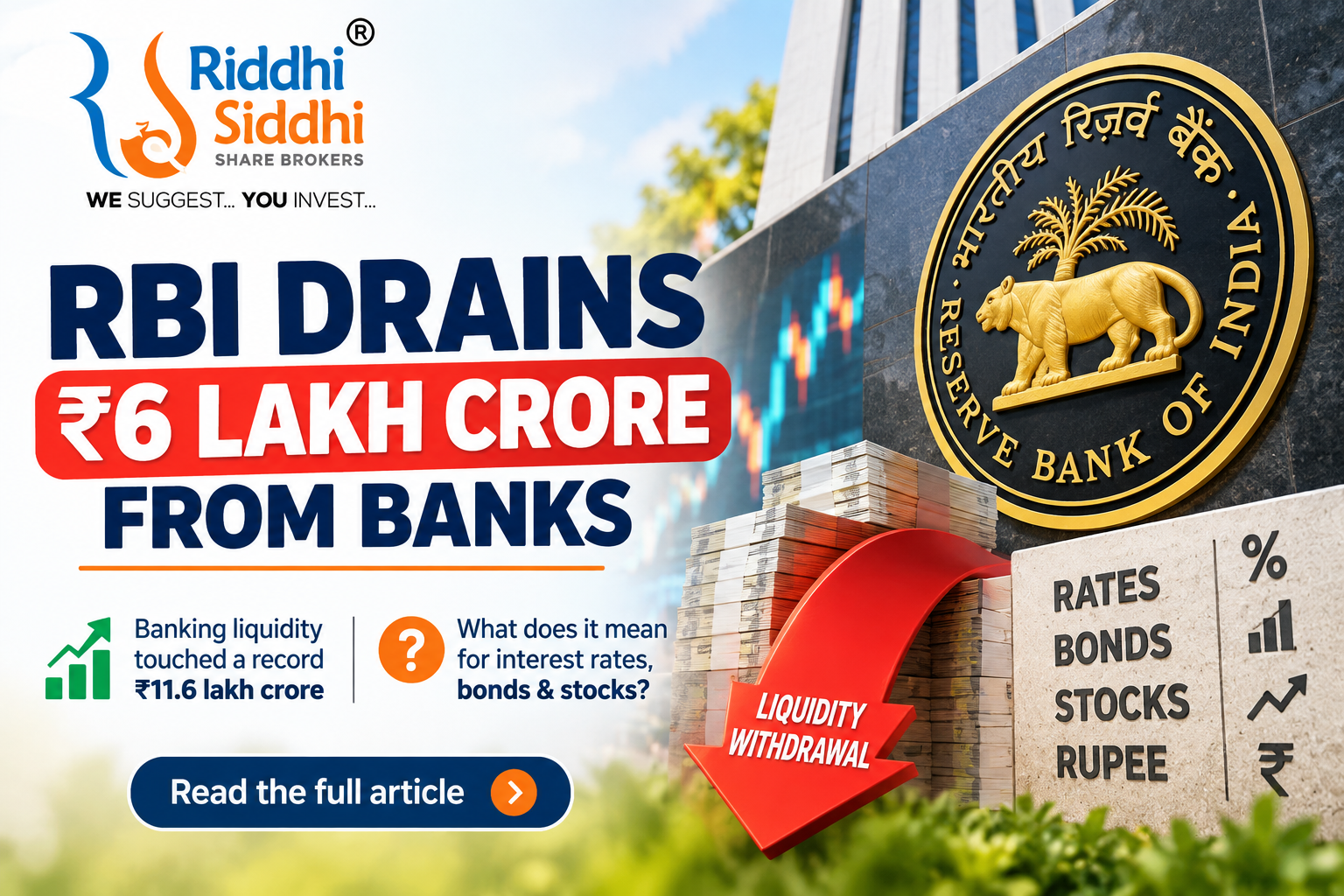
Why would the Reserve Bank of India remove more than ₹6 lakh crore from the banking system in a single day?
That question became particularly relevant on September 7, 2026, after India’s banking-system liquidity surplus surged to a record ₹11.6 lakh crore.
The RBI responded by accepting around ₹3.53 lakh crore through an overnight Variable Rate Reverse Repo (VRRR) and another approximately ₹2.59 lakh crore through a 30-day VRRR.
Together, the two operations absorbed more than ₹6.1 lakh crore from the banking system.
The numbers are enormous.
But for investors, the more important issue is not simply the size of the operation.
It is understanding:
Why did so much excess money enter the banking system, why is RBI absorbing it, and what could this mean for interest rates, bonds, banks, mutual funds, the rupee and equities?
At Riddhi Siddhi Share Brokers, we believe this is a useful example of why investors should understand liquidity—not just stock prices.
What Happened on September 7, 2026?
India’s banking system had accumulated an extraordinary liquidity surplus.
According to market data reported on September 7, the banking-system surplus had reached approximately:
₹11.6 lakh crore
That was equivalent to nearly 4% of total banking deposits and represented a record level of surplus liquidity.
To absorb part of this excess money, RBI conducted two VRRR operations.
| RBI Operation | Approximate Amount Absorbed |
|---|---|
| Overnight VRRR | ₹3.53 lakh crore |
| 30-day VRRR | ₹2.59 lakh crore |
| Total | ₹6.12 lakh crore |
The RBI had offered to absorb substantially more through the 30-day operation, but banks did not place enough funds to fill the entire notified amount.
RBI also announced another overnight VRRR auction for September 8, 2026, confirming that liquidity management remained an active priority.
This makes the development more than a one-day technical adjustment.
Why Was There ₹11.6 Lakh Crore of Excess Banking Liquidity?
The answer lies largely in an unusually large inflow of foreign currency.
India received around $136.38 billion through special external funding measures that encouraged foreign-currency deposits and overseas borrowing flows into the country.
These inflows were far larger than markets had initially expected.
When foreign currency enters India and is effectively exchanged into rupees through the banking and central-bank system, rupee liquidity can increase.
Think of the broad chain as:
Foreign currency comes in → RBI/banking system receives dollars → rupees enter the domestic banking system → banking liquidity rises
By September 3, surplus liquidity was already around ₹10.3 lakh crore. It subsequently climbed to the record ₹11.6 lakh crore level.
This is why RBI suddenly found itself managing not a liquidity shortage—but a liquidity deluge.
What Does “Excess Liquidity” Actually Mean?
Let us simplify this.
Imagine the banking system collectively needs ₹100 to comfortably meet withdrawals, lending needs and regulatory requirements.
But banks suddenly have ₹120.
That extra ₹20 is surplus liquidity.
Banks may lend it, invest it, place it in money markets or park it temporarily with the RBI.
When the entire banking system has far more cash than it currently requires, short-term market interest rates can come under downward pressure.
That may sound positive.
But too much liquidity for too long can also create distortions.
Cheap and abundant money can potentially encourage:
- excessive short-term risk-taking,
- unusually easy financial conditions,
- asset-price speculation,
- weaker monetary-policy transmission, and
- inflationary pressures if excess liquidity ultimately fuels excessive demand.
Central banks therefore try to maintain liquidity conditions consistent with their monetary-policy objective rather than simply keeping “as much money as possible” in the system.
What Is a VRRR?
Variable Rate Reverse Repo Explained Simply
A Variable Rate Reverse Repo, or VRRR, is one of the tools RBI can use to temporarily absorb money from banks.
Banks bid to place surplus funds with RBI for a specified period.
In return, they earn an interest rate determined through the auction.
In very simplified terms:
Bank has excess cash → Bank parks cash with RBI → RBI temporarily removes that liquidity from circulation
When the VRRR matures:
RBI returns the money to the bank + applicable interest
Therefore, a VRRR does not ordinarily destroy the money permanently.
It temporarily locks up excess liquidity.
RBI has historically used VRRRs and other fine-tuning operations to manage unexpected or temporary liquidity conditions within its monetary-policy operating framework.
Why Is RBI Removing So Much Liquidity?
There are several reasons.
1. To Keep Short-Term Interest Rates Aligned With Monetary Policy
RBI currently operates monetary policy through an interest-rate corridor around the policy repo rate.
As of September 7, 2026, RBI’s published policy rates included:
- Repo Rate: 5.25%
- Standing Deposit Facility: 5.00%
- Marginal Standing Facility: 5.50%
If banks have enormous surplus cash, short-term money-market rates can fall excessively.
Absorbing liquidity can help RBI keep overnight interest rates more closely aligned with its intended monetary-policy framework.
2. To Prevent Financial Conditions From Becoming Too Loose
Liquidity and the repo rate work differently, but they interact.
If RBI wants a particular monetary-policy stance while massive excess cash is simultaneously pushing market rates lower, policy transmission can become less effective.
3. To Reduce Potential Inflation Risks
Excess liquidity does not automatically cause inflation.
However, persistently excessive liquidity can contribute to easier credit and financial conditions, potentially supporting demand.
RBI therefore needs to assess liquidity alongside inflation, growth and financial stability.
4. To Limit Financial-Market Distortions
Very cheap money can sometimes encourage investors or financial institutions to take additional risk simply because funding is abundant.
Liquidity management is therefore also linked to orderly market functioning.
Does RBI Liquidity Withdrawal Mean a Repo Rate Hike Is Coming?
Not necessarily.
This distinction is extremely important.
A VRRR operation is a liquidity-management action.
A repo-rate hike is a monetary-policy decision.
They should not automatically be interpreted as the same thing.
RBI can absorb excess liquidity while leaving the repo rate unchanged.
Similarly, RBI can inject liquidity without necessarily cutting the repo rate.
Investors should therefore avoid headlines that suggest:
“RBI removes ₹6 lakh crore = interest-rate hike coming.”
That conclusion is too simplistic.
Future repo-rate decisions will depend on a much broader combination of factors including inflation, economic growth, global rates, crude oil, currency conditions and the Monetary Policy Committee’s assessment.
RBI Liquidity Withdrawal vs Repo Rate Hike
| RBI Action | Primary Purpose | Temporary/Persistent | Directly Changes Policy Repo Rate? |
|---|---|---|---|
| VRRR | Absorb surplus banking liquidity | Usually temporary | No |
| Dollar selling | Foreign-exchange/currency management; also removes rupee liquidity | Variable | No |
| OMO bond sale | Absorb liquidity | Can have longer impact | No |
| CRR increase | Require banks to hold more cash with RBI | Persistent until changed | No |
| Repo-rate hike | Tighten monetary-policy rate | Policy decision | Yes |
Understanding this difference prevents investors from treating every RBI liquidity operation as a change in monetary-policy direction.
How Can Excess Liquidity Affect Bank Stocks?
The relationship is not as simple as:
“More liquidity = bank stocks rise.”
Bank profitability depends on multiple variables.
Excess banking-system liquidity can affect:
Funding Costs
When liquidity is abundant, wholesale funding conditions can become easier.
Deposit Competition
If banks have adequate liquidity, pressure to aggressively raise deposit rates may reduce in some circumstances.
Lending Rates
Money-market conditions eventually influence funding and lending conditions, although transmission varies across banks and loan products.
Net Interest Margins
The ultimate effect on margins depends on how quickly deposit costs, lending yields and asset composition adjust.
Loan Growth
Liquidity may support lending capacity, but actual credit growth depends more importantly on demand, underwriting standards, capital availability and economic conditions.
Therefore, liquidity is one variable among many when analysing banking stocks—not an independent buy or sell signal.
What Does RBI Liquidity Withdrawal Mean for Government Bonds?
Liquidity can be particularly important for the bond market.
Banks are major participants in government securities.
When liquidity is abundant, institutions generally have greater capacity to deploy money into short-term instruments and government bonds.
That can support bond prices and suppress yields, particularly at the shorter end.
When RBI absorbs liquidity aggressively, some of that downward pressure on money-market rates can reverse.
Indeed, the bond market has been closely watching RBI’s liquidity operations, while the benchmark 10-year government bond yield recently traded around the 7% area amid the combination of domestic liquidity conditions, crude oil prices and global yields.
However, investors should remember:
Bond yields are influenced by much more than liquidity.
Inflation expectations, government borrowing, fiscal policy, global yields, crude oil and expectations regarding future RBI policy all matter.
What Does It Mean for Mutual Funds?
The impact depends heavily on the type of mutual fund.
Overnight and Liquid Funds
These funds invest heavily in very short-term instruments.
Changes in overnight and short-term money-market rates can therefore influence their portfolio yields relatively quickly.
If RBI successfully moves overnight rates upward from unusually depressed levels caused by excess liquidity, incremental yields on newly purchased short-term instruments may improve.
Short-Duration Debt Funds
Liquidity conditions can also affect shorter-maturity bond yields, although portfolio performance depends on the entire interest-rate curve and securities held by the fund.
Long-Duration Debt Funds
For longer-duration funds, inflation expectations and expectations surrounding future repo rates can matter substantially more than a single overnight VRRR.
Investors should therefore avoid changing debt-fund allocations purely because RBI conducted one large liquidity auction.
What Does Excess Liquidity Mean for Equity Investors?
Liquidity matters to equities because abundant financial-system liquidity can support risk appetite.
But investors should be careful with the popular equation:
More liquidity = stocks always rise.
Markets do not work that mechanically.
Equity valuations ultimately interact with:
Liquidity + Earnings + Interest Rates + Inflation + Growth + Global Flows + Risk Appetite
Strong liquidity can support financial markets.
But it cannot indefinitely compensate for weak earnings, extreme valuations or deteriorating macroeconomic conditions.
Similarly, RBI absorbing liquidity does not automatically mean a stock-market correction is coming.
It simply changes one component of the financial environment.
Investors following the broader September market setup can also read our Nifty Outlook for September 7–11, 2026, where we discuss crude oil, inflation, FII flows and other macro triggers. Nifty Outlook September 7–11, 2026
How Is RBI’s Rupee Intervention Connected?
This is perhaps the most interesting connection.
RBI has also been actively intervening in the foreign-exchange market.
Bankers estimated that RBI sold at least $8 billion, and potentially considerably more, during the previous week to support the rupee.
Why does dollar selling matter for domestic liquidity?
Imagine RBI sells $1 billion to banks.
The banks pay RBI in rupees.
So:
RBI gives dollars → Banks give rupees to RBI
Those rupees leave the banking system.
Therefore:
RBI dollar sales can automatically absorb rupee liquidity.
This means RBI’s currency-management operations and domestic liquidity management can become interconnected.
In the current environment, this is particularly interesting because the original foreign-currency inflows helped create massive rupee liquidity, while subsequent RBI dollar sales can remove some of that liquidity while also managing the rupee.
Could RBI Use Other Tools to Remove Liquidity?
Yes.
VRRR is not RBI’s only option.
Potential liquidity-absorption tools include:
Longer-Duration VRRR
Banks park surplus funds with RBI for longer periods.
Market Stabilisation Scheme
Government securities or Treasury Bills can be issued specifically to absorb liquidity.
Open Market Operation Sales
RBI can sell government bonds from its portfolio and receive rupees from buyers.
FX Sell/Buy Swaps
RBI can sell dollars against rupees initially and reverse the transaction later.
Cash Reserve Ratio
RBI could increase the proportion of deposits banks are required to maintain as cash reserves.
Each tool affects markets differently.
For example, outright government-bond sales may put upward pressure on bond yields, while increasing CRR directly locks up part of banks’ balance sheets.
That is why the choice of liquidity-management instrument can matter almost as much as the amount being absorbed.
Will Home-Loan and Deposit Rates Rise Because RBI Absorbed ₹6 Lakh Crore?
Not automatically.
This is another important distinction for retail borrowers and savers.
A VRRR primarily manages surplus money in the banking system.
Home-loan rates depend on factors such as:
- the repo rate,
- banks’ benchmark lending frameworks,
- cost of deposits,
- funding conditions,
- credit risk, and
- individual loan terms.
Similarly, deposit rates depend heavily on how aggressively banks need deposits to fund credit growth.
Therefore:
One ₹6-lakh-crore liquidity-absorption operation does not automatically mean your home-loan EMI or fixed-deposit rate will rise.
If tighter liquidity conditions persist for a long period and funding costs move meaningfully higher, there could eventually be effects.
But that is a very different conclusion.
Why Investors Should Watch Liquidity Alongside RBI Policy
Retail investors typically follow:
Repo Rate → Inflation → Stock Market
But there is another important chain:
Banking Liquidity → Overnight Rates → Bond Yields → Funding Conditions → Financial Markets
Both matter.
This is also why regulatory and market-structure changes should be understood in context rather than viewed as isolated headlines.
Readers may also find our recent guide on NSE futures pre-open and SEBI ETF rule changes from September 7, 2026 useful. New Stock Market Rules From September 7, 2026
For investors active in derivatives, our analysis of SEBI’s FY25–FY26 F&O trader study provides another useful perspective on liquidity, leverage and risk management. Nearly 88% of Individual F&O Traders Lost Money: SEBI FY26 Study
What Should Retail Investors Watch Next?
Rather than reacting to the ₹6-lakh-crore headline alone, investors should watch the direction of several indicators together:
- further RBI VRRR and liquidity auctions,
- banking-system surplus liquidity,
- overnight money-market rates,
- government-bond yields,
- inflation data,
- crude-oil prices,
- the rupee against the U.S. dollar,
- RBI’s foreign-exchange intervention, and
- future RBI Monetary Policy Committee commentary.
The duration of excess liquidity may ultimately matter more than one day’s number.
Riddhi Siddhi Share Brokers View
The scale of RBI’s September 2026 liquidity operations is unusual enough to deserve investor attention.
A banking-system surplus of around ₹11.6 lakh crore followed by absorption of more than ₹6.1 lakh crore in a single day demonstrates how quickly liquidity conditions can change when exceptionally large foreign-currency flows enter the economy.
But investors should avoid drawing extreme conclusions from the headline.
A VRRR does not automatically signal an imminent repo-rate hike.
It does not automatically mean bank stocks will fall.
And it does not automatically predict a stock-market correction.
Large RBI liquidity operations may look like technical banking-market events, but they matter because liquidity influences money-market rates, bond yields, currency conditions, funding costs and financial-market risk appetite.
The smarter approach is therefore:
Watch liquidity—but interpret it together with inflation, interest rates, earnings, valuations, currency movements and economic growth.
Riddhi Siddhi Share Brokers
We Suggest… You Invest.
For market updates and information on Equity, Derivatives, Bonds, Mutual Funds, IPOs, SLBM, Loans and Assisted Trading Services, visit Riddhi Siddhi Share Brokers. Visit Riddhi Siddhi Share Brokers
Message +91 99875 53455 to request access to our exclusive WhatsApp community for daily prices, opportunities and market updates.
Frequently Asked Questions
1. Why is RBI withdrawing liquidity from banks in September 2026?
RBI is absorbing liquidity because an unusually large influx of foreign currency helped create a record banking-system surplus. Surplus liquidity reached around ₹11.6 lakh crore before RBI absorbed more than ₹6.1 lakh crore through overnight and 30-day VRRR operations on September 7, 2026. The objective is to manage excess liquidity and keep money-market conditions consistent with monetary policy.
2. What is a VRRR and how does it affect interest rates?
A Variable Rate Reverse Repo is an auction through which banks temporarily park surplus funds with RBI in exchange for interest. By taking excess cash out of the banking system, RBI can influence short-term liquidity and help keep overnight money-market rates aligned with its monetary-policy framework.
3. Does RBI absorbing ₹6 lakh crore mean home-loan and deposit rates will rise?
Not necessarily. Liquidity absorption and changes in the policy repo rate are different actions. A single VRRR does not automatically raise home-loan or deposit rates. Persistent changes in banking liquidity, funding costs and eventual monetary-policy decisions would be more relevant.
Disclaimer
This article is intended solely for educational and informational purposes and should not be construed as investment advice, research advice, a trading recommendation, solicitation or an assurance of returns.
Market conditions, liquidity, interest rates, bond yields, currencies and securities prices can change rapidly. References to possible market impacts are explanatory and should not be interpreted as predictions or recommendations regarding any security, sector, mutual fund, bond or other financial instrument.
Riddhi Siddhi Share Brokers is an NSE & BSE Authorised Person and is not a SEBI-registered Investment Adviser. Investors should conduct their own research, understand the relevant risks and, where appropriate, consult a SEBI-registered Investment Adviser before making investment decisions. Investments in securities markets are subject to market risks. Past performance is not indicative of future results.