
By Riddhi Siddhi Share Brokers | 18 November 2026 | Stock Market Analysis
Gold and silver prices are falling sharply, and the impact is already being felt across Indian jewellery stocks.
For consumers, cheaper precious metals may appear to be good news. But for listed jewellery companies holding substantial inventories, sudden price corrections can introduce financial risks that investors often overlook.
Could jewellery companies report weaker profits, inventory write-downs or margin pressure even when their sales remain strong?
At Riddhi Siddhi Share Brokers, we believe the recent correction in gold and silver warrants a closer examination of jewellery companies’ inventory exposure, hedging arrangements, cash flows and earnings expectations.
The concern is not that every jewellery company will necessarily suffer losses. Rather, investors must understand why some businesses may be more vulnerable than others.
Gold and Silver Prices Fall Sharply on 18 November 2026
Precious metals witnessed significant selling pressure on Wednesday, 18 November 2026.
International gold prices fell below $3,800 per troy ounce during the session, while silver slipped below $46 per troy ounce.
Domestic futures markets reflected the weakness.
At approximately 12:06 PM IST, reported Multi Commodity Exchange prices showed:
| Precious metal | MCX futures price | Daily decline |
|---|---|---|
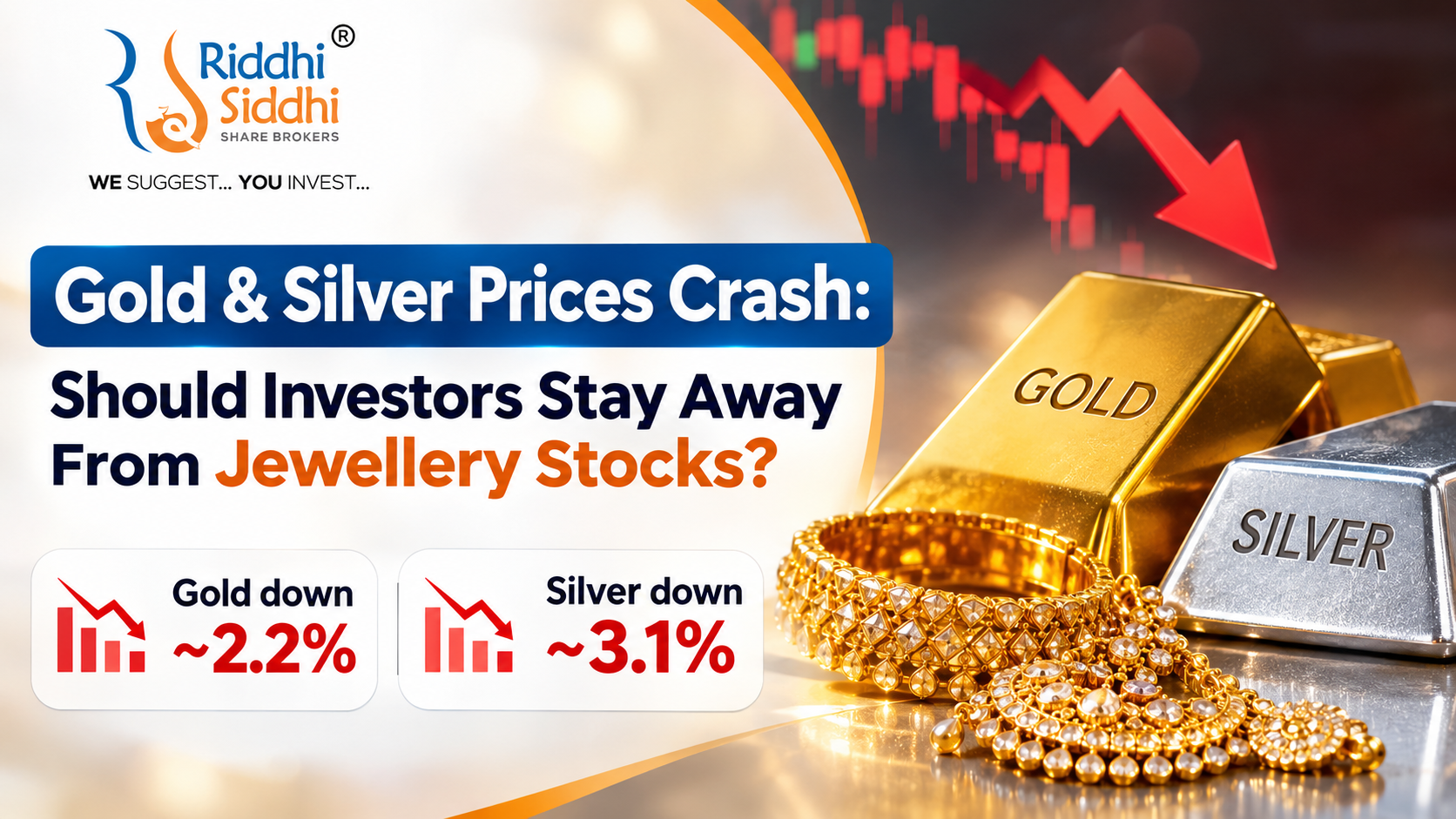
| Gold, December 2026 contract | ₹1,31,257 per 10 grams | 2.21% |
| Silver, December 2026 contract | ₹1,64,359 per kg | 3.15% |
Source: Published MCX futures market data reported on 18 November 2026. Figures represent a specific intraday observation, not settlement prices.
The correction was also reflected in jewellery stocks.
Reported market figures for 18 November showed:
| Jewellery company | Reported share-price decline |
|---|---|
| Titan Company | 4.24% |
| Kalyan Jewellers | 4.83% |
| Sky Gold and Diamonds | 5.63% |
| Thangamayil Jewellery | 3.30% |
| Senco Gold | 2.54% |
| PC Jeweller | 2.52% |
These are published session observations, not independently verified official exchange closing returns.
The simultaneous decline in precious metals and jewellery equities highlights growing investor sensitivity to commodity-price volatility.
However, the movement in share prices does not establish that these companies have already incurred inventory losses.
The actual financial consequences will depend on company-specific circumstances.
Why Falling Gold Prices Can Hurt Jewellery Companies
Gold is the dominant raw material for many organised jewellery retailers.
Companies purchase gold, manufacture ornaments and maintain finished jewellery inventories to meet consumer demand.
If gold prices decline significantly after inventory has been acquired, businesses may face pressure on the recoverable value of their stock.
Three important risks emerge.
1. Inventory valuation risk
A company holding jewellery manufactured using expensive gold may find that the selling value of its products has declined following a sharp correction in bullion prices.
Under applicable inventory accounting principles, inventories are generally measured at the lower of cost and net realisable value.
If the expected net amount recoverable from selling inventory falls below its recorded cost, an inventory write-down may become necessary.
However, the decline in the market price of gold alone does not automatically establish an accounting loss.
Finished jewellery also incorporates manufacturing costs, making charges and other components.
2. Gross margin pressure
Jewellery companies may face pressure to reduce selling prices or offer discounts when underlying gold prices decline.
The financial impact depends on how quickly selling prices adjust relative to inventory costs and procurement arrangements.
A company that effectively manages its commodity exposure may experience a very different outcome from one carrying significant unhedged inventory.
3. Working-capital pressure
Jewellery businesses often require substantial capital to maintain inventories.
Sudden commodity-price movements can complicate procurement planning, inventory financing and cash-flow management.
For companies already operating with elevated debt or slower inventory turnover, additional uncertainty may increase financial pressure.
The Silver Risk: Why Investors Should Not Ignore the Second Precious Metal
Gold usually receives the most attention when analysing jewellery stocks.
But silver deserves consideration, particularly for companies involved in silver jewellery, silverware, ornaments, gifting products or bullion-related activities.
Silver can experience substantial short-term price fluctuations because its market is influenced by both investment demand and industrial consumption.
Unlike gold, silver has significant industrial applications, including electronics, solar technology and electrical components.
Consequently, silver prices can respond to changes in industrial demand, economic expectations and investment flows.
Why silver-price volatility matters
A jewellery company holding substantial silver inventory may face risks similar to those associated with gold.
These include inventory valuation pressure, selling-price adjustments, hedging mismatches and changes in consumer demand.
However, silver exposure is not uniform across jewellery businesses.
A company primarily selling gold ornaments may have relatively limited silver-related inventory risk.
Another business with a meaningful silver jewellery or silverware segment could be more sensitive to fluctuations in silver prices.
Investors should therefore examine the actual product mix rather than assume that every jewellery company has significant exposure to both metals.
The ₹1,000 Crore Example: How Precious-Metal Prices Can Affect Inventory Exposure
Consider a hypothetical jewellery business with the following commodity-price exposure:
| Inventory exposure | Amount |
|---|---|
| Gold-related exposure | ₹800 crore |
| Silver-related exposure | ₹200 crore |
| Total | ₹1,000 crore |
Now assume:
- Gold prices decline by 10%.
- Silver prices decline by 15%.
The theoretical gross price sensitivity would be:
| Metal | Price correction | Gross sensitivity |
|---|---|---|
| Gold | 10% | ₹80 crore |
| Silver | 15% | ₹30 crore |
| Total | ₹110 crore |
Suppose the company has effective hedging coverage of 75% for gold exposure and 40% for silver exposure.
The simplified residual exposure would be:
| Metal | Residual price sensitivity |
|---|---|
| Gold | ₹20 crore |
| Silver | ₹18 crore |
| Total | ₹38 crore |
This illustrates how hedging can materially change a company’s exposure to precious-metal price movements.
Important: These figures represent a hypothetical commodity-price sensitivity calculation, not a projected inventory write-down or accounting loss.
Actual financial results depend on hedge effectiveness, timing, inventory turnover, financing arrangements, net realisable value and other operational factors.
The lesson is straightforward.
Two jewellery companies with identical inventory values may face very different financial risks during the same gold and silver correction.
Can Every Jewellery Company Hedge Its Gold and Silver Exposure?
Not necessarily to the same extent or with the same effectiveness.
Hedging involves financial costs, operational requirements, liquidity considerations and the need to match contracts with underlying exposures.
Companies may use gold metal loans, forward contracts, futures or other permitted risk-management arrangements.
But investors should distinguish between having a hedging policy and being fully protected against commodity-price fluctuations.
Titan Company
Titan has historically disclosed the use of gold-on-lease arrangements and derivative instruments to manage gold-price exposure.
These arrangements are intended to reduce the financial impact of fluctuations in gold prices.
However, Titan remains exposed to consumer demand, operating expenses, competition and valuation risks.
Kalyan Jewellers
Kalyan Jewellers has disclosed the use of gold metal loans and forward or futures contracts within its commodity-risk management framework.
These mechanisms can help manage gold-price fluctuations, although the extent of effective protection must be evaluated using current financial disclosures.
Senco Gold, Thangamayil Jewellery and Other Players
Other listed jewellery businesses may have different procurement arrangements, inventory cycles, financing structures and risk-management policies.
Their actual exposure cannot be determined merely by comparing the size of their inventory balances.
At Riddhi Siddhi Share Brokers, we believe investors should examine each company’s disclosures before drawing conclusions about its ability to withstand falling precious-metal prices.
Why Strong Jewellery Sales May Not Translate Into Strong Profits
A jewellery company can report growing revenue while experiencing declining profitability.
Consider a hypothetical example.
| Financial indicator | Previous period | Current period |
|---|---|---|
| Revenue | ₹1,000 crore | ₹1,150 crore |
| Gross profit margin | 12% | 9% |
| Gross profit | ₹120 crore | ₹103.5 crore |
Revenue increases by 15%.
Yet gross profit declines by 13.75%.
The reason is margin compression.
This example is illustrative and does not represent the financial performance of any particular company.
It demonstrates why investors must evaluate profitability alongside revenue growth.
Strong festive sales, expanding store networks and higher billing values do not automatically guarantee stronger earnings.
When precious-metal prices are volatile, gross margins, operating cash flows and inventory turnover become especially important.
Could Falling Gold and Silver Prices Actually Benefit Jewellery Retailers?
Yes. This is the counterargument investors should not ignore.
Lower gold and silver prices can improve affordability.
Consumers purchasing wedding jewellery, ornaments or silver gifting products may be able to buy larger quantities within the same budget.
This can potentially support sales volumes.
However, the timing of demand matters.
If customers expect further price declines, some may postpone discretionary purchases.
Additionally, higher sales volumes do not necessarily translate into higher profits if making-charge realisations weaken or inventory-related costs increase.
The impact of lower precious-metal prices can therefore be positive for some companies and negative for others.
The direction of bullion prices alone is insufficient to determine the future earnings of jewellery retailers.
Six Warning Signs Investors Should Monitor in Jewellery Stocks
At Riddhi Siddhi Share Brokers, we believe investors should pay particular attention to six financial indicators.
1. Inventory growth exceeding sales growth
A sustained increase in inventory relative to revenue may indicate slower turnover or greater working-capital requirements.
2. Limited transparency on commodity hedging
Investors should examine whether companies disclose their risk-management policies, hedging instruments and relevant commodity exposures.
3. Declining gross profit margins
Margin compression may indicate pricing pressure, product-mix changes, discounts or inventory-related costs.
4. Weak operating cash flows
A company reporting accounting profits but consistently generating weak operating cash flow deserves closer examination.
5. Rising borrowing costs
Businesses dependent on inventory financing may become more vulnerable when interest expenses rise or working-capital requirements increase.
6. Expensive equity valuations
Even fundamentally strong businesses can experience substantial share-price corrections when earnings fail to meet elevated expectations.
Investors should evaluate these indicators together rather than relying on any single metric.
For related investor education and market-risk awareness, explore the Riddhi Siddhi Share Brokers Blog and our article on SEBI’s warning about WhatsApp stock tips and the importance of independent verification.
Should Investors Stay Away From Jewellery Stocks for Some Time?
The recent correction in gold and silver prices raises legitimate concerns about the near-term outlook for jewellery equities.
However, a blanket recommendation to sell every jewellery stock would overlook important differences between companies.
Some businesses may benefit from improved affordability, strong consumer demand and effective hedging arrangements.
Others may face greater financial uncertainty because of inventory exposure, weak cash flows or elevated valuations.
Riddhi Siddhi Share Brokers’ educational market perspective is that investors should exercise heightened caution when evaluating fresh jewellery-sector exposure until commodity-price volatility and earnings visibility improve.
This is not a company-specific buy, sell or hold recommendation.
Existing investors should assess their holdings based on individual company fundamentals, investment horizon, portfolio concentration and risk tolerance.
For prospective investors, greater clarity on margins, hedging and cash-flow trends may provide a more informed basis for evaluating opportunities.
What Could Improve the Outlook for Jewellery Stocks?
Several developments could support confidence in the sector.
- Greater stability in gold and silver prices.
- Sustained improvement in jewellery sales volumes.
- Stable or improving gross profit margins.
- Effective commodity-price risk management.
- Healthy operating cash flows.
- Manageable inventory financing and debt.
- Equity valuations supported by realistic earnings expectations.
Conversely, continued commodity-price volatility, weaker demand, margin compression or disappointing quarterly results could increase uncertainty.
The next round of company financial disclosures will be important in assessing whether the recent precious-metal correction has translated into measurable earnings pressure.
Frequently Asked Questions
Can jewellery companies report losses when gold prices fall?
Yes. Falling gold prices can create inventory valuation pressure or losses on unhedged exposures. However, actual accounting losses depend on inventory valuation, hedging, procurement and selling-price arrangements.
Can falling silver prices affect jewellery companies?
Yes, particularly companies with meaningful silver jewellery, silverware or bullion inventory exposure. The financial impact depends on their product mix and risk-management practices.
Does a 10% fall in gold prices mean a 10% inventory loss?
No. Inventory values include additional cost components, and hedging or financing arrangements may reduce commodity-price exposure. Actual accounting outcomes depend on applicable valuation principles.
Are Titan and Kalyan Jewellers completely protected against falling gold prices?
Both have historically disclosed commodity-risk management arrangements, but these do not eliminate all operational, financial or valuation risks.
Can cheaper gold and silver increase jewellery demand?
Yes. Lower prices can improve affordability and encourage purchases. However, some customers may delay buying if they expect prices to decline further.
Should long-term investors immediately exit jewellery stocks?
A sector-wide exit decision cannot be justified solely by falling precious-metal prices. Investors should evaluate company fundamentals, financial resilience, valuations and their own investment objectives.
Conclusion: When Gold and Silver Lose Their Shine, Investors Must Look Beyond the Glitter
India’s jewellery industry continues to benefit from long-term cultural demand, wedding-related consumption and growing organised retail participation.
However, a strong industry does not guarantee that every listed jewellery company will deliver strong profits under all market conditions.
Sharp corrections in gold and silver prices can introduce uncertainty around inventory valuations, hedging effectiveness, profit margins and working-capital requirements.
The impact will differ from company to company.
At Riddhi Siddhi Share Brokers, we believe the current environment calls for greater attention to financial quality, risk management and earnings sustainability.
The key takeaway: Falling gold and silver prices may create opportunities for consumers, but they can also introduce financial risks for jewellery companies and their shareholders.
Investors should avoid treating every share-price correction as an automatic buying opportunity.
Understanding the underlying business risks remains essential.
We Suggest… You Invest.
Connect With Riddhi Siddhi Share Brokers
Stay informed about Indian stock markets, sector developments, investment education and financial opportunities.
Website: Riddhi Siddhi Share Brokers
Business Enquiries: +91 91379 69859
Join Our Exclusive WhatsApp Community
Message +91 99875 53455 to request access to our exclusive WhatsApp community for daily prices, opportunities and market updates.
Community information is educational and does not constitute personalised investment advice.
Explore SAMRiddhi — Assisted Trading Services
Looking for assistance with trade execution while maintaining visibility of your own trading account?
Explore SAMRiddhi, the assisted trading offering from Riddhi Siddhi Share Brokers, including web and mobile account access and transaction-related support.
Learn More About SAMRiddhi Assisted Trading Services
Assisted trading is subject to applicable client authorisations, registered stockbroker arrangements and regulatory requirements. No assured returns are offered.
Regulatory Disclaimer
This article is intended solely for educational and informational purposes.
Riddhi Siddhi Share Brokers is an Authorised Person of an NSE & BSE registered stockbroker.
The content represents general market commentary and does not constitute personalised investment advice, an independent securities research recommendation, or an offer to buy or sell any security.
Securities market investments and trading involve risks, including possible loss of capital. Investors should independently evaluate relevant financial disclosures, investment objectives and risk tolerance, and consult a SEBI-registered investment adviser where appropriate.
Past performance is not indicative of future results.