
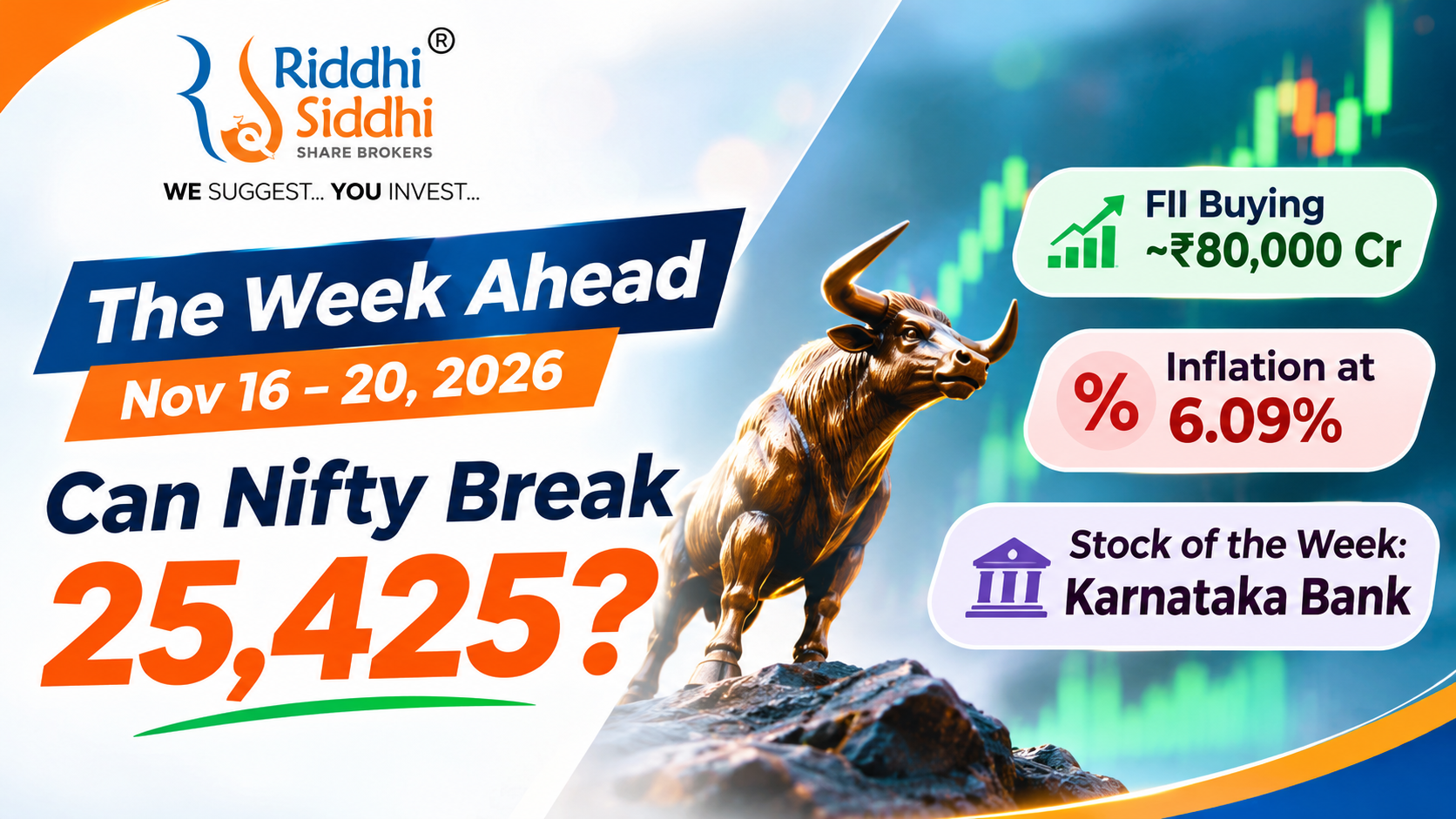
Riddhi Siddhi Share Brokers | Weekly Market Outlook | November 15, 2026
We Suggest… You Invest.
Three consecutive weeks of gains. Foreign investors are returning. Banks are outperforming. But can the rally withstand inflation, crude oil and global uncertainty?
Dalal Street enters November 16–20, 2026, at an important crossroads.
Nifty has reclaimed the psychological 25,000 mark, Bank Nifty has emerged as a major outperformer, and foreign institutional buying has supported the recovery. Midcap and smallcap stocks have also attracted investor interest.
However, India’s October retail inflation has risen to 6.09%, crude oil remains sensitive to geopolitical developments, and investors await the US Federal Reserve’s meeting minutes.
At Riddhi Siddhi Share Brokers, our assessment is that the recovery remains constructive, but the next advance requires confirmation from earnings, institutional flows and broader market participation.
1. The Week That Was: Bulls Retain Control Despite Friday’s Selling
Indian equities completed another positive week, although profit booking emerged during Friday’s session.
| Index | November 13 Close |
|---|---|
| Nifty 50 | 25,144.30 |
| Sensex | 81,592.45 |
| Bank Nifty | 61,034.10 |
| Nifty Midcap 100 | 61,889.50 |
| Nifty Smallcap 100 | 19,656.45 |
| India VIX | 15.50 |
Bank Nifty gained approximately 3.7% during the week, while midcap and smallcap indices also delivered positive returns.
Nifty touched a weekly high near 25,424 before retreating.
Friday’s decline demonstrated that investors are becoming more selective after the recent rally.
Riddhi Siddhi Market Insight: The market has moved from recovery into confirmation. Sustained gains will increasingly depend on earnings, valuations and wider sector participation.
2. Banking Stocks: The Strongest Pillar of the Rally
Banking stocks emerged as major outperformers, with PSU banks leading the advance.
The PSU banking index gained approximately 7.5%–7.8% during the week, substantially outperforming private-sector banks.
The important question is whether this momentum can continue.
Investors should monitor credit growth, deposit mobilisation, net interest margins, asset quality and profitability.
Private banking heavyweights such as HDFC Bank, ICICI Bank, Axis Bank and Kotak Mahindra Bank could play an important role if the rally broadens.
Our view: Banking remains constructive, but the sharp recent advance makes earnings quality and valuation discipline increasingly important.
3. FII Buying: Is Foreign Money Returning for the Long Term?
Foreign institutional investment has been one of November’s most significant market developments.
Provisional figures compiled through November 13 suggest cumulative FII net buying approaching ₹80,000 crore.
On November 13, reported FII cash purchases were ₹5,737 crore, compared with DII net selling of ₹2,254 crore.
Foreign inflows can support liquidity and large-cap valuations, but they do not guarantee rising markets.
The sustainability of foreign investment will depend on global yields, currency movements, geopolitical risks and corporate earnings.
Riddhi Siddhi Market Insight: The durability of foreign inflows matters more than one month’s headline figure.
4. Inflation Shock: India’s CPI Reaches 6.09%
India’s October retail inflation increased to 6.09%, compared with 5.54% in September.
Food inflation rose to 8.94%.
The headline reading exceeded the RBI’s upper inflation tolerance threshold.
Higher inflation can affect household purchasing power, corporate margins, borrowing costs and bond yields.
FMCG, automobiles, real estate and financial services may experience different effects depending on pricing power and financing conditions.
One elevated inflation reading does not automatically guarantee an RBI rate hike.
The upcoming wholesale inflation release will provide another important indication of pricing pressures.
5. Monday’s WPI Inflation: A Test for Corporate Margins
India’s October Wholesale Price Index inflation release is expected on November 16.
Investors should monitor manufactured-product inflation, fuel and power prices, and primary articles.
Higher wholesale inflation can increase production costs and pressure operating margins, particularly where companies have limited pricing power.
The difference between wholesale and retail inflation will also deserve attention.
6. Crude Oil, West Asia and the Rupee
Crude oil remains an important external risk for India.
Geopolitical uncertainty involving the United States, Iran and Gulf shipping routes has increased the importance of energy-price developments.
Sustained higher crude prices can affect India’s import bill, inflation, currency and corporate profitability.
Aviation, paints, chemicals and logistics businesses may face higher operating costs.
Upstream oil producers may benefit from stronger crude realisations, subject to company-specific and regulatory factors.
Oil marketing companies require a more nuanced assessment because refining margins, retail pricing and inventory movements influence profitability.
Our assessment: Investors should distinguish between companies producing energy and those consuming petroleum-linked inputs.
7. US Federal Reserve Minutes: A Global Liquidity Test
The US Federal Reserve is scheduled to release minutes of its October 27–28 meeting on November 18.
Indian markets will primarily react during Thursday’s trading session.
Investors will examine policymakers’ assessment of inflation, employment, economic growth and the future interest-rate path.
US bond yields and dollar movements can influence global capital flows and emerging-market valuations.
For India, the interaction between the dollar, rupee and foreign institutional investment will remain important.
8. AI Earnings and Global Technology Sentiment
Global technology stocks remain sensitive to expectations surrounding artificial-intelligence investment and valuations.
Major technology earnings during the week could influence investor sentiment.
For Indian IT companies, the important factors are enterprise technology spending, client budgets, demand visibility and currency movements.
Higher global AI infrastructure expenditure does not automatically translate into stronger profits for every technology company.
Investors should distinguish between companies generating measurable earnings from AI-related spending and those primarily benefiting from market enthusiasm.
9. India–US Trade Relations: An Additional Market Catalyst
Developments in India–US trade negotiations could influence export-oriented sectors.
Textiles, pharmaceuticals, chemicals, engineering goods and electronics may react to changes in expectations about tariffs and market access.
However, any agreement must be evaluated through its actual provisions.
Tariff concessions, sector exclusions, rules of origin and implementation timelines could affect individual industries differently.
Speculation alone should not be treated as confirmation of an agreement.
10. Nifty Technical Outlook: 25,000 Is the Key Support
Nifty closed at 25,144.30 on November 13.
| Technical Reference | Nifty Level |
|---|---|
| Previous Close | 25,144.30 |
| Immediate Support | 25,000 |
| Lower Support | 24,800–24,750 |
| Immediate Resistance | 25,300–25,425 |
| Higher Resistance | 25,500 |
| Extended Resistance | 25,800–25,850 |
Bullish Scenario
A sustained move above 25,425, supported by stronger market breadth and banking participation, could strengthen momentum towards higher resistance zones.
Consolidation Scenario
Nifty may remain between 25,000 and 25,425 as investors digest recent gains.
Bearish Scenario
A decisive breakdown below 25,000 could expose the 24,800–24,750 support region.
Riddhi Siddhi Technical View: The recovery remains constructive, but investors should seek price and volume confirmation rather than assume that every decline presents an immediate opportunity.
11. Bank Nifty Outlook: Can the Index Challenge 62,000?
Bank Nifty closed at 61,034.10 after a strong weekly advance.
| Technical Reference | Bank Nifty Level |
|---|---|
| Previous Close | 61,034.10 |
| Immediate Support | 60,400–60,500 |
| Major Support | 60,000 |
| Immediate Resistance | 61,650 |
| Higher Resistance | 62,000 |
A sustained breakout above 61,650 could strengthen bullish momentum.
Conversely, a move below 60,400 may encourage profit booking.
The sustainability of PSU banking leadership and participation from private banks will be important.
12. Sector Outlook for November 16–20
| Sector | Market Assessment |
|---|---|
| PSU Banks | Strong momentum; monitor valuations |
| Private Banks | Potential for broader participation |
| Information Technology | Sensitive to global technology sentiment |
| Capital Goods | Selective, earnings-driven |
| Defence & Shipbuilding | Focus on order execution and margins |
| Oil & Gas | Crude-price and policy sensitivity |
| FMCG | Inflation and consumption pressures |
| Automobiles | Financing costs and demand |
| Real Estate | Interest-rate sensitivity |
| Metals | China and global commodity developments |
| Pharmaceuticals | Company-specific opportunities |
Our approach: Prefer companies with sustainable earnings, sound balance sheets and reasonable valuations over stocks rising primarily because of short-term market enthusiasm.
13. Single Stock of the Week: Karnataka Bank (NSE: KTKBANK)
Improving Earnings, Strong Credit Growth and Technical Momentum
November 13 closing price: ₹361.95
Karnataka Bank is our Single Stock of the Week for research monitoring.
The bank has reported improving profitability, strong advances growth and better net interest margins, while its share price has demonstrated notable momentum.
Q2 FY27 Financial Performance
| Financial Metric | Q2 FY27 |
|---|---|
| Net Profit | ₹435.89 crore |
| Year-on-Year Profit Growth | 36.6% |
| Interest Earned | ₹2,503.87 crore |
| Gross Advances | ₹92,015 crore |
| Total Deposits | ₹1,15,117 crore |
| Net Interest Margin | 3.17% |
| Return on Assets | 1.26% |
| Return on Equity | 12.51% |
| Capital Adequacy Ratio | 20.36% |
The bank reported advances growth of approximately 25%, while deposits increased by around 12%.
The improvement in profitability and margins is encouraging.
However, advances growing faster than deposits can create funding-cost pressures if the divergence persists.
Technical Outlook
The stock advanced from approximately ₹318.90 on November 6 to ₹361.95 on November 13, representing a gain of about 13.5% between those closing prices.
It also approached a recent high near ₹368.
| Technical Reference | Price |
|---|---|
| November 13 Close | ₹361.95 |
| Immediate Resistance | ₹367–₹368 |
| Higher Resistance | ₹372–₹377 |
| Immediate Support | ₹357 |
| Secondary Support | ₹352 |
| Lower Support | ₹346–₹347 |
What Could Support the Stock?
Improving profitability, stronger net interest margins, credit growth and sustained banking-sector momentum could support investor interest.
What Are the Risks?
Recent sharp price appreciation increases the possibility of profit booking.
Deposit mobilisation, funding costs, credit quality, valuations and overall banking-sector sentiment require continued monitoring.
Riddhi Siddhi Stock of the Week Verdict
Constructive earnings momentum, but entry-price discipline is essential.
Karnataka Bank is highlighted for educational research monitoring, not as a personalised buy recommendation or an assurance of returns.
14. Economic Calendar: November 16–20, 2026
| Date | Important Development |
|---|---|
| Monday, November 16 | India WPI inflation |
| Tuesday, November 17 | US industrial production and technology earnings watch |
| Wednesday, November 18 | US Federal Reserve meeting minutes |
| Thursday, November 19 | Indian reaction to Fed minutes and US economic data |
| Friday, November 20 | Weekly positioning, currency and commodity developments |
Investors should also monitor crude oil, geopolitical developments, India–US trade discussions, corporate announcements and institutional flows throughout the week.
Scheduled events may be revised.
15. Three Scenarios for the Coming Week
Bullish Continuation
Nifty sustains above 25,000, FII buying continues and banking stocks maintain leadership.
A sustained breakout above 25,425 could strengthen momentum.
Healthy Consolidation
Nifty trades within a range as investors reassess inflation, valuations and global developments.
Sector rotation and company-specific developments may dominate.
Risk-Off Correction
Higher crude prices, adverse global monetary-policy signals or weaker institutional flows could increase selling pressure.
A sustained breakdown below 25,000 would shift attention towards lower support zones.
These scenarios are conditional assessments, not guaranteed predictions.
16. Riddhi Siddhi Share Brokers’ Market Perspective
The market has recovered meaningfully, supported by foreign institutional buying and strong banking-sector performance.
However, liquidity alone cannot sustain an equity rally indefinitely.
The next phase will require improving earnings expectations, broader market participation and resilience against external risks.
For short-term participants, disciplined position sizing and risk management remain essential.
For long-term investors, business quality, cash-flow generation, valuations and diversification should remain central.
Our market stance for November 16–20 is constructively cautious.
17. Frequently Asked Questions
What is the Nifty outlook for November 16–20, 2026?
Nifty’s technical structure remains constructive while it sustains above important support levels. A confirmed move above 25,425 could strengthen momentum.
What is the important Nifty support level?
The immediate support is around 25,000, followed by the 24,800–24,750 region.
What are the important Bank Nifty levels?
Immediate support is around 60,400–60,500, while 61,650 and 62,000 are important resistance references.
Why is FII buying important?
Foreign institutional flows influence liquidity and investor sentiment, but do not guarantee market returns.
Why is Karnataka Bank the Single Stock of the Week?
The bank has reported improving profitability, stronger advances and higher net interest margins, alongside notable recent share-price momentum.
Does the analysis recommend buying Karnataka Bank?
No. The analysis identifies research considerations and risks. It is not personalised investment advice.
18. Conclusion: The Rally Has Momentum, but Confirmation Matters
The week of November 16–20 could provide an important test of India’s equity-market recovery.
Nifty has reclaimed 25,000, banking stocks have delivered strong gains and foreign buying has improved market sentiment.
However, elevated inflation, crude-oil uncertainty and global monetary-policy developments remain important risks.
For Nifty, sustaining above 25,000 and eventually overcoming 25,425 will be important.
For Bank Nifty, the sustainability of PSU bank leadership and broader participation will determine the strength of the next move.
For individual stocks, earnings quality and valuation discipline remain essential.
The bulls have regained momentum. The coming week will test whether they can sustain it.
At Riddhi Siddhi Share Brokers, our emphasis remains on informed investing, risk awareness and disciplined market participation.
We Suggest… You Invest.
Connect With Riddhi Siddhi Share Brokers
Explore our SAMRiddhi Assisted Trading Services for information about assisted trading, account access and transaction reporting.
Learn more about our Equity Trading Services and other financial market services.
Message +91 99875 53455 to request access to our exclusive WhatsApp community for daily prices, opportunities and market updates.
For assisted trading and other service enquiries, connect with us at +91 91379 69859.
Website: www.riddhisiddhisharebrokers.com
Explore our Market Insights & Blogs.
Disclaimer
Educational purpose only. Riddhi Siddhi Share Brokers is an Authorised Person of an NSE & BSE registered stockbroker. Markets are risky. Consult a SEBI-registered advisor. Past performance is not indicative.
This article contains general market commentary and educational research. It does not constitute personalised investment advice or a guarantee of returns. Technical levels are indicative and subject to change. Investors should independently evaluate the risks and consult appropriately registered professionals before making investment decisions.