
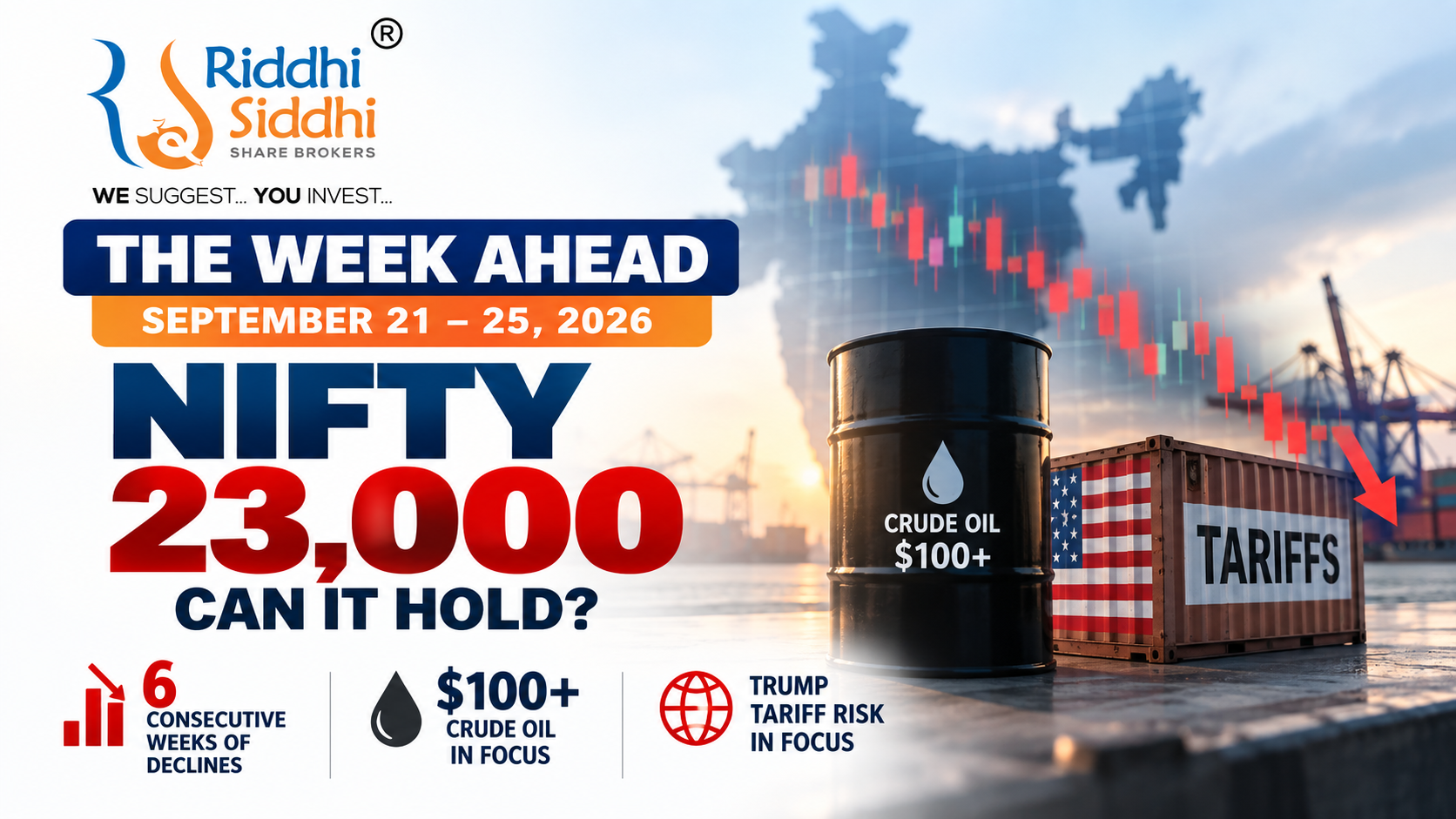
Riddhi Siddhi Share Brokers presents The Week Ahead for September 21–25, 2026, covering the key global and domestic triggers, Nifty and Bank Nifty levels, sector outlook, stocks in focus and our Stock of the Week.
Indian equities enter the new week at an important crossroads.
The Nifty 50 closed Friday at 23,346.40, ending lower for the sixth consecutive week — its longest weekly losing streak since 2020.
Friday did bring some bargain buying, but the broader market continues to deal with a difficult combination of crude oil above $100, elevated US bond yields, foreign institutional selling, rupee pressure and tighter global monetary conditions.
And now another variable has entered the equation:
US tariff and sanctions risk.
A new US sanctions law targeting Russia’s energy sector gives President Donald Trump the authority to impose tariffs of up to 100% on major buyers of Russian oil and gas.
India, being a significant purchaser of Russian crude, naturally comes into focus.
Importantly, this should not be interpreted as an automatic 100% tariff having already been imposed on Indian exports. The eventual impact will depend on implementation, negotiations, exemptions and India’s response.
Nevertheless, for a market already navigating expensive crude and high global yields, it introduces another layer of uncertainty.
So, as Dalal Street enters a fresh week, one question becomes particularly important:
Can Nifty protect 23,000 — or will another global shock extend the six-week losing streak?
RIDDHI SIDDHI MARKET VIEW | TRUMP TARIFF RISK RETURNS
Tariffs make dramatic headlines.
But their impact on Indian companies will not necessarily be uniform.
The consequences can vary substantially depending on a company’s US exposure, product mix, margins, pricing power, supply chain and ability to pass additional costs to customers.
Here is Riddhi Siddhi Share Brokers’ sector-wise view of the potential impact.
1. IT SERVICES | LIMITED DIRECT TARIFF IMPACT, BUT WATCH US SPENDING
Traditional customs tariffs primarily apply to physical goods.
Indian IT companies such as TCS, Infosys, HCLTech and Wipro therefore do not face the same direct merchandise-tariff exposure as exporters of physical products.
The larger risk is indirect.
If escalating trade tensions weaken US economic activity or corporate profitability, American companies could become more cautious about discretionary technology expenditure.
For Indian IT companies, therefore, the variables to watch include:
- US economic growth
- Technology budgets
- Deal conversion
- Client discretionary spending
- US bond yields
- USD/INR
A weaker rupee can provide some currency support to exporters, but that benefit may not fully compensate for a significant slowdown in client spending.
2. PHARMACEUTICALS | DEFENSIVE CHARACTERISTICS, BUT POLICY RISK REMAINS
India has substantial exposure to the US pharmaceutical and generics market.
Healthcare and pharma can display defensive characteristics during broader market volatility, but investors should distinguish between domestic-focused companies and businesses with substantial US exposure.
Any future change in US trade policy affecting pharmaceutical imports could create uncertainty around pricing, supply chains and margins.
Companies with diversified markets, differentiated products or manufacturing closer to end customers could potentially be positioned differently from businesses heavily dependent on commoditised exports.
The takeaway:
Pharma may remain relatively defensive, but US trade-policy headlines still need to be monitored carefully.
3. TEXTILES, GEMS & JEWELLERY AND LEATHER | AMONG THE MOST SENSITIVE
This is where tariff risk can become much more direct.
Many businesses in these industries operate on relatively thin margins and depend heavily on export competitiveness.
A meaningful additional tariff can create three possible outcomes:
- Exporters absorb part of the cost, hurting margins.
- US customers absorb it, potentially reducing demand.
- Buyers redirect orders toward countries with a more favourable tariff structure.
For labour-intensive Indian exporters, therefore, the final tariff position of competitors such as Vietnam and Bangladesh can matter almost as much as India’s own tariff rate.
These sectors deserve close monitoring if India-US trade tensions intensify.
4. AUTO ANCILLARIES, ENGINEERING & METALS | CONTRACT STRUCTURE MATTERS
Indian manufacturers exporting auto components, forgings, engineering products, steel and aluminium to the US could also face pressure.
However, the impact can differ considerably between companies.
Businesses supplying specialised components or operating under long-term contracts may have greater ability to negotiate price increases.
Commodity-oriented exporters with limited differentiation could find it harder to pass higher costs to customers.
This is therefore a stock-specific story rather than a simple sector-wide call.
COULD INDIA ALSO BENEFIT FROM GLOBAL TRADE REALIGNMENT?
There is another side to the tariff story.
If US trade barriers against competing manufacturing countries remain substantially higher than those ultimately applicable to India, the global China+1 supply-chain diversification trend could continue creating opportunities for Indian manufacturers.
Potential long-term beneficiaries could emerge across:
- Electronics manufacturing
- Specialty chemicals
- Engineering goods
- Auto components
- Industrial manufacturing
- Select textiles
- Contract manufacturing
Tariffs therefore should not automatically be interpreted as universally negative for India.
Relative competitiveness matters.
The eventual impact will depend partly on where India stands compared with competing exporting nations after negotiations and exemptions are known.
HOW TARIFF RISK CAN REACH DALAL STREET
The transmission mechanism is important.
Tariff uncertainty
↓
Global risk aversion
↓
FII/FPI selling
↓
Rupee pressure
↓
Imported inflation
↓
Margin and earnings uncertainty
↓
Pressure on equity valuations
Foreign institutional behaviour will therefore remain one of the most important indicators during the week.
Domestic institutional investors have continued to provide an important counterweight to foreign selling.
But if global yields remain elevated and the dollar stays strong, FII/FPI flows could continue influencing short-term market sentiment.
CRUDE ABOVE $100 | INDIA’S OTHER BIG CHALLENGE
Tariffs are not the only concern.
Brent crude remained above the psychologically important $100-per-barrel level during the past week.
For an oil-import-dependent economy such as India, persistently expensive crude can influence:
- Inflation
- Import costs
- Current-account dynamics
- Rupee
- Government finances
- Fuel-sensitive industries
- Corporate margins
- RBI policy expectations
Crude and the rupee should therefore not be viewed as two isolated market indicators.
The relationship can broadly work like this:
Crude rises
↓
India’s import bill can rise
↓
Dollar demand can increase
↓
Rupee can weaken
↓
Imported inflation can increase
↓
Corporate margins and interest-rate expectations can be affected
Riddhi Siddhi Share Brokers recently analysed this relationship in detail:
Crude Oil Above $100, Rupee Above ₹95: What It Means for Nifty, Inflation & Indian Stocks
For Dalal Street, sustained cooling in crude would be one of the most constructive developments that could emerge during the coming week.
US BOND YIELDS | WHY 5% MATTERS TO INDIA
Another major global variable is the US bond market.
The benchmark US 10-year Treasury yield has moved above the 5% mark, changing the relative risk-reward equation for global investors.
Why should an Indian equity investor care?
Because when relatively low-risk US government securities offer higher yields, international investors can reassess how much additional risk they are willing to accept in emerging-market equities.
The transmission can broadly work like this:
Higher US Treasury yields
↓
US assets become relatively more attractive
↓
Global capital allocation changes
↓
Dollar strength
↓
FII/FPI pressure
↓
Rupee pressure
↓
Equity valuation pressure
For a deeper explanation, read our analysis:
US Bond Yields Hit 5%: Why Rising US Treasury Yields Matter for Nifty & Indian Stocks
The important point is that US yields do not determine Nifty’s direction on their own.
Corporate earnings, valuations, domestic flows, crude oil, the rupee and economic growth all matter.
But a 5% US 10-year yield is too important for Indian investors to ignore.
FED RATE HIKE | GLOBAL LIQUIDITY REMAINS TIGHT
The US Federal Reserve raised interest rates by 25 basis points during the past week.
For Indian equities, the issue is not simply one rate hike.
Markets will now evaluate:
- How long US interest rates remain elevated
- Whether inflation permits future easing
- The direction of US Treasury yields
- Dollar strength
- Foreign capital flows into emerging markets
The combination of high US yields + expensive crude is particularly challenging for an oil-importing emerging economy such as India.
US–CHINA TALKS | SEPTEMBER 24 IN FOCUS
Another major international event arrives during the week.
Investors will closely track developments around the expected September 24 meeting between US President Donald Trump and Chinese President Xi Jinping.
Trade and tariffs will naturally command attention, but markets should also watch developments concerning:
- Critical minerals and rare earths
- Technology restrictions
- Artificial intelligence
- Energy
- Agricultural trade
- Sanctions
- Global supply chains
Ahead of the leaders’ meeting, US Treasury Secretary Scott Bessent and Chinese Vice Premier He Lifeng are also holding talks covering trade, AI and critical minerals.
Any constructive progress could improve Asian risk sentiment.
Conversely, renewed trade confrontation could increase volatility across global equity and commodity markets.
INDIA MACRO WATCH | WHAT DALAL STREET SHOULD TRACK
Domestic economic data should not be ignored amid the international headlines.
India’s August infrastructure/core-sector output will be among the important domestic data points to track.
Investors should particularly watch trends across:
- Electricity
- Steel
- Cement
- Coal
- Refinery products
- Natural gas
- Crude oil
- Fertilisers
The numbers can provide an early indication of underlying industrial momentum.
NSE IPO | A HISTORIC WEEK FOR INDIAN CAPITAL MARKETS
The NSE IPO will remain one of the biggest domestic market events of the week.
The issue closes on Monday, September 21, while the listing is planned on the BSE for Thursday, September 24.
The IPO had already been fully subscribed by its second day, demonstrating substantial investor interest.
Rather than repeating our entire IPO analysis here, readers can follow Riddhi Siddhi Share Brokers’ existing coverage:
NSE IPO Subscription Status, GMP & Anchor Demand
The listing will be watched for much more than potential listing-day returns.
It could establish an important new valuation benchmark for India’s capital-market ecosystem.
IPO WATCH | ELEVATE CAMPUSES
Another primary-market issue to watch during the week is Elevate Campuses IPO.
Issue Size: ₹2,100 crore
Price Band: ₹343–₹362 per share
IPO Opens: September 23, 2026
IPO Closes: September 25, 2026
Expected Allotment: September 28, 2026
Tentative Listing: September 30, 2026
With substantial capital being directed toward primary markets, investors should also watch whether heavy IPO activity temporarily affects liquidity available in the secondary market.
RIDDHI SIDDHI CALL OF THE WEEK | EXPECT VOLATILITY TO REMAIN ELEVATED
Nifty has now declined for six consecutive weeks — its longest weekly losing streak since 2020.
The positive side is that repeated weakness can create oversold conditions and the possibility of sharp relief rallies.
The negative side is equally important:
Oversold does not automatically mean the trend has reversed.
A sustainable recovery requires confirmation through price action, market breadth and institutional participation.
RIDDHI SIDDHI VIEW | WHAT BULLS NEED
For a more sustainable recovery, bulls would ideally want to see:
- Brent crude cooling decisively from above $100.
- De-escalation in geopolitical tensions.
- US bond yields retreating from elevated levels.
- Improvement in FII/FPI flows.
- A stable-to-stronger rupee.
- Nifty reclaiming important resistance levels with broader market participation.
Until some of these variables improve, sharp rebounds should not automatically be interpreted as confirmation of a new uptrend.
RIDDHI SIDDHI GYAN MANTRA | PROTECT CAPITAL FIRST
Periods of high volatility frequently create attractive-looking prices, but attempting to catch every market bottom can be expensive.
Avoid excessive leverage, respect stop losses and differentiate between:
A cheap stock.
A temporarily oversold stock.
A fundamentally broken stock.
They are not the same thing.
RIDDHI SIDDHI NIFTY OUTLOOK | SEPTEMBER 21–25, 2026
Nifty CMP: 23,346
Support: 23,000 / 22,722
Resistance: 23,651 / 24,000
Expected Range: 23,103–23,522
200 DMA: 24,487
Nifty PCR: 0.99
Bias: Neutral
The options market indicates a broad expected zone of approximately 22,500–24,000.
Maximum Call Open Interest is concentrated around 24,000, followed by the 24,500 strike, making 24,000 an important overhead resistance zone.
Maximum Put Open Interest stands around 23,000, followed by 24,000.
Call writing has been visible around 24,000 and 23,800, while Put writing has emerged around 23,500–23,600.
The message from the derivatives market is relatively clear:
23,000 is the level bulls cannot afford to surrender easily.
The broader 23,000–23,100 region is also significant from a price-action perspective.
A sustained break below this area could strengthen the prevailing bearish structure.
On the upside, Nifty first needs to negotiate 23,600–23,700 before a more meaningful attempt toward 24,000 becomes technically credible.
RIDDHI SIDDHI BANK NIFTY OUTLOOK | SEPTEMBER 21–25, 2026
Bank Nifty CMP: 56,359
Support: 55,750 / 54,000
Resistance: 57,500 / 59,000
Expected Range: 55,800–57,488
200 DMA: 57,309
Bank Nifty PCR: 0.96
Bias: Neutral
Bank Nifty remains around an important technical zone.
The 57,300–57,500 region is particularly important on the upside.
A sustained recovery above this area could improve the technical structure.
On the downside, 55,750 remains the immediate level to monitor. A decisive break could expose the index to deeper support levels.
RIDDHI SIDDHI PREFERRED TRADING VIEW FOR THE WEEK
NIFTY | CMP 23,346
Trading View: Bearish below resistance / Sell-on-rise approach
Initial Downside Levels: 23,000 / 22,722
Aggressive Downside Zone: 22,260–22,300
Risk-Control Level: 23,675
This is a technical trading framework and not an assurance of market direction.
Position sizing and risk management remain critical, particularly in a market being influenced simultaneously by crude oil, global rates and geopolitical headlines.
RIDDHI SIDDHI SECTOR OUTLOOK | SECTORS TO WATCH THIS WEEK
RELATIVELY STRONG / BULLISH WATCH
REALTY
Recent price action has shown relative strength, although the sector remains sensitive to interest rates and liquidity conditions.
HEALTHCARE
Defensive characteristics can become valuable during periods of elevated broader-market volatility.
PHARMA
Recent relative performance remains constructive, although investors should continue monitoring US trade-policy developments for export-oriented companies.
RELATIVELY WEAK / BEARISH WATCH
FMCG
Consumption trends and valuations warrant greater selectivity.
AUTO
Global trade uncertainty, input costs and uneven demand can create stock-specific pressure.
ENERGY
High crude creates very different outcomes for producers, refiners and downstream companies. The sector therefore requires a selective approach.
IT
Direct merchandise-tariff exposure may be limited, but US growth, technology spending, bond yields and currency movements remain important variables.
RIDDHI SIDDHI STOCKS IN FOCUS | BULLISH & BEARISH WATCHLIST
BULLISH WATCHLIST
ADANIPORTS | AUBANK | BAJFINANCE | BHARATFORG | BDL | BAJAJFINSV
BEARISH WATCHLIST
TCS | LTIM | MARUTI | TITAN | HCLTECH | VOLTAS | TATAELXSI | DIXON | TORNTPHARM | PERSISTENT | BOSCHLTD
These stocks are being highlighted from a market/technical perspective and should not be interpreted as unconditional buy or sell recommendations.
RIDDHI SIDDHI STOCK OF THE WEEK | R R KABEL LIMITED
Oversold Conditions Meet a Structural Growth Story
R R Kabel Ltd.
CMP: ₹2,451
52-Week High/Low: ₹2,984 / ₹1,180
P/E: 45.30
EPS (TTM): ₹53.16
Book Value: ₹228
Market Capitalisation: approximately ₹27,725 crore
Preferred Strategy
Action: BUY / ACCUMULATE ON DECLINES
Preferred Accumulation Zone: ₹2,300–₹2,325
Immediate Targets: ₹2,663 / ₹2,777
Medium-Term Target Zone: ₹3,000–₹3,051
Risk-Control Level: ₹2,139
Investment Horizon: 9–12 Months
Risk Profile: Moderate–High
R R KABEL | THE BUSINESS
R R Kabel is an Indian consumer electrical-products company with an operating history spanning more than 25 years.
Part of RR Global, the company has evolved from primarily being a wires-and-cables manufacturer into a broader electrical-products business.
Its investment story can broadly be divided into two businesses.
1. WIRES & CABLES | THE CORE EARNINGS ENGINE
Wires & Cables remain the company’s principal business and an important contributor to revenue and profitability.
Its products serve residential, commercial, industrial and infrastructure applications.
The structural demand opportunity is supported by several long-duration themes:
- Housing construction
- Urbanisation
- Power transmission and distribution
- Renewable-energy infrastructure
- Industrial capex
- Data centres
- Railways and infrastructure
- Replacement demand
- Premiumisation in residential electrical products
This makes the segment central to the R R Kabel investment thesis.
2. FMEG | BUILDING THE NEXT GROWTH ENGINE
R R Kabel has also expanded into Fast-Moving Electrical Goods (FMEG).
Its portfolio includes:
- Fans
- Lighting
- Switches
- Switchgear
- Appliances
- Other consumer electrical products
The opportunity is significant because the company can leverage its existing electrical distribution network and brand.
Execution, however, remains important.
FMEG needs to achieve adequate scale and improve profitability over time for the business to become a meaningful second earnings engine.
BRAND, DISTRIBUTION & EXPORT PRESENCE
Distribution is a major competitive advantage in India’s electrical-products industry.
R R Kabel has developed a sizeable domestic distribution presence while simultaneously building an international business.
The company states that its wires and cables are exported to more than 90 countries.
Its products also carry multiple international certifications.
That gives R R Kabel an interesting combination of:
Domestic structural growth + Export opportunity.
MANUFACTURING & CAPACITY EXPANSION
R R Kabel has manufacturing facilities across multiple Indian locations, including:
Silvassa | Waghodia | Bengaluru | Roorkee | Gagret
Capacity expansion is particularly relevant to the next phase of the company’s growth.
R R Kabel has commenced commercial production at its Silvassa Unit 3, initially unlocking approximately 12,000 MT of capacity toward planned annual capacity of approximately 18,000 MT.
For investors with a 9–12 month horizon, this deserves close attention.
Capacity itself does not create shareholder value.
The real test is whether additional capacity converts into:
Higher volumes
↓
Better capacity utilisation
↓
Revenue growth
↓
Operating leverage
↓
Sustainable earnings growth
Q1 FY27 | PROFITABILITY OUTPACES REVENUE
The most encouraging feature of R R Kabel’s recent performance has been the improvement in profitability.
Q1 FY27 reflected healthy growth in the core Wires & Cables business together with stronger operating leverage.
Q1 FY27 at a Glance
Revenue: ₹3,300+ crore
EBITDA: ₹300+ crore
PAT: ₹180+ crore
EBITDA Margin: 9%+
PAT Growth: approximately 129% YoY
The important point is not merely the absolute growth.
Profitability grew substantially faster than revenue.
If this operating leverage proves sustainable rather than temporary, it could materially strengthen the medium-term earnings case.
WHY WIRES & CABLES REMAIN THE BIGGEST POSITIVE
India is simultaneously investing in:
Housing + Power + Renewables + Manufacturing + Railways + Data Centres + Urban Infrastructure
Almost every one of these themes requires substantial electrical infrastructure.
That creates a structural demand environment for organised wires-and-cables manufacturers.
Formalisation of the industry and increasing consumer preference for branded electrical products can provide another long-term tailwind.
R R Kabel therefore does not depend on one single industry to generate growth.
It participates across several parts of India’s infrastructure, capex and electrification cycle.
COMPETITIVE POSITION
R R Kabel has established itself as one of India’s major organised Wires & Cables players.
However, investors should not assume that strong industry growth automatically translates into superior shareholder returns.
Competition is increasing.
Existing organised players already possess strong brands and distribution networks, while new entrants are committing substantial capital to the sector.
UltraTech’s announced entry into wires and cables is one example of the growing competitive interest in the industry.
That validates the size of the opportunity — but it also means competitive intensity could increase.
R R KABEL | KEY STRENGTHS
Established Operating History
More than two decades in the electrical-products industry.
Strong Wires & Cables Franchise
The core business participates directly in India’s infrastructure and electrification cycle.
Diversification into FMEG
Provides the potential for a second growth engine.
Manufacturing Footprint
Multiple manufacturing locations provide scale and product diversification.
International Reach
Exports to more than 90 countries.
Capacity Expansion
Creates the platform for additional volume growth.
Operating Leverage
Recent profitability growth has materially outpaced revenue growth.
WHAT CAN GO WRONG? | KEY RISKS
No investment thesis is complete without understanding what could invalidate it.
1. VALUATION RISK
This may be the most important market risk.
A company can continue growing earnings while its share price underperforms if investors are no longer willing to pay the same valuation multiple.
Earnings growth and share-price returns are not the same thing.
2. COPPER & ALUMINIUM VOLATILITY
Copper and aluminium are important raw materials.
Sharp commodity-price movements can affect:
- Margins
- Inventory
- Working capital
- Pricing
- Cash flow
The company’s ability to manage and pass through raw-material changes therefore remains important.
3. COMPETITION
The wires-and-cables industry is attractive — and competitors know it.
Existing organised players remain aggressive while new entrants can intensify pricing, distribution and capacity competition.
4. CAPEX EXECUTION
Additional manufacturing capacity only creates value when demand exists and utilisation rises profitably.
Execution therefore needs to be monitored quarter by quarter.
5. FMEG EXECUTION
The consumer electrical opportunity is substantial, but building market share requires investment in branding, distribution and working capital.
Margins need to improve over time for FMEG to become a meaningful contributor to shareholder returns.
R R KABEL | 9–12 MONTH INVESTMENT FRAMEWORK
CMP: ₹2,451 — September 18 close
View: BUY / ACCUMULATE ON DECLINES
Preferred Accumulation Zone: ₹2,300–₹2,325
Immediate Targets: ₹2,663 / ₹2,777
Medium-Term Target Zone: ₹3,000–₹3,051
Risk-Control Level: ₹2,139
Investment Horizon: 9–12 Months
Risk Profile: Moderate–High
The thesis rests primarily on three factors:
Structural Wires & Cables demand
Capacity expansion
Improving operating leverage
The principal counterweights are valuation, raw-material volatility and rising competitive intensity.
RIDDHI SIDDHI MONDAY MORNING CHECKLIST | SEPTEMBER 21, 2026
Before taking a strong directional view on Monday, watch these indicators:
1. NIFTY 23,000–23,100
Does this important support zone continue attracting buyers?
2. NIFTY 23,600–23,700
Can the index reclaim its immediate resistance zone?
3. BRENT CRUDE
Does crude remain above $100 or begin cooling decisively?
4. US 10-YEAR TREASURY YIELD
Do elevated US yields continue putting pressure on global risk assets?
5. USD/INR
Further rupee weakness could increase India’s macro pressure.
6. FII/DII ACTIVITY
Does domestic institutional buying continue absorbing foreign selling?
7. MARKET BREADTH
A sustainable recovery requires participation beyond a handful of index heavyweights.
8. BANK NIFTY
Watch 55,750 on the downside and approximately 57,300–57,500 on the upside.
9. NSE IPO
Final subscription figures and institutional demand will remain in focus ahead of the September 24 listing.
10. US TARIFF / RUSSIA SANCTIONS DEVELOPMENTS
Implementation details will matter considerably more than reacting to the headline maximum tariff number.
RIDDHI SIDDHI WEEK AHEAD | THE BOTTOM LINE
The week of September 21–25, 2026 begins with Indian equities caught between increasingly attractive prices and an unusually complicated global environment.
Nifty has already declined for six consecutive weeks.
That creates the possibility of a relief rally.
But the index remains below important resistance levels, foreign investors remain cautious, crude is above $100, US Treasury yields are elevated and a fresh US sanctions/tariff risk has entered the equation.
Riddhi Siddhi Share Brokers will be watching four variables particularly closely:
NIFTY 23,000 | CRUDE OIL | US BOND YIELDS | FII FLOWS
Add the September 24 US–China meeting and NSE listing to that mix, and investors should prepare for another potentially eventful week.
Our approach remains simple:
Do not predict first and manage risk later.
Manage risk first and let the market confirm the direction.
For investors, volatility can create opportunities in fundamentally strong businesses.
For traders, however, capital protection, disciplined position sizing and respect for stop losses remain paramount.
RIDDHI SIDDHI SHARE BROKERS | ASSISTED TRADING / TRADE EXECUTION SUPPORT
Too busy to track the market throughout the day?
Markets can change quickly when global news, crude oil, institutional flows and technical levels are moving simultaneously.
Explore Assisted Trading / Trade Execution Support from Riddhi Siddhi Share Brokers for eligible investors who may require execution support during market hours.
WhatsApp: +91 99875 53455
Riddhi Siddhi Share Brokers
We Suggest… You Invest.
DISCLAIMER
Riddhi Siddhi Share Brokers is an NSE & BSE Authorised Person.
The investments and trading ideas discussed in market analysis, educational articles and other content may not be suitable for all investors. Nothing contained in this article should be construed as an assurance of returns or personalised investment advice.
Investments in securities markets are subject to market risks. Readers should independently evaluate the information and consult an appropriately registered market intermediary/adviser according to their investment objectives, risk profile and financial circumstances before investing or trading.
Derivatives and leveraged trading involve substantial risk and may result in significant losses. Historical performance, technical levels, targets and market observations do not guarantee future results.
Registration granted by SEBI and certification from NISM in no way guarantee performance of an intermediary or provide any assurance of returns to investors.
Investors must make their own investment decisions based on their specific investment objectives, financial position and risk appetite after appropriate due diligence.