
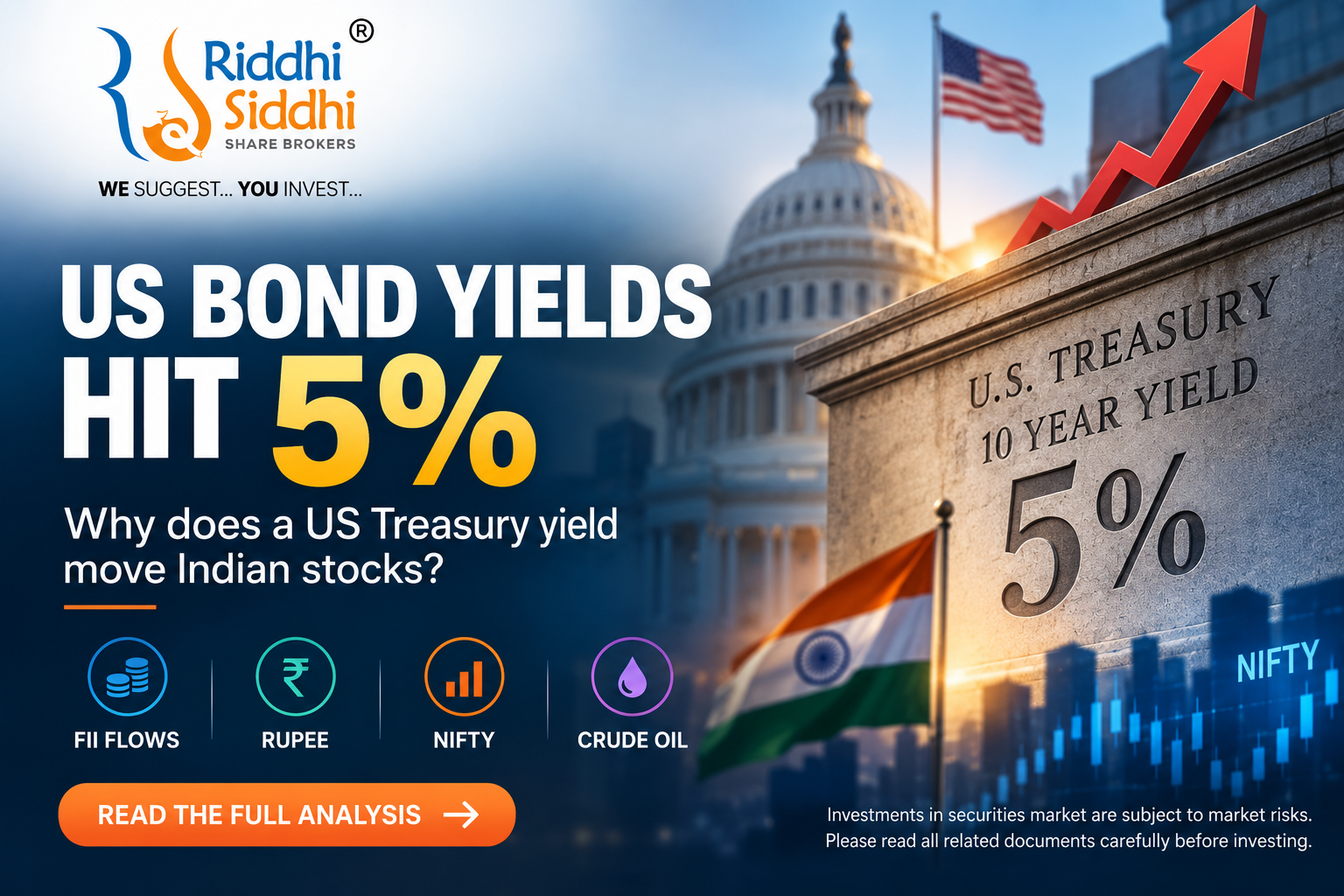
A number in the US bond market has suddenly become important for Indian investors again:
5%.
The benchmark 10-year US Treasury yield has crossed the 5% mark, reaching its highest level since October 2023.
At first glance, this may appear to have little connection with an investor holding Indian shares or mutual funds.
After all, what does the interest rate on a US government bond have to do with Nifty, foreign investor flows or the Indian rupee?
Quite a lot.
The impact of US bond yields on the Indian stock market travels through several interconnected channels:
US Treasury Yields ↑ → Relative Attractiveness of US Assets ↑ → Global Capital Allocation Changes → Dollar Strength → FII/FPI Flows → Rupee Pressure → Equity Valuations
And the present situation is particularly interesting because several macroeconomic pressures have arrived together.
The US 10-year Treasury yield has crossed 5%.
Brent crude is hovering around $108 per barrel.
The Indian rupee is trading close to ₹96 against the US dollar.
And global investors are awaiting the US Federal Reserve’s September policy decision.
For Indian investors, understanding how these variables interact may be far more useful than simply reacting to another day’s rise or fall in the Nifty.
US Bond Yields Impact on Indian Stock Market — The Simple Explanation
Let us start with the most basic question.
What exactly is a US Treasury yield?
The US government borrows money by issuing Treasury securities.
The yield represents, broadly speaking, the return investors can earn by holding those securities, depending on their purchase price and maturity.
US Treasuries occupy an unusually important position in global finance because they are widely treated as a benchmark for relatively low-risk dollar-denominated returns.
This creates an important comparison for global investors.
Imagine an international fund deciding where to allocate its capital.
It can invest in:
- US government bonds,
- US equities,
- Indian equities,
- other emerging markets,
- corporate bonds,
- commodities, or
- numerous other assets.
When the yield available from US government securities rises significantly, the relative attractiveness of riskier assets can change.
At a 3% Treasury yield, an investor may be willing to accept substantially greater risk elsewhere to pursue a higher return.
At 5%, that calculation can look different.
This does not mean investors automatically sell Indian equities whenever Treasury yields rise.
But the hurdle for taking additional risk can become higher.
Why Is a 5% US 10-Year Treasury Yield Important?
The significance is not simply the number 5.
The benchmark 10-year US Treasury yield moved above 5% in September 2026, reaching levels last seen in October 2023.
Several factors can influence Treasury yields, including:
- inflation expectations,
- Federal Reserve policy expectations,
- economic growth,
- government borrowing,
- fiscal concerns,
- supply and demand for bonds, and
- investors’ expectations for future interest rates.
The reason behind a rise in yields matters.
For example, yields rising because economic growth is exceptionally strong may have different implications from yields rising because investors are worried about persistent inflation or government borrowing.
That is why investors should avoid the simplistic conclusion:
US yield rises = Nifty must fall.
Markets rarely work through one variable alone.
How Rising US Bond Yields Can Affect FII/FPI Flows in India
This is one of the most important connections for Indian equity investors.
Foreign investors constantly compare expected returns across countries and asset classes.
Indian equities potentially offer:
Economic Growth + Corporate Earnings Growth + Capital Appreciation
But they also involve:
Equity Risk + Emerging-Market Risk + Currency Risk + Valuation Risk
US Treasury securities offer a very different risk-return proposition.
When US Treasury yields rise materially, global investors can earn higher yields on dollar-denominated government securities without taking equity-market risk.
The relative equation can therefore change.
Higher US Yield
↓
US Assets Become Relatively More Attractive
↓
Emerging-Market Risk Premium Is Reassessed
↓
Some Global Capital May Move Towards Dollar Assets
↓
FII/FPI Flows Into Markets Such as India Can Come Under Pressure
Notice the words “can” and “may.”
Foreign flows do not depend on Treasury yields alone.
Indian corporate earnings, valuations, domestic economic growth, political and geopolitical risk, crude oil, currency expectations and opportunities available in competing markets all matter.
India also has substantial domestic institutional and retail participation, meaning foreign flows are important—but they are not the only source of market liquidity.
Why US Bond Yields Can Put Pressure on the Indian Rupee
There is another important transmission mechanism.
The dollar.
Higher US interest rates and bond yields can increase demand for dollar-denominated assets.
If global capital moves towards the US, demand for dollars can strengthen.
For India, this becomes particularly relevant when another pressure is simultaneously operating:
Expensive crude oil.
India imports a significant amount of the crude oil it consumes, and international oil transactions generally create demand for foreign currency.
The broad chain can therefore look like this:
US Yields ↑ → Dollar Demand ↑ → Rupee Pressure
At the same time:
Crude Oil ↑ → India’s Import Bill ↑ → Dollar Demand From Importers ↑ → Additional Rupee Pressure
This is why the combination of high US Treasury yields and expensive crude can become considerably more important for India than either variable viewed independently.
The rupee has recently traded near ₹96 to the US dollar, while the Reserve Bank of India has intervened in the foreign-exchange market to moderate currency pressure.
For a deeper explanation of the oil-currency relationship, read our earlier analysis:
Crude Oil Above $100, Rupee Above ₹95: What It Means for Nifty, Inflation & Indian Stocks
How Higher US Bond Yields Can Affect Indian Stock Valuations
Foreign flows are only part of the story.
Bond yields also matter because investors value financial assets partly by comparing expected future returns.
A company’s share price reflects expectations about profits and cash flows that may be generated many years into the future.
When the return available from relatively lower-risk assets rises, investors may demand a higher expected return for accepting equity risk.
That can put pressure on the valuation multiples investors are willing to pay.
This can be particularly relevant for companies where a large part of today’s valuation depends on expectations of profits far into the future.
In simplified terms:
Risk-Free/Benchmark Yields ↑ → Required Equity Return Can Rise → Valuation Multiples Can Face Pressure
Again, this is a framework—not a prediction.
Exceptional earnings growth can sometimes outweigh the impact of higher yields.
Which Indian Sectors Can Be More Sensitive to Rising US Yields?
Rather than assuming an entire sector must rise or fall, investors should examine the underlying characteristics of individual businesses.
1. High-Valuation Growth Companies
Businesses trading at very high multiples can be more sensitive to changes in discount rates because a significant portion of their valuation may depend on future growth.
2. Highly Leveraged Companies
Companies carrying substantial debt can become more vulnerable if global and domestic borrowing costs remain elevated.
3. Import-Dependent Businesses
Companies relying heavily on imported raw materials may face additional pressure if rising US yields coincide with a weaker rupee.
4. Companies With Foreign-Currency Borrowings
A weaker rupee can increase the rupee value of unhedged foreign-currency liabilities.
5. Rate-Sensitive Businesses
If global yields influence domestic bond yields and monetary-policy expectations, financial conditions can eventually affect rate-sensitive sectors.
But currency weakness can have a different effect on some exporters.
Companies earning a substantial portion of revenue in dollars may receive a translation benefit when those earnings are converted into rupees.
The actual effect depends on hedging, costs, overseas expenses, competitive conditions and individual business models.
That is why company-level analysis remains more useful than blanket sector conclusions.
US Bond Yields vs Crude Oil: Which Is the Bigger Risk for India?
This is where the present market environment becomes particularly interesting.
The two variables affect India through somewhat different channels.
Higher US Treasury Yields
Primarily influence:
Global Capital → Dollar → FII/FPI Flows → Currency → Discount Rates → Equity Valuations
Higher Crude Oil
Can influence:
Import Bill → Dollar Demand → Rupee → Inflation → Corporate Costs → Consumer Spending → RBI Policy
Now combine them:
US Treasury Yield Near/Above 5%
Brent Crude Around $108
Rupee Near ₹96/$
Federal Reserve Policy Uncertainty
That combination can create several simultaneous pressure points for Indian financial markets.
This is also why looking only at the Nifty level can sometimes hide what is happening underneath the market.
Where Does RBI Fit Into This Picture?
The Reserve Bank of India becomes relevant through both currency management and domestic liquidity conditions.
RBI can intervene in the foreign-exchange market when currency movements become disorderly.
But foreign-exchange intervention can itself affect domestic banking liquidity.
For example:
RBI Sells Dollars → Banks Pay RBI Rupees → Rupee Liquidity Can Be Absorbed
Interestingly, RBI has simultaneously been dealing with unusually high banking-system liquidity during September.
We recently explained this in detail in:
Understanding the interaction between global bond yields, currency intervention and domestic liquidity gives investors a much broader picture than watching the repo rate alone.
What Does the Federal Reserve Have to Do With All This?
A lot.
Bond markets continuously attempt to anticipate what the Federal Reserve may do next.
If investors believe inflation will remain persistent and US interest rates will need to stay high—or rise further—Treasury yields can respond.
If inflation expectations moderate or monetary policy is expected to become easier, yields can move in the opposite direction.
But there is another important lesson.
Markets react to the difference between expectations and reality.
If virtually everyone expects a particular Federal Reserve decision, that outcome may already be substantially reflected in asset prices.
The bigger market reaction can occur when:
Actual Fed Outcome ≠ What Markets Had Priced In
That is why investors should monitor not only the headline interest-rate decision but also:
- the Fed’s economic projections,
- inflation expectations,
- the dot plot,
- commentary on future rates, and
- the bond market’s reaction after the announcement.
Our current weekly market analysis examines these triggers in greater detail:
The Week Ahead: Fed Decision, NSE IPO, Crude Oil & NYKAA in Focus | September 14–18, 2026
Does a 5% US Treasury Yield Mean Indian Stocks Will Fall?
No.
This is perhaps the most important point in this article.
Financial markets are multi-variable systems.
Indian equities ultimately respond to a combination of:
Corporate Earnings + Valuations + Domestic Growth + Interest Rates + Inflation + FII/FPI Flows + Domestic Flows + Currency + Crude Oil + Global Risk Sentiment
US Treasury yields influence several of these variables.
But they do not control all of them.
India could potentially perform well even with elevated US yields if corporate earnings, economic growth and domestic liquidity remain strong enough.
Similarly, falling US yields do not guarantee that Indian equities will rise if domestic fundamentals deteriorate.
Investors should therefore treat Treasury yields as an important macro indicator, not a trading signal in isolation.
The Five-Indicator Dashboard Indian Investors Can Watch
Rather than trying to predict every global headline, investors can monitor five interconnected indicators:
1. US 10-Year Treasury Yield
Is the yield sustaining above 5%, moving higher or cooling?
2. Brent Crude Oil
For India, oil remains particularly important because of its impact on the import bill, inflation and currency.
3. USD/INR
Is the rupee stabilising or continuing to weaken?
4. Foreign Portfolio Flows
Are foreign investors consistently selling Indian equities or beginning to return?
5. Indian Government Bond Yields & RBI Liquidity
Are domestic financial conditions becoming tighter?
Together, these indicators provide far more context than watching Nifty alone.
What Does This Mean for Long-Term Investors?
Long-term investors should be careful not to convert every macroeconomic development into a portfolio action.
A Treasury yield crossing 5% is important.
But it does not automatically mean:
Sell equities.
Nor does a subsequent decline in yields automatically mean:
Buy equities.
For long-term wealth creation, factors such as asset allocation, diversification, investment horizon, valuations and consistency can be more important than attempting to predict every short-term move in bond markets.
For investors who prefer diversified market participation rather than selecting individual stocks, mutual funds can provide access to professionally managed portfolios across equity, debt and hybrid strategies, subject to the risks of the chosen scheme.
👉 Explore Mutual Funds and other investment services offered through Riddhi Siddhi Share Brokers
Investors should select mutual-fund categories and schemes according to their goals, investment horizon and risk profile rather than recent market movements alone.
Active Trader? Volatility Requires a Different Approach
For traders, the same environment has a different implication.
A combination of:
Federal Reserve Decision + 5% US Treasury Yield + $100+ Crude + Rupee Volatility + FII Flows
can create sharp movements in both directions.
This is precisely when leverage, position sizing and trading discipline become particularly important.
A strong market view can still result in a loss if position sizing or risk management is poor.
For investors and traders who prefer support in market execution and monitoring, Riddhi Siddhi Share Brokers also provides Assisted Trading Services.
👉 Know more about Assisted Trading Services at Riddhi Siddhi Share Brokers
Assisted Trading does not eliminate market risk, and returns are never guaranteed.
Listed Markets and Unlisted Markets Are Connected Too
Global interest rates are not relevant only to listed shares.
The cost of capital also influences how investors think about valuations in private markets, venture capital, pre-IPO companies and unlisted shares.
When relatively low-risk yields rise, investors may become more demanding about the valuation premium they are willing to pay for assets that involve:
- lower liquidity,
- longer holding periods,
- uncertain exit timelines, and
- greater valuation uncertainty.
This makes entry valuation particularly important in unlisted markets.
For readers interested in understanding India’s pre-IPO and unlisted-share ecosystem, explore the research and educational articles published by our associated private-market platform:
👉 VaultStreet Advisors — Unlisted Shares & Pre-IPO Insights
One recent real-world example is the valuation difference between NSE’s unlisted-market price and its IPO pricing:
👉 Bought NSE Unlisted Shares Above ₹2,000? What the ₹1,785 IPO Price Could Mean for Investors
The broader principle applies across listed and unlisted markets:
A Good Business and a Good Entry Price Are Two Different Questions.
Riddhi Siddhi’s View
The US 10-year Treasury yield crossing 5% deserves attention.
But the bigger story for Indian investors is not the 5% number by itself.
It is the interaction between:
US Treasury Yields
Crude Oil
Dollar/Rupee
Foreign Investor Flows
Federal Reserve Policy
RBI Liquidity
Corporate Earnings & Valuations
This is the chain investors should understand.
A movement in the American bond market can travel thousands of kilometres through global capital flows, currencies and valuation models before eventually influencing the price investors are willing to pay for an Indian company.
That does not make every movement predictable.
It makes the connections worth understanding.
Frequently Asked Questions
Why do rising US bond yields affect the Indian stock market?
Higher US Treasury yields can make dollar-denominated government securities relatively more attractive to global investors. This can affect international capital allocation, FII/FPI flows, the US dollar, the rupee and the valuation multiples investors are willing to pay for equities. However, Treasury yields are only one of many variables affecting Indian markets.
Do Indian stocks always fall when US bond yields rise?
No. Indian equities are also influenced by corporate earnings, economic growth, domestic institutional flows, valuations, crude oil, inflation, the rupee and monetary policy. Rising US yields can create pressure, but they do not mechanically determine Nifty’s direction.
Which Indian stocks are most affected by rising US bond yields?
There is no universal list. Sensitivity depends on factors such as valuation, leverage, foreign-currency borrowing, import dependence, interest-rate exposure and overseas revenue. Investors should analyse individual companies rather than assume every company within a particular sector will react similarly.
Why does the US 10-year Treasury yield matter so much?
The 10-year Treasury yield is an important global benchmark used in financial markets when assessing borrowing costs, asset valuations and the relative attractiveness of different investments. Large changes in the yield can therefore influence global capital allocation.
Can rising US yields weaken the Indian rupee?
They can contribute to rupee pressure if higher US yields strengthen demand for dollar-denominated assets or affect foreign capital flows. But USD/INR is influenced by many other variables, including crude oil, India’s trade flows, importer and exporter demand, RBI intervention and broader global currency movements.
Riddhi Siddhi Gyan Mantra
Don’t react to one number. Understand the chain connecting the numbers.
Markets rarely move because of one factor alone.
Understanding how US yields → dollar → FII flows → rupee → interest rates → valuations interact can help investors interpret market volatility with greater context.
Want Support With Your Investments?
Whether you are a long-term investor exploring Mutual Funds or an active market participant looking for Assisted Trading Services, explore the investment solutions available through Riddhi Siddhi Share Brokers.
👉 Explore Assisted Trading, Mutual Funds & Other Services
Riddhi Siddhi Share Brokers
We Suggest… You Invest.
Disclaimer
Riddhi Siddhi Share Brokers is an NSE & BSE Authorised Person of a leading broker. The information contained in this article is for educational and informational purposes only and should not be construed as investment advice, research advice or a recommendation to buy or sell any security.
Market investments are subject to risk. Equity and derivatives trading can result in significant losses. Mutual fund investments are subject to market risks; read all scheme-related documents carefully before investing. Historical performance does not guarantee future returns.
Readers should conduct their own research and consult an appropriately qualified or SEBI-registered investment adviser where required before making investment decisions.