
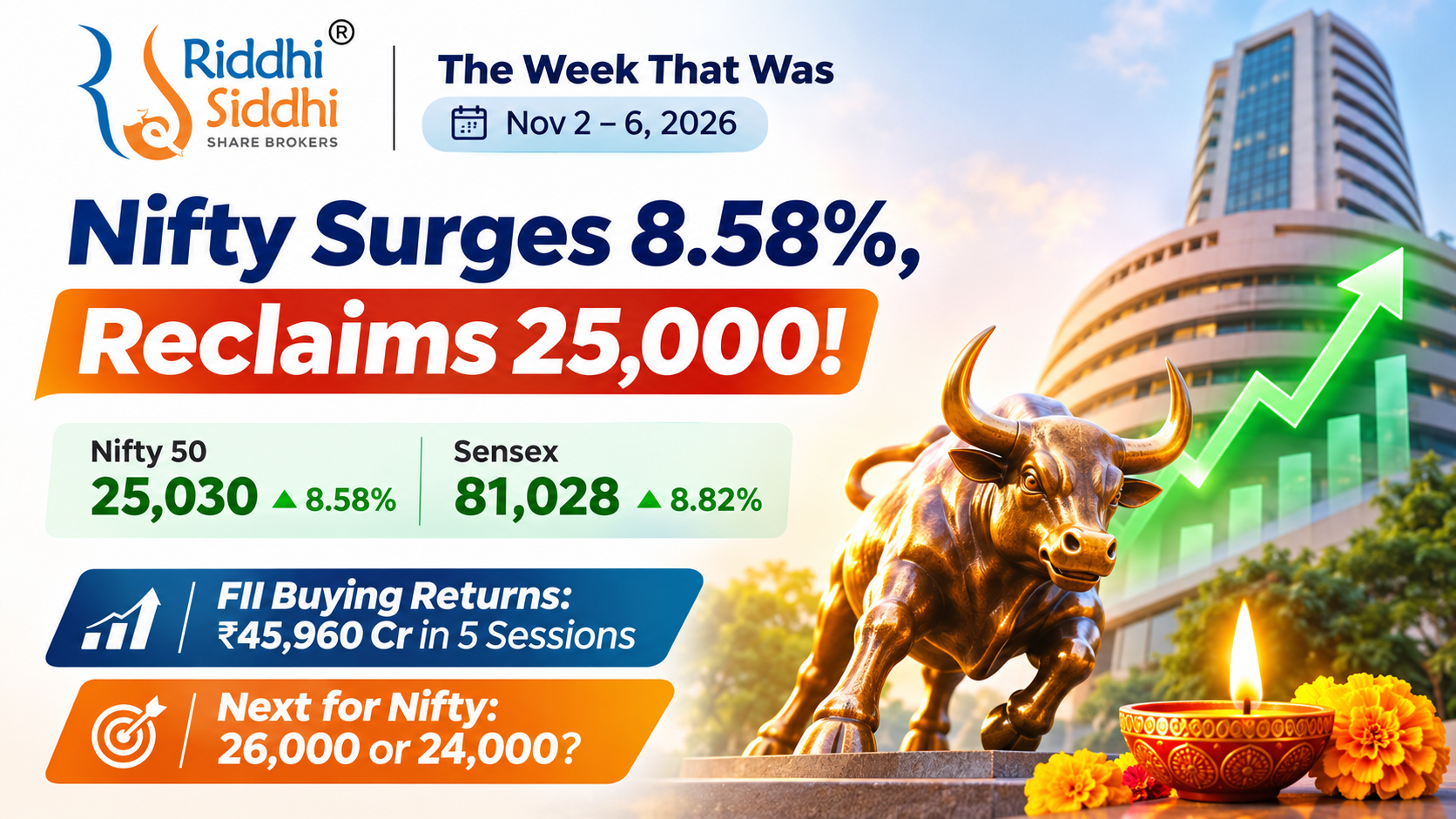
The Week That Was | November 2–6, 2026
Published: Saturday, November 7, 2026
By Riddhi Siddhi Share Brokers
Five trading sessions. Five consecutive gains. Nearly 2,000 Nifty points added.
Diwali celebrations arrived early on Dalal Street.
The Nifty 50 surged 8.58% to close at 25,030.35, while the Sensex jumped 8.82% to 81,028.02. Both benchmarks recorded their strongest weekly gains since February 2021.
Foreign investors returned as aggressive buyers, crude oil prices declined, the rupee strengthened, and banking, financial services, automobiles and real estate stocks participated in the recovery.
But something even more interesting happened.
Indian markets delivered an extraordinary rally during a week when global technology stocks were under pressure over artificial intelligence valuations and investment spending.
That divergence deserves attention.
Just a week earlier, investors were questioning whether Nifty could sustain 23,000. By Friday, the benchmark had reclaimed 25,000.
As highlighted in our previous weekly market review for October 26–30, 2026, elevated crude prices, foreign selling and weak market breadth were among the major concerns.
Within five sessions, several of those conditions changed dramatically.
The question now is whether this recovery represents the beginning of a more sustainable upward trend or whether markets need time to consolidate after such a sharp advance.
In this edition of The Week That Was, Riddhi Siddhi Share Brokers examines the market’s performance, institutional flows, sector rotation, important stocks, global developments and the events investors should monitor during November 8–13, 2026.
1. Indian Stock Market Weekly Performance: November 2–6, 2026
Indian equities delivered an exceptional weekly performance, with strong gains across major benchmark and sectoral indices.
| Index | November 6 Close | Weekly Change |
|---|---|---|
| Nifty 50 | 25,030.35 | +8.58% |
| BSE Sensex | 81,028.02 | +8.82% |
| Bank Nifty | 59,086 | +8.04% |
| Nifty Midcap | — | +5.91% |
| Nifty Smallcap | — | +2.77% |
| India VIX | 17.47 | +14.13% |
Market data: November 6, 2026. Weekly percentage changes compare with October 30. Midcap and smallcap returns are indicative of the respective indices in the supplied market summary; index variants should be distinguished when comparing data.
Nifty gained 1,977.25 points from its October 30 closing level of 23,053.10.
Sensex climbed approximately 6,568 points from 74,459.53 to 81,028.02.
The scale of the recovery was remarkable.
However, the India VIX also increased significantly, suggesting that expectations of market volatility remained elevated despite the rally.
Why the 25,000 milestone matters
The 25,000 level carries considerable psychological significance for Nifty.
Reclaiming a major round-number level after a sharp correction can influence market sentiment, particularly when accompanied by strong institutional flows.
But crossing a level and sustaining above it are two different things.
The next few sessions will help determine whether buyers can defend the gains or whether profit-booking emerges after the festive rally.
2. Dalal Street’s Five-Day Journey: From 23,441 to 25,030
| Trading Day | Nifty Close | Daily Gain |
|---|---|---|
| Monday, November 2 | 23,440.80 | +387.70 |
| Tuesday, November 3 | 23,810.85 | +370.05 |
| Wednesday, November 4 | 23,960.60 | +149.75 |
| Thursday, November 5 | 24,536.60 | +576.00 |
| Friday, November 6 | 25,030.35 | +493.75 |
Monday, November 2: Buyers return with confidence
Nifty gained nearly 388 points to close at 23,440.80.
The recovery reflected improving market sentiment as investors responded to falling crude oil prices and renewed interest in large-cap companies.
Reliance Industries and selected financial stocks helped support the advance.
Tuesday, November 3: The recovery gathers momentum
Nifty added another 370 points, closing at 23,810.85.
Institutional buying and improving expectations around global developments helped sustain the upward movement.
The index moved closer to 24,000, indicating that buying interest was extending beyond the initial rebound.
Wednesday, November 4: A slower but positive session
Nifty advanced approximately 150 points to 23,960.60.
The relatively modest gain suggested some consolidation after the sharp moves earlier in the week.
Nevertheless, the benchmark maintained its upward trajectory.
Thursday, November 5: The biggest advance of the week
Nifty jumped 576 points to close at 24,536.60.
Foreign institutional investors purchased approximately ₹14,975 crore in the cash market, providing significant support to sentiment.
Banking and financial stocks participated strongly as the market moved decisively above 24,500.
Friday, November 6: Nifty finally reclaims 25,000
Nifty gained another 493.75 points to settle at 25,030.35.
Sensex advanced approximately 1,718 points to close at 81,028.02.
Private-sector banks and other financial stocks were important contributors.
However, there was one development investors should not overlook.
Despite the strong benchmark performance, selected midcap and smallcap indices ended Friday in negative territory.
The lesson: A rising Nifty does not automatically mean every investor’s portfolio is rising.
That distinction becomes particularly important when a rally is concentrated in heavily weighted index constituents.
3. Foreign Institutional Investors Return: What Changed?
One of the most important developments during the week was the sharp improvement in foreign institutional investment flows.
According to the day-wise provisional cash-market figures:
| Date | FII Net Flow | DII Net Flow |
|---|---|---|
| November 2 | +₹3,115 Cr | −₹392 Cr |
| November 3 | +₹6,837 Cr | −₹3,679 Cr |
| November 4 | +₹7,284 Cr | −₹3,712 Cr |
| November 5 | +₹14,975 Cr | −₹10,445 Cr |
| November 6 | +₹13,750 Cr | −₹5,969 Cr |
| Weekly Total | +₹45,960 Cr | −₹24,197 Cr |
Figures are rounded from the day-wise provisional cash-market series. Final institutional statistics and alternative reporting classifications may differ.
Foreign investors were net buyers in each of the five sessions.
Domestic institutional investors, meanwhile, were net sellers.
Why is this important?
During the preceding months, persistent foreign selling had weighed on Indian equities.
Elevated crude oil prices, currency weakness, geopolitical uncertainty and valuation concerns had affected international investors’ appetite for Indian stocks.
November’s sharp buying reversal helped change that narrative.
Foreign demand can influence benchmark performance significantly, particularly when buying is concentrated in large banks and other heavily weighted companies.
But there is another side to the story.
Domestic institutions sold substantial amounts during the same period.
This suggests that institutional investors were not uniformly bullish.
Can FII buying continue?
That is now one of the most important questions for the market.
A sustained recovery would benefit from continued foreign participation, improving earnings expectations and wider buying across sectors.
If foreign flows reverse abruptly, the market could experience renewed volatility.
For investors, monitoring institutional flows is useful, but daily FII and DII figures should not be treated as standalone trading signals.
4. Why Did Indian Markets Rally While Global AI Stocks Struggled?
One of the week’s most interesting developments was the divergence between Indian equities and global technology shares.
Concerns surrounding artificial intelligence valuations, infrastructure spending and the returns on massive AI investments affected sentiment in overseas technology markets.
Indian equities, however, benefited from a different combination of factors.
India’s benchmark composition is different
The Nifty and Sensex have substantial exposure to financial services, energy, automobiles, consumer businesses and other sectors linked to domestic economic activity.
This differs from technology-heavy global benchmarks.
Consequently, weakness in overseas AI-related stocks does not necessarily translate into an equivalent decline in Indian benchmark indices.
Lower crude oil prices supported sentiment
India imports a substantial portion of its crude oil requirements.
Lower crude prices can reduce pressure on the country’s import bill and current account.
They may also help inflation expectations and support margins for businesses that depend heavily on energy or petroleum-based inputs.
However, the impact varies across industries.
Currency strength provided another positive signal
The rupee strengthened to approximately ₹93.91 against the US dollar by the end of the week, reaching its strongest level since April 2026.
Improving foreign flows and lower oil prices contributed to the currency’s recovery.
A stronger rupee can reduce imported inflation pressures, although it may create different outcomes for export-oriented businesses.
Is India becoming a relative beneficiary of global technology weakness?
It is possible that some international investors are reassessing capital allocation between expensive technology companies and markets offering different sector exposure.
However, one week of contrasting performance is insufficient to establish a permanent change in global investment preferences.
India remains exposed to international interest rates, geopolitical developments, capital flows and global economic conditions.
The week’s performance demonstrates relative resilience, not immunity from global risks.
5. Sector Performance: Realty, Autos and Financials Lead
The recovery extended across major sectoral indices.
| Sector | Weekly Performance |
|---|---|
| Nifty Financial Services | +10.41% |
| Nifty Realty | +10.17% |
| Nifty Auto | +9.40% |
| Nifty Private Bank | +9.06% |
| Nifty Bank | +8.04% |
| Nifty Metal | +7.58% |
| Nifty Infrastructure | +7.36% |
| Nifty FMCG | +7.28% |
| Nifty Energy | +5.46% |
| Nifty Pharma | +3.01% |
| Nifty Defence | +2.58% |
| Nifty Media | +2.41% |
| Nifty IT | +1.14% |
Financial services: The backbone of the recovery
Financial stocks were among the strongest performers.
Large private-sector banks benefited from renewed institutional buying, while the broader financial services index recorded double-digit weekly gains.
Given the weight of financial companies in India’s benchmark indices, this sector played a major role in lifting Nifty and Sensex.
Realty and automobiles: Domestic demand comes into focus
Real estate and automobile stocks also participated strongly.
Improving sentiment around domestic demand, financing conditions and business activity contributed to investor interest.
However, a rising sector index does not automatically indicate that every company within the sector has equally strong fundamentals.
Metals and infrastructure: Cyclical participation improves
Metal and infrastructure stocks recorded substantial gains.
Such participation can indicate improving investor appetite for economically sensitive businesses.
Nevertheless, commodity prices, input costs, global demand and project execution remain important considerations.
IT: Positive, but relatively weak
Nifty IT gained approximately 1.14%, significantly less than the broader benchmark.
This reflected the continuing uncertainty surrounding global technology spending and overseas demand.
The important distinction is that Indian IT service providers and global AI infrastructure companies operate under different business models and investment requirements.
What does sector rotation indicate?
All major sectors finishing positive is encouraging.
It suggests that the recovery was not confined to a single industry.
However, Friday’s weakness in some broader-market segments indicates that participation was not uniformly strong throughout the week.
Market breadth, valuations and earnings quality remain important.
6. Stocks in the Spotlight: Reliance, Banking and Consumer Businesses
Several prominent companies recorded strong weekly gains.
Major Nifty 50 gainers
| Company | Weekly Change |
|---|---|
| Shriram Finance | +16.76% |
| Bajaj Finance | +15.83% |
| Mahindra & Mahindra | +15.73% |
| HDFC Bank | +13.78% |
| Reliance Industries | +13.31% |
Reliance Industries
Reliance was among the week’s important contributors.
The company reported strong quarterly earnings, and its shares gained approximately 13.3%.
Given Reliance’s significant benchmark weight, the stock’s recovery contributed meaningfully to overall market performance.
HDFC Bank and ICICI Bank
Large private-sector banks attracted substantial buying interest.
The recovery in financial stocks was particularly important because institutional investors often use large, liquid banking shares when increasing exposure to Indian equities.
Bajaj Finance and Shriram Finance
Financial services companies also recorded strong advances.
Their performance highlighted renewed interest in the broader financial sector.
However, investors should continue assessing credit growth, asset quality, funding costs, margins and valuations.
Mahindra & Mahindra
M&M was another prominent weekly performer.
The automobile sector’s broader rally provided a supportive environment, although company-specific fundamentals and demand trends remain essential considerations.
Stocks that did not participate
Not every major company joined the rally.
| Company | Weekly Change |
|---|---|
| Power Grid | −1.92% |
| Infosys | −0.30% |
| TCS | −0.16% |
| Apollo Hospitals | −0.02% |
These differences demonstrate why investors should avoid treating benchmark performance as a reliable measure of individual portfolio returns.
A portfolio’s performance depends on stock selection, sector exposure, purchase valuations, allocation and risk management.
7. Global Markets, Crude Oil and Currency: The External Picture
The global environment remained mixed.
While Indian benchmarks advanced sharply, overseas technology stocks faced pressure.
Global market snapshot
| Indicator | Reported Weekly Change |
|---|---|
| Dow Jones | −0.94% |
| Nasdaq | −4.91% |
| Brazil Bovespa | +0.34% |
| Crude Oil | −13.23% |
| Gold | +5.02% |
| Silver | +6.09% |
Global and commodity figures are indicative of the supplied weekly market snapshot. Differences in benchmarks, contract selection, closing times and currency denominations can affect comparisons.
Crude oil: A major positive development for India
The decline in crude oil prices was one of the important changes in the global environment.
Lower energy costs can improve India’s external economic position.
However, the geopolitical situation remains uncertain, and crude prices can reverse quickly.
Gold and silver: Precious metals remain volatile
Gold and silver advanced during the week.
Precious metals respond to multiple influences, including interest rates, currency movements, geopolitical developments and investment demand.
Their performance should not be interpreted as a guaranteed indicator of future equity-market direction.
US elections: Greater clarity, but policy uncertainty remains
The November 2026 US midterm elections resulted in Democrats securing control of both chambers of Congress.
This provided clarity regarding congressional control, but investors still need to evaluate the implications for fiscal policy, trade, geopolitical relations and economic regulation.
Political outcomes can influence expectations without producing immediate or predictable market consequences.
8. Nifty Outlook: Will 26,000 Arrive Before 24,000?
After reclaiming 25,000, Nifty enters the festive trading period with considerably stronger short-term momentum.
But an 8.58% weekly advance also raises the possibility of consolidation or profit-booking.
Bullish scenario: Towards 25,500 and 26,000
If Nifty sustains above the 24,500–25,000 region and institutional buying continues, the market could attempt further advances.
The 25,500 and 26,000 levels become important upside reference points.
A sustained improvement in corporate earnings expectations and broader participation would strengthen this scenario.
The previous record region near 26,373 could become relevant if the recovery continues, but it should not be treated as an assured destination.
Bearish scenario: What could bring 24,000 back into focus?
A sharp reversal in foreign flows, higher crude prices, disappointing inflation data or renewed global risk aversion could trigger profit-booking.
A sustained move below 24,500 would weaken the immediate bullish interpretation.
Further weakness could bring the 24,000 region into focus.
Riddhi Siddhi Share Brokers’ market observation
The week’s price action has improved the near-term technical picture.
However, forecasting whether 26,000 or 24,000 will arrive first with certainty would be inappropriate.
The more useful approach is to identify conditions that support each scenario and monitor whether those conditions remain valid.
Market momentum has improved. Risk has not disappeared.
9. Muhurat Trading 2026: A Special Session on November 8
Indian equity markets will conduct a special Muhurat Trading session on Sunday, November 8, 2026, marking Diwali Laxmi Pujan.
Muhurat Trading timings
- Date: Sunday, November 8, 2026
- Equity pre-open: 2:05 PM to 2:20 PM IST
- Normal equity trading for non-CAS stocks: 2:20 PM to 3:30 PM IST
- Equity F&O session: 2:20 PM to 3:40 PM IST
The session is traditionally associated with the beginning of a new financial year in the Samvat calendar.
However, the symbolic significance of Muhurat Trading should not be confused with an assurance of positive returns.
Investors should continue following normal risk-management practices.
Official exchange information is available through the NSE website.
10. The Week Ahead: November 8–13, 2026
The next trading week will be important for determining whether the market can sustain its sharp recovery.
Domestic triggers
Muhurat Trading — November 8
The special trading session provides the first opportunity to assess market sentiment after Friday’s close.
Diwali-Balipratipada holiday — November 10
NSE and BSE will remain closed for regular trading on Tuesday, November 10, 2026.
India’s October CPI inflation
The October inflation release will help investors assess domestic price pressures and expectations surrounding the Reserve Bank of India’s monetary policy.
A softer inflation reading could improve sentiment, although monetary policy decisions depend on a wider set of economic indicators.
Global triggers
US inflation data
The US Consumer Price Index release is scheduled for November 10.
The data will influence expectations about the Federal Reserve’s future interest-rate decisions.
Because Indian equity markets will be closed that day, the domestic reaction to the release may become visible when regular trading resumes.
Crude oil and geopolitical developments
Investors will monitor whether the recent decline in crude oil prices continues.
Any renewed escalation in geopolitical tensions could influence energy prices and global risk appetite.
Global technology stocks
The direction of US technology shares remains relevant, particularly given recent concerns about AI-related valuations and investment spending.
Corporate earnings watch
Several companies are scheduled to announce quarterly results during the coming days.
| Date | Companies to Monitor |
|---|---|
| November 7 | Divi’s Laboratories, Tata Steel |
| November 10 | Kalyan Jewellers |
| November 11 | Tata Power |
| November 12 | Hindustan Aeronautics, Vodafone Idea, Oil India |
| November 13 | Grasim Industries, ABB India |
Earnings dates may change. Investors should confirm the latest announcements through official exchange disclosures.
What could disrupt the recovery?
Three developments deserve particular attention.
First, a reversal in foreign institutional buying could weaken momentum.
Second, an unexpected rebound in crude oil prices could renew concerns about inflation and India’s import costs.
Third, disappointing global inflation data or a sharp correction in overseas markets could affect investor sentiment.
The market has entered the coming week from a position of strength, but the external environment remains uncertain.
11. Five Lessons Investors Can Take From This Week
1. Market sentiment can change faster than expected
Within five sessions, Nifty moved from approximately 23,000 to above 25,000.
Investors should avoid assuming that prevailing market conditions will continue indefinitely.
2. Institutional flows can influence short-term direction
Foreign buying played a major role in the recovery.
However, institutional flows can reverse and should be evaluated alongside fundamentals and valuations.
3. Index performance and portfolio performance are different
A handful of heavily weighted companies can lift a benchmark even when many individual stocks remain weak.
Investors should assess their actual holdings rather than judge performance exclusively by Nifty or Sensex.
4. Sector rotation matters
Financials, realty and automobiles outperformed, while IT lagged.
Understanding why capital moves between sectors can provide useful context, although sector momentum alone is not sufficient for an investment decision.
5. Strong rallies still require risk management
Sharp market advances can encourage excessive confidence.
Investors should remain mindful of leverage, concentration, liquidity, investment horizons and the possibility of sudden corrections.
12. Frequently Asked Questions
How much did Nifty gain during November 2–6, 2026?
Nifty gained 1,977.25 points, or 8.58%, closing at 25,030.35 on November 6.
Why did the Indian stock market rally so sharply?
The recovery was supported by foreign institutional buying, falling crude oil prices, a stronger rupee, improving sentiment towards large-cap financial stocks and selected corporate earnings.
How much did FIIs buy during the week?
The day-wise provisional cash-market figures indicate net foreign institutional purchases of approximately ₹45,960 crore during November 2–6, 2026.
Why did DIIs sell while FIIs bought?
Domestic and foreign institutions operate with different investment mandates, liquidity requirements, valuations and portfolio objectives. Their transactions do not necessarily move in the same direction.
Which sectors performed best?
Financial services, real estate, automobiles and private-sector banking were among the strongest sectors.
Why did some portfolios underperform despite Nifty’s rally?
Benchmark gains were influenced heavily by large companies. Individual portfolios may have different sector allocations, stock selections and purchase prices.
Is Nifty 26,000 the next guaranteed target?
No. Nifty 26,000 is a potential upside reference level, not a guaranteed outcome. Market direction depends on earnings, liquidity, global developments and investor behaviour.
When is Muhurat Trading in 2026?
Muhurat Trading is scheduled for Sunday, November 8, 2026. Normal trading for non-CAS equity stocks is scheduled from 2:20 PM to 3:30 PM IST.
Is the Indian stock market closed on November 10?
Yes. NSE and BSE are scheduled to remain closed for regular equity trading on November 10, 2026, on account of Diwali-Balipratipada.
What should investors monitor next week?
Important indicators include institutional flows, Nifty’s ability to sustain 25,000, crude oil prices, India’s CPI inflation, US inflation data and quarterly corporate earnings.
13. Riddhi Siddhi Share Brokers’ Gyan Mantra
The market rewards discipline, not excitement.
An 8.58% weekly rally is certainly encouraging.
But strong market performance can also create unrealistic expectations.
When indices rise sharply, investors may feel pressure to participate immediately, increase exposure or take additional risks.
That is precisely when financial discipline becomes important.
Understanding valuations, maintaining appropriate diversification, evaluating risk and avoiding excessive leverage remain relevant regardless of whether markets are rising or falling.
A successful investment process should not depend on predicting every market movement correctly.
It should be built around informed decisions, realistic expectations and an understanding of potential losses.
14. Final Verdict: The Bulls Have Reclaimed 25,000. Can They Hold It?
November 2–6, 2026, will be remembered as an exceptional week for Indian equities.
Nifty surged 8.58%, Sensex advanced 8.82%, and foreign institutional buying returned strongly.
Financial services, automobiles and real estate stocks led the recovery, while lower crude oil prices and a stronger rupee helped improve sentiment.
The most remarkable development was India’s ability to outperform during a difficult week for global technology shares.
Nevertheless, the market’s next phase will depend on whether the recent improvements prove sustainable.
Institutional flows, inflation, crude oil, corporate earnings and global developments will remain important.
At Riddhi Siddhi Share Brokers, we believe investors should distinguish between a powerful market recovery and a confirmed long-term trend.
The bulls have won an important battle by reclaiming 25,000. The next test is whether they can defend their gains.
And as Dalal Street enters the festive season, one principle remains relevant:
Make hay while the sun shines — but never forget to manage the risks.
Connect with Riddhi Siddhi Share Brokers
We Suggest… You Invest.
At Riddhi Siddhi Share Brokers, we help clients access listed-market products and trading-related services through an NSE & BSE registered stockbroker.
Explore our services:
SAMRiddhi – Assisted Trading Support
For clients who want assistance with their trading activities, SAMRiddhi offers trading support through their own trading accounts.
Clients retain access to their trading accounts through web and mobile applications, with transaction communications and contract notes available through the applicable broker and exchange systems.
Your own trading account. Transparent transaction records. No PMS. No pooled money.
Services are subject to applicable eligibility, authorisations, broker arrangements and regulatory requirements.
For SAMRiddhi Assisted Trading enquiries, connect with Riddhi Siddhi Share Brokers.
Join Our Financial Markets Community
Message +91 99875 53455 to request access to our exclusive WhatsApp community for daily prices, opportunities and market updates.
Website: www.riddhisiddhisharebrokers.com
Riddhi Siddhi Share Brokers
We Suggest… You Invest.
Disclaimer and Regulatory Disclosure
This article is published solely for educational, learning and informational purposes.
Riddhi Siddhi Share Brokers is an Authorised Person of an NSE & BSE registered stockbroker. It does not represent itself as a SEBI-registered investment adviser, research analyst or portfolio management service provider.
The market commentary, historical performance figures, technical reference levels and forward-looking scenarios discussed in this article do not constitute personalised investment advice, investment research recommendations or an offer to buy, sell or hold any security.
Investments in securities markets are subject to market risks. Trading in derivatives involves substantial risk, including the possibility of significant financial losses. Leverage can magnify losses.
Market data is based on publicly available information and may be provisional, revised or subject to differences in reporting methodologies. While reasonable care has been taken in preparing this article, accuracy and completeness cannot be guaranteed.
Readers should evaluate their investment objectives, financial circumstances, liquidity requirements and risk tolerance before making financial decisions.
Consult a SEBI-registered investment adviser or other appropriately registered professional where necessary.
Past performance is not indicative of future results. Regulatory registration or certification does not guarantee investment performance or provide assurance of returns.
Educational purpose only. Riddhi Siddhi Share Brokers is an Authorised Person of an NSE & BSE registered stockbroker. Markets are risky. Consult a SEBI-registered advisor. Past performance is not indicative.