
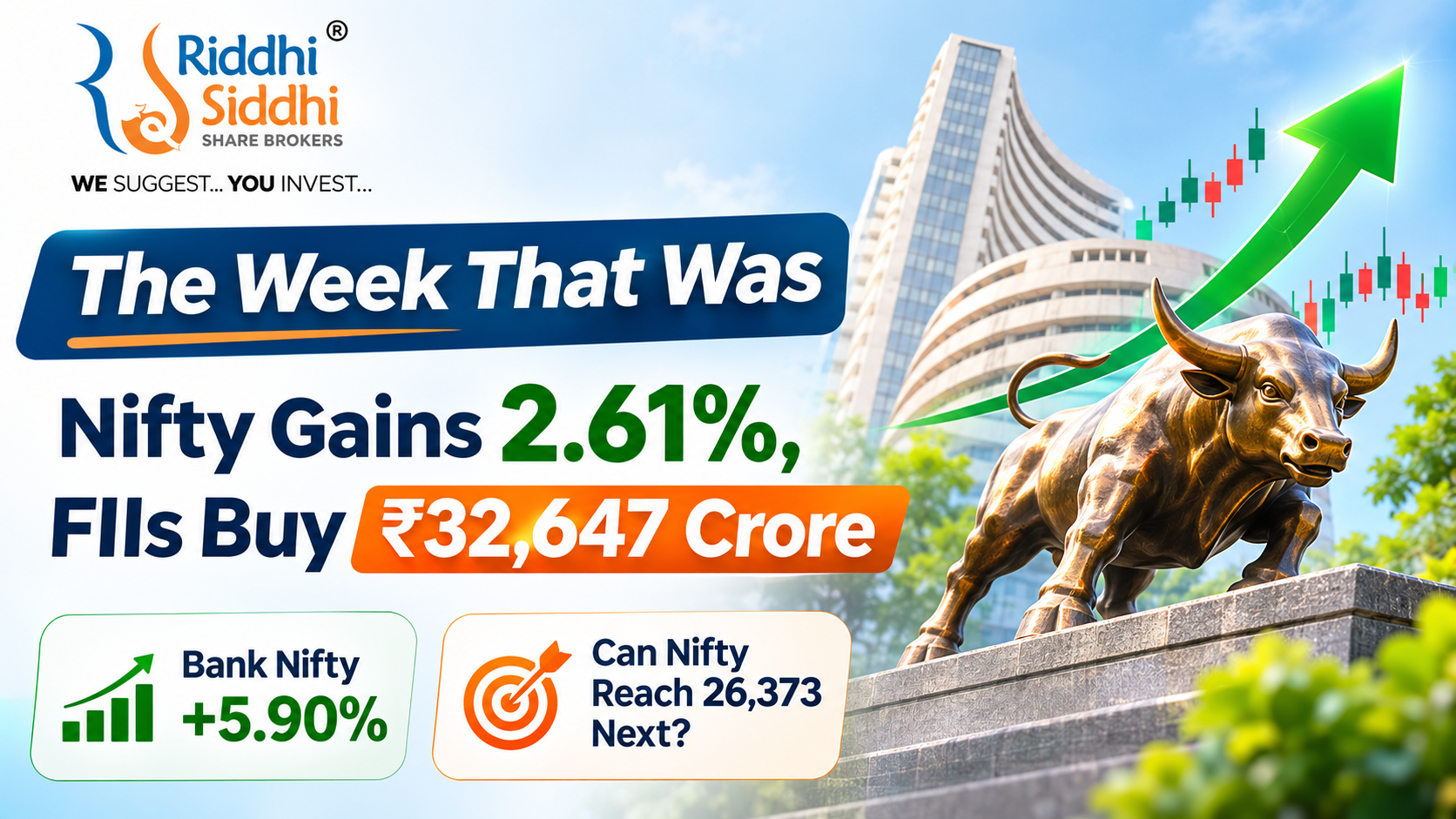
Indian Stock Market Weekly Review | 16–20 November 2026
By Riddhi Siddhi Share Brokers | 21 November 2026
From Buy-the-Dip to Momentum Buying: Is Dalal Street Entering a New Bull Phase?
A powerful banking rally, aggressive foreign institutional buying and improving investor sentiment helped Indian equity markets register their fourth consecutive weekly gain.
While global markets struggled with a sharp correction in artificial intelligence and technology stocks, Indian benchmarks displayed remarkable resilience.
The Nifty 50 gained 2.61%, the Sensex advanced 2.85%, and Bank Nifty surged 5.90%.
Foreign institutional investors (FIIs) purchased approximately ₹32,647 crore of Indian equities during the week.
But beneath the optimism lies an important divergence.
Large-cap stocks are rallying strongly, while the broader market is struggling to participate.
At Riddhi Siddhi Share Brokers, we believe this distinction will be critical in determining whether the current momentum develops into a sustainable, broad-based bull market.
1. Indian Stock Market Weekly Scorecard: 16–20 November 2026
| Index | Closing Level | Weekly Change |
|---|---|---|
| Nifty 50 | 25,800.60 | +2.61% |
| Sensex | 83,919.71 | +2.85% |
| Bank Nifty | 64,635 | +5.90% |
| Nifty Midcap 100 | — | +0.23% |
| Nifty Smallcap 100 | — | −1.08% |
Banking stocks were the clear outperformers, with the PSU Bank index gaining approximately 6.72% and the Private Bank index advancing 5.65%.
The contrast between large-cap and small-cap performance highlights an important market reality: a rising index does not necessarily mean every investor’s portfolio is rising.
Our Observation
The rally has momentum, but its sustainability will depend on whether buying interest spreads beyond a relatively concentrated group of large-cap companies.
2. FIIs Make a Powerful Comeback: ₹32,647 Crore in One Week
Foreign institutional investors emerged as one of the strongest drivers of the market rally.
Weekly institutional activity:
- FII net buying: ₹32,646.67 crore
- DII net selling: ₹12,698.39 crore
- November FII net buying: approximately ₹1.12 lakh crore, based on the reported month-to-date figures
Friday alone witnessed approximately ₹10,308 crore of net foreign buying.
Why Are Foreign Investors Returning to India?
Global portfolio diversification: The sharp correction in US artificial intelligence stocks has encouraged investors to reconsider concentrated exposure to technology-heavy markets.
Banking-sector strength: Indian banks have attracted significant buying interest, supported by profitability expectations and credit growth prospects.
Currency appreciation: A stronger rupee can improve dollar-denominated returns for overseas investors.
Lower crude oil prices: Softer energy prices can benefit India’s inflation outlook, import bill and selected corporate margins.
The Bigger Picture
Foreign investment can create powerful short-term market momentum. However, sustained market performance ultimately depends on corporate earnings, valuations and economic fundamentals.
At Riddhi Siddhi Share Brokers, we view institutional flows as an important indicator, but not a standalone investment signal.
3. Banking Stocks Lead the Charge
Bank Nifty surged approximately 5.90% during the week, substantially outperforming the Nifty 50.
Public-sector and private-sector banks both contributed to the rally.
The Nifty PSU Bank index advanced approximately 6.72%, while the Private Bank index gained 5.65%.
The strong performance reflects improving investor expectations surrounding credit demand, profitability and the banking sector’s earnings outlook.
Why Does Banking Leadership Matter?
Financial services carry significant weight in India’s benchmark indices.
Strong buying in major banks can therefore lift the Nifty even when other sectors remain weak.
However, this also creates concentration risk.
If banking stocks experience profit-booking before broader market participation improves, benchmark indices could become vulnerable.
Riddhi Siddhi Share Brokers’ View: Banking leadership is encouraging, but the next phase of the rally should ideally be supported by stronger participation from manufacturing, capital goods, consumption and mid-cap companies.
4. India Defies the Global AI Sell-Off
One of the most striking developments of the week was the divergence between Indian and US equity markets.
While Indian benchmarks advanced, Wall Street experienced a severe correction.
Reported weekly declines included:
- Nasdaq Composite: approximately 10%
- S&P 500: approximately 8.6%
- Dow Jones: approximately 8%
Selling pressure was concentrated in technology and artificial intelligence-related companies as investors reassessed valuations and the scale of AI infrastructure spending.
Is India Benefiting From Global Portfolio Rotation?
India’s benchmark indices have relatively greater exposure to banking, financial services, consumption and industrial businesses than technology-heavy US indices.
This difference in sector composition may be supporting India’s relative resilience.
Foreign investors seeking diversification away from concentrated AI exposure may find India’s market structure attractive.
However, relative strength should not be confused with immunity from global risks.
A prolonged global sell-off could eventually affect emerging-market fund flows and investor sentiment.
Our Assessment: India’s resilience is encouraging, but it is too early to conclude that domestic markets have permanently decoupled from global equity movements.
5. Crude Oil and Rupee: Two Important Market Tailwinds
Two macroeconomic developments provided additional support to Indian equities.
Softer Crude Oil Prices
Brent crude settled around $92.57 per barrel after declining approximately 3.4% during the week.
For an energy-importing economy such as India, lower crude prices can potentially reduce pressure on inflation, the import bill and corporate input costs.
However, benefits vary across sectors and companies.
Stronger Indian Rupee
The rupee strengthened during the week, closing near ₹92.67 against the US dollar.
Currency appreciation can improve foreign investors’ dollar-denominated equity returns.
It can also benefit import-dependent businesses, although export-oriented companies may face different implications.
Why This Combination Matters
Foreign equity inflows, a stronger rupee and softer crude oil prices together create a potentially favourable macroeconomic environment.
Whether these conditions persist will depend on global liquidity, currency movements and energy-market developments.
6. The Hidden Warning: Small-Cap Stocks Are Not Participating
Despite the Nifty’s 2.61% weekly gain, the Nifty Smallcap 100 declined approximately 1.08%.
The Nifty Midcap 100 gained only 0.23%.
This divergence indicates that buying interest remains concentrated in relatively large and liquid companies.
Three factors may explain the difference:
Valuations: Some smaller companies may remain vulnerable to corrections after periods of strong price appreciation.
Institutional preference: Large foreign investors often favour highly liquid stocks with established market capitalisation and stronger institutional ownership.
Earnings visibility: Investors may be becoming more selective about companies capable of delivering sustainable profitability.
What Investors Should Understand
A bullish benchmark does not automatically translate into a bullish portfolio.
Company fundamentals, valuations, liquidity and financial strength remain essential considerations.
At Riddhi Siddhi Share Brokers, we believe this is a market where stock selection deserves greater attention than index-level enthusiasm.
7. Stocks in Focus: Healthcare, Banking and Automobiles
Several prominent companies attracted investor attention during the week.
| Company | Approx. Weekly Change |
|---|---|
| Max Healthcare | +14.1% |
| Maruti Suzuki | +9% |
| Axis Bank | +8.64% |
| Apollo Hospitals | +7.9% |
| State Bank of India | +7.88% |
Healthcare Stocks Attract Buying
Max Healthcare and Apollo Hospitals benefited from favourable brokerage reassessments and expectations of improving profitability.
The interesting observation is that individual healthcare companies performed strongly despite mixed performance across the broader healthcare sector.
Banking Stocks Remain in Demand
Axis Bank and SBI benefited from strong institutional interest in financial stocks.
Investors evaluating banks should nevertheless continue monitoring credit growth, deposit costs, asset quality and valuations.
Automobile Stocks Gain Momentum
Automobile stocks attracted buying interest amid expectations of resilient domestic demand and potentially favourable input costs.
The sustainability of these gains will depend on sales growth, margins and company-specific fundamentals.
8. Sector Rotation: Where Is the Money Moving?
The week’s performance suggests a preference for domestic-facing businesses and financial companies.
Stronger sectors included:
- PSU Banks: +6.72%
- Private Banks: +5.65%
- FMCG: +3.63%
- Automobiles: +3.07%
- Infrastructure: +2.21%
- Realty: +1.92%
Weaker sectors included:
- Metals: −2.98%
- Information Technology: −1.91%
- Defence: −1.43%
- Pharmaceuticals: −0.52%
This pattern may reflect a shift towards businesses with relatively stronger domestic earnings visibility.
However, sector leadership can change quickly, particularly when global liquidity and commodity prices are volatile.
9. The Week Ahead: 23–27 November 2026
Indian markets enter a holiday-shortened trading week with several important domestic and international developments to monitor.
Monday, 23 November
- Flash PMI releases
- Nifty monthly derivatives expiry
- US economic activity indicators
Tuesday, 24 November
- NSE and BSE closed for Guru Nanak Jayanti
- Global economic developments remain in focus
Wednesday, 25 November
- Scheduled US economic releases
- Global growth and inflation expectations
Thursday, 26 November
- US Thanksgiving holiday
- Reduced global market participation
Friday, 27 November
- Global market reaction to economic developments
- Institutional flows and currency movements
What Could Support the Bulls?
Sustained foreign buying, stable banking stocks, softer crude oil prices and improved broader-market participation could support the positive market structure.
What Could Trigger Profit-Booking?
Renewed global technology selling, reversal of foreign inflows, higher crude oil prices or disappointing economic developments could weaken sentiment.
Holiday-shortened trading may also increase short-term volatility.
10. Nifty Outlook: 26,373 or 24,800 — Which Comes First?
The Nifty closed the week near 25,801.
Two important reference levels are now attracting attention.
Upside reference: 26,373
Downside reference: 24,800
The index is approximately 2.22% below the upside reference and 3.88% above the downside reference.
These distances do not establish the probability of either outcome.
Bullish Scenario
If foreign inflows continue, banking stocks remain strong and market breadth improves, Nifty could attempt to move towards the 26,000–26,400 region.
Consolidation Scenario
After four consecutive weeks of gains, the market could experience a period of consolidation as investors reassess valuations.
Bearish Scenario
A reversal in foreign buying, deterioration in global risk appetite or disappointing earnings could expose the market to deeper corrections.
Riddhi Siddhi Share Brokers’ Market View
Our near-term assessment remains cautiously bullish.
The strength of institutional buying and banking leadership supports the positive outlook.
However, weak small-cap participation and global market uncertainty suggest that investors should avoid excessive leverage and aggressive momentum chasing.
The 26,373 region remains an important upside reference, while 24,800 represents a significant downside risk level.
These are scenario-based observations, not guaranteed targets or personalised trading recommendations.
11. Five Important Lessons for Investors
- Institutional liquidity matters, but earnings determine long-term value. Strong foreign buying can support markets, but corporate performance must eventually justify valuations.
- Banking leadership is encouraging, but broader participation is essential. A durable rally should ideally extend across multiple sectors.
- Global diversification can influence capital flows. India’s relative resilience during the AI sell-off demonstrates the importance of market composition.
- Index performance and portfolio performance are different. Investors should not assume that all stocks will benefit equally from a rising benchmark.
- Risk management remains important even in bullish markets. Position sizing, diversification and disciplined investment decisions matter regardless of market momentum.
12. Frequently Asked Questions
Why did Nifty rise during 16–20 November 2026?
Nifty gained approximately 2.61%, supported by foreign institutional buying, banking-sector strength, rupee appreciation and softer crude oil prices.
How much did FIIs buy during the week?
Foreign institutional investors recorded approximately ₹32,647 crore of net equity purchases during the five trading sessions, based on provisional cash-market data.
Why did Bank Nifty outperform?
Bank Nifty benefited from strong buying in public-sector and private-sector banking stocks, supported by profitability expectations and institutional demand.
Why did small-cap stocks decline?
Large-cap stocks attracted stronger buying interest, while valuations, liquidity conditions and earnings expectations contributed to weaker broader-market participation.
Can Nifty reach 26,373?
It remains a possible upside scenario if supportive market conditions continue. However, no market level or forecast is guaranteed.
Is 23 November 2026 the Nifty monthly expiry?
The November Nifty derivatives expiry is scheduled for Monday, 23 November, because Tuesday, 24 November, is an exchange trading holiday. Investors should confirm their specific contract details.
Is this a good time to invest in Indian equities?
Investment suitability depends on financial goals, risk tolerance, investment horizon and valuations. A strong market rally alone is not sufficient grounds for an investment decision.
13. Conclusion: The Bulls Have Momentum, but the Market Needs Broader Conviction
The week ending 20 November 2026 highlighted three important developments.
Foreign institutional investors returned with substantial buying interest. Banking stocks emerged as the strongest drivers of the rally. Indian equities displayed relative resilience during a sharp correction in global technology stocks.
But the broader market has not yet confirmed the strength visible in benchmark indices.
For Riddhi Siddhi Share Brokers, the next phase of the rally will depend on whether institutional confidence translates into stronger earnings expectations and broader participation.
The bulls have momentum. The banks have leadership. Foreign investors have returned. The next test is whether the rest of the market can follow.
Our approach remains focused on disciplined participation, informed decision-making and risk management.
Riddhi Siddhi Share Brokers — We Suggest… You Invest.
Connect With Riddhi Siddhi Share Brokers
Looking for professional trading assistance, market insights and access to financial market opportunities?
Explore our Assisted Trading Services and discover how we assist clients with trading and execution through their own accounts.
Message +91 99875 53455 to request access to our exclusive WhatsApp community for daily prices, opportunities and market updates.
Website: www.riddhisiddhisharebrokers.com
Contact for assisted trading enquiries: +91 91379 69859
Disclaimer
This article is for educational and informational purposes only. It does not constitute personalised investment advice, an offer to buy or sell securities, or a guarantee of future market performance.
Riddhi Siddhi Share Brokers is an Authorised Person of an NSE & BSE registered stockbroker. Securities market investments are subject to market risks, including potential loss of capital. Investors should consult a SEBI-registered investment adviser before making investment decisions.
Market figures are based on publicly reported information available as of 21 November 2026. Institutional activity figures are provisional and may be revised. Past performance is not indicative of future results.