
Published: 6 October 2026 | Category: Stock Market News & Derivatives
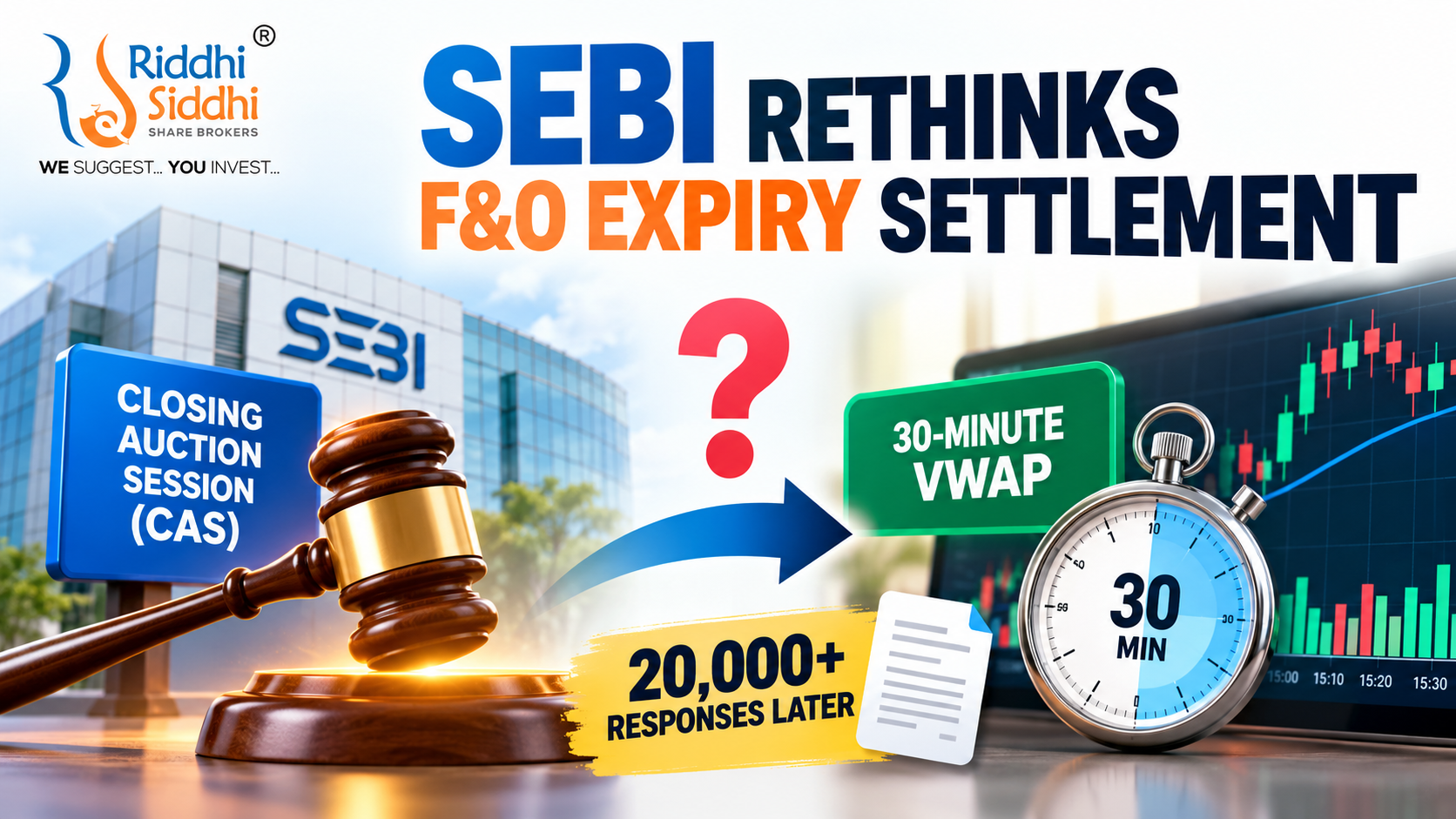
SEBI may significantly revise India’s F&O expiry settlement mechanism after receiving approximately 20,000 public responses to its consultation on the Closing Auction Session (CAS). According to a Reuters report dated 5 October 2026, the regulator is considering keeping CAS out of derivatives settlement for at least one year and using the final 30-minute volume-weighted average price (VWAP) instead.
However, there is an important distinction: SEBI has not formally announced this reported revision as a final rule.
For Nifty, Sensex, Bank Nifty and stock derivatives traders, the development raises an important question: Could the way expiry settlement prices are calculated change again?
The answer matters because even small differences in settlement prices can have significant consequences for derivatives positions approaching expiry.
SEBI F&O Settlement Review: Key Facts at a Glance
| Question | Position as of 6 October 2026 |
|---|---|
| Has SEBI announced a final revised rule? | No formal revised circular verified |
| Public responses received | Approximately 20,000 |
| When was CAS introduced? | 3 August 2026 |
| What change is being reported? | Retaining final 30-minute VWAP for derivatives settlement |
| Will CAS be excluded from F&O settlement? | Reportedly, for at least one year |
| Is CAS being abolished entirely? | No such decision has been confirmed |
| Will CAS continue for cash-market price discovery? | Expected to continue in relevant segments |
| When might changes take effect? | By end-October 2026, according to Reuters sources |
| Is the implementation date confirmed? | No |
Important: These are reported developments, not a final regulatory announcement. Traders should follow official SEBI and exchange circulars for implementation details.
Why Is SEBI Reconsidering the Closing Auction Session?
India introduced the Closing Auction Session in August 2026 to strengthen end-of-day price discovery for eligible equity securities.
The idea was to create a structured auction mechanism where buyers and sellers could establish closing prices through concentrated order matching.
Closing auctions are already used in several international markets.
However, India’s initial experience raised concerns, particularly around the behaviour of indicative prices and derivatives premiums near expiry.
During some expiry sessions, indicative index levels moved sharply as the auction order book changed.
These fluctuations created uncertainty for traders attempting to understand where expiring contracts might finally settle.
The issue became particularly visible on 8 September 2026.
The 850-Point Nifty CAS Swing That Raised Questions
On 8 September, Nifty’s indicative closing level experienced an extraordinary swing of approximately 850 points during the auction process.
Yet the index ultimately closed near its pre-auction level.
This was not an ordinary 850-point crash during continuous trading. It reflected changing indicative auction calculations.
Nevertheless, the episode demonstrated how dramatically expectations about final settlement could fluctuate.
We previously explained this event in detail:
Related reading: Nifty Swings 850 Points in Closing Auction: Why F&O Traders Need to Understand CAS
That article explains how CAS works and why indicative prices can move sharply.
The latest development goes one step further: SEBI is reportedly reconsidering whether the closing auction should determine derivatives settlement prices at all during the initial transition period.
What Exactly Is SEBI Reportedly Planning to Change?
According to Reuters, SEBI is preparing to partially revise the framework following stakeholder feedback.
The reported approach would separate two important functions:
- Establishing closing prices through the Closing Auction Session.
- Determining the settlement reference for expiring derivatives contracts.
Under the reported revision, derivatives settlement would use the volume-weighted average price from the final 30 minutes of continuous trading instead of relying on CAS-derived closing prices.
The arrangement could remain in place for at least one year.
Meanwhile, CAS would continue to play a role in relevant cash-market closing-price discovery.
This is not the same as abolishing CAS.
The central distinction is that a mechanism used to discover a stock’s closing price does not necessarily have to be the mechanism used to calculate derivatives settlement prices.
What Is the 30-Minute VWAP in F&O Settlement?
VWAP stands for Volume-Weighted Average Price.
It calculates the average traded price of a security while accounting for the quantity traded at each price.
The formula is:
VWAP = Total Traded Value ÷ Total Traded Quantity
For example, consider the following hypothetical transactions during a measurement period.
| Price | Quantity | Traded value |
|---|---|---|
| ₹100 | 1,000 | ₹1,00,000 |
| ₹102 | 2,000 | ₹2,04,000 |
| ₹104 | 1,000 | ₹1,04,000 |
| Total | 4,000 | ₹4,08,000 |
The VWAP would be:
₹4,08,000 ÷ 4,000 = ₹102
This means the volume-weighted average is ₹102, even though individual transactions occurred at ₹100, ₹102 and ₹104.
Why Does the Final 30-Minute VWAP Matter?
Instead of using a single auction-derived closing reference, the VWAP method considers trading activity across a specified continuous-market window.
This may reduce dependence on the outcome of one concentrated auction.
However, VWAP is not immune to volatility or unusual trading activity.
Large orders, liquidity conditions and market movements can still influence the calculation.
For index derivatives, the precise methodology also depends on the applicable exchange rules for calculating the underlying index settlement reference.
Therefore, the exact formula and timing must be confirmed through the final regulatory and exchange circulars.
CAS vs 30-Minute VWAP: What Is the Difference?
| Feature | Closing Auction Session (CAS) | 30-Minute VWAP |
|---|---|---|
| Price discovery | Auction-based equilibrium mechanism | Volume-weighted average of trades |
| Measurement | Dedicated closing auction | Specified continuous-trading window |
| Main characteristic | Concentrated closing-order matching | Trading activity spread across a period |
| Sensitivity | Auction order imbalances can influence indicative prices | Trading volume and prices influence the average |
| Cash-market closing role | Expected to continue | Depends on applicable market rules |
| F&O expiry settlement | Reportedly may be excluded temporarily | Reportedly may be retained |
| Regulatory status | Existing mechanism subject to review | Proposed/reported settlement approach |
Neither method guarantees stable prices.
Both can be affected by market conditions.
The regulatory question is which methodology provides a more appropriate settlement reference while balancing transparency, liquidity and market integrity.
Why Did SEBI Receive Approximately 20,000 Responses?
SEBI’s consultation invited feedback on the Closing Auction Session, derivatives settlement methodology, market timings and related operational questions.
By 3 October 2026, approximately 20,000 responses had been received.
This level of participation indicates substantial market interest in the proposed changes.
However, an important clarification is necessary.
Receiving 20,000 responses does not mean 20,000 investors opposed CAS.
The submissions could include support, objections, technical suggestions and alternative proposals.
The response count demonstrates engagement, not a unanimous verdict.
Market participants have raised concerns about expiry-day volatility, settlement-price uncertainty, the relationship between cash and derivatives trading, and the operational implications of changing market timings.
Reuters subsequently reported that SEBI was preparing a partial revision of the settlement approach.
How Could the Change Affect Nifty and Bank Nifty Traders?
For derivatives traders, settlement methodology is more than a technical detail.
It can influence the final outcome of contracts held until expiry.
1. Greater Clarity Around the Settlement Reference
If the reported revision is implemented, traders would know that the applicable derivatives settlement calculation follows the prescribed continuous-market VWAP methodology rather than the closing auction.
This could make the reference methodology easier to understand.
It would not, however, make the final settlement price predictable.
2. Reduced Dependence on Indicative Auction Movements
Under the CAS framework, rapidly changing indicative prices can create uncertainty about the eventual closing level.
Separating derivatives settlement from CAS could reduce the direct importance of these indicative auction movements for expiry settlement.
3. Continued Volatility Near Expiry
Even if SEBI adopts the reported VWAP approach, derivatives trading will remain risky.
Options close to expiry can react sharply to relatively small changes in the underlying index.
Liquidity conditions, market direction, volatility and leverage will continue to matter.
4. Settlement Price May Differ From the Last Traded Price
This is an important concept for retail traders.
The last traded price visible on a screen is not necessarily the same as the final settlement reference calculated under exchange rules.
Traders should not assume that an option’s expiry outcome can be determined simply by looking at the last displayed index value.
5. Contract-Specific Rules Still Matter
Nifty, Bank Nifty, Sensex and individual stock derivatives are governed by their respective exchange and clearing frameworks.
Traders must verify the applicable settlement methodology for each contract rather than assuming every product uses an identical calculation.
Will SEBI Completely Scrap the Closing Auction Session?
Based on the latest reporting, no.
The proposed revision appears to concern how CAS interacts with derivatives settlement, not whether closing auctions should exist at all.
Closing auctions can serve several functions, including institutional order execution, end-of-day price discovery, portfolio valuation and index-related trading.
For example, index rebalancing can generate substantial trading activity near the market close.
Our earlier article on BSE’s inclusion in the Nifty 50 explains how passive investment flows can influence closing-session activity.
Related reading: BSE Enters Nifty 50: Index Rebalancing and Passive Fund Flows
The distinction matters because a mechanism that supports cash-market price discovery may still require a different treatment for derivatives expiry settlement.
What About SEBI’s Proposal on Indicative Index Values?
Another issue under consideration concerns the display of indicative index values during CAS.
These values can change as the auction order book evolves.
The September 2026 Nifty episode demonstrated how dramatic those changes could appear.
According to Reuters, SEBI is expected to retain the display of indicative index values rather than remove it.
The regulator may also strengthen investor education around how these values are calculated and interpreted.
This would preserve a degree of transparency while helping participants distinguish indicative calculations from final executable or settlement prices.
The final treatment remains subject to official confirmation.
Could the Revision Change Market Closing Times?
Market timings were also part of SEBI’s consultation.
However, the latest reporting suggests the existing trading schedule may be retained.
This is significant because changing the relationship between cash-market closing, derivatives trading and settlement calculations can create operational complications.
Until official circulars are issued, traders should continue following the exchange-published trading schedules and contract specifications.
Why Settlement Rules Matter as Much as Trading Direction
Retail derivatives discussions often focus on predicting whether Nifty will rise or fall.
But successful understanding of market mechanics requires more than a directional view.
Traders must also understand how contracts are priced, how margins operate, how expiry settlement is determined and what happens when liquidity becomes concentrated near market close.
Regulatory changes can affect these mechanics even when the underlying investment thesis remains unchanged.
For additional context, read our earlier coverage of SEBI’s review of F&O margin rules for longer-term derivatives.
Margin requirements and settlement methodology are separate regulatory subjects, but both demonstrate why derivatives participants must keep track of evolving exchange rules.
What Should F&O Traders Do While Awaiting the Final Circular?
There is no need to assume that the reported changes have already taken effect.
The appropriate approach is to distinguish confirmed rules from proposed revisions.
Traders should pay attention to official exchange notices, understand the settlement methodology applicable to their contracts and avoid treating indicative closing prices as guaranteed settlement outcomes.
They should also consider the risks associated with carrying leveraged positions into expiry.
A change in settlement methodology may alter how the final reference is determined, but it does not remove the possibility of substantial trading losses.
Frequently Asked Questions
Has SEBI changed the F&O expiry settlement rules in October 2026?
As of 6 October 2026, Reuters has reported that SEBI is preparing a partial revision, but a final revised circular has not been verified. The reported approach would retain the final 30-minute VWAP for derivatives settlement for at least one year.
Is SEBI removing CAS from Nifty expiry settlement?
Reuters reports that SEBI is likely to exclude CAS from derivatives settlement temporarily. The exact application to individual index and stock derivative contracts will depend on the final regulatory and exchange instructions.
What is the difference between CAS and VWAP?
CAS is an auction-based closing-price discovery mechanism. VWAP is an average price weighted by trading volume over a specified period. The two mechanisms can produce different reference values.
Why did SEBI receive 20,000 comments?
The consultation addressed derivatives settlement, closing auctions, trading schedules and related market-structure questions. The approximately 20,000 responses reflected substantial public and industry participation, not necessarily uniform opposition.
Will CAS be discontinued in India?
There is no confirmed decision to abolish CAS entirely. Reports suggest the regulator may separate its cash-market price-discovery role from derivatives expiry settlement.
Will the 30-minute VWAP eliminate expiry-day volatility?
No. VWAP can change with market prices and trading volumes. Derivatives premiums may still experience significant volatility, especially near expiry.
When will the revised F&O settlement rules become effective?
Reuters sources suggest implementation could occur by the end of October 2026. The official effective date remains unconfirmed.
Does the settlement price always equal the last traded price?
No. Settlement prices are calculated according to the relevant exchange and clearing rules and may differ from the last displayed traded price.
Riddhi Siddhi Share Brokers View: Market Structure Matters
The latest developments reinforce an important lesson for India’s derivatives community.
Trading is not only about predicting where the market will move. It is also about understanding how prices are discovered, how contracts expire and how final settlement values are determined.
The September 8 CAS episode highlighted the potential uncertainty created by rapidly changing indicative auction prices.
The latest reported SEBI revision suggests that regulators are considering how to address those concerns while preserving the broader benefits of closing auctions.
If the final 30-minute VWAP is retained for derivatives settlement, it could provide a different basis for calculating expiry outcomes.
However, no settlement mechanism eliminates trading risk.
For F&O participants, understanding the rules remains essential.
The final SEBI circular—not speculation or market rumours—should determine how traders interpret the revised framework.
Need Assistance With Equity and Derivatives Trading?
Understanding market direction is only one part of participating in equity and derivatives markets.
Trade execution, contract selection, margin requirements, expiry mechanics and risk awareness also deserve attention.
Riddhi Siddhi Share Brokers provides Assisted Trading Services and Trade Execution Support for eligible clients participating in equity delivery, index futures, stock futures and index options.
Our focus is on helping clients navigate the trading and execution process while maintaining transparency and awareness of market risks.
Explore our Assisted Trading Services to understand the available service arrangements and eligibility requirements.
Connect with Riddhi Siddhi Share Brokers
Call / WhatsApp: +91 91379 69859
Website: https://www.riddhisiddhisharebrokers.com
We suggest… you invest.
Disclaimer
Riddhi Siddhi Share Brokers is an NSE & BSE Authorised Person of a leading broker. We do not provide investment advisory services. This article is for educational and informational purposes only and should not be construed as investment advice, a trading recommendation or a guarantee of returns.
Derivatives trading involves substantial risk and may not be suitable for all investors. Regulatory proposals and reported developments are subject to change. Readers should refer to official SEBI, NSE, BSE and relevant clearing corporation circulars for applicable rules.
Sources
- Reuters, 5 October 2026 — India Markets Regulator to Partly Reverse Derivative Settlement Rules After Pushback
- Business Standard, 4 October 2026 — SEBI CAS Review Draws Over 20,000 Responses
- Securities and Exchange Board of India — Official regulatory circulars and consultation documents