
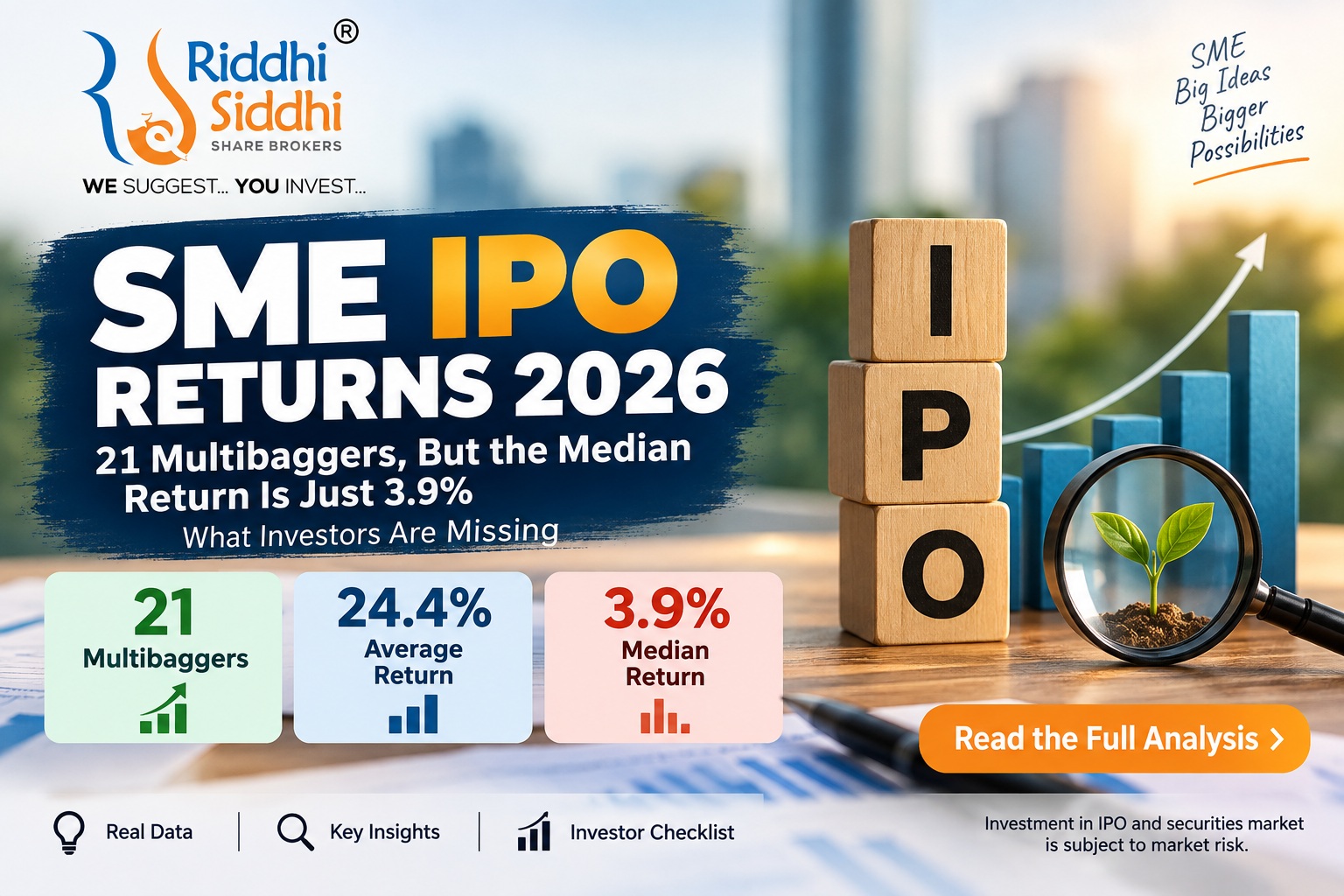
If you looked only at the biggest winners, 2026 would appear to be an extraordinary year for SME IPO investors.
Twenty-one SME IPOs in a 126-issue analysis became multibaggers. The strongest performer was reported to have risen around 456% from its issue price.
But there is another number investors should pay even closer attention to:
3.9%.
That was the median return across the SME IPO cohort analysed, compared with an average return of approximately 24.4%.
The difference between those two numbers tells us something important.
A relatively small group of spectacular performers can make the overall SME IPO market look far more rewarding than the experience of the company sitting in the middle of the pack.
And with 13 SME IPOs scheduled to open during the September 21–25 week alone, understanding that difference matters more than ever.
So, what do SME IPO returns in 2026 actually tell investors?
Let’s look beyond the multibagger headlines.
SME IPO Returns 2026: The Numbers at a Glance
A recent analysis of 126 SME IPOs listed during 2026 produced a fascinating scorecard:
| 2026 SME IPO Snapshot | Reported Figure |
|---|---|
| SME IPOs analysed | 126 |
| Trading above issue price | 65 |
| Multibaggers | 21 |
| Multibaggers as % of cohort | 16.7% |
| Average return | 24.4% |
| Median return | 3.9% |
| Best reported performer | Approx. +456% |
Source: ET Markets/Prime Database analysis, with subsequent market-data analysis. Returns are market-price dependent and therefore change over time.
At first glance, a 24.4% average return sounds impressive.
But averages can sometimes hide more than they reveal.
Average Return vs Median Return: Why 24.4% and 3.9% Tell Different Stories
Imagine five IPOs produced these hypothetical returns:
-20%, -10%, +4%, +20% and +130%.
Their average return would be almost 25%.
Yet four of the five investments delivered nowhere close to 25%.
The single 130% winner dramatically lifted the average.
The median, on the other hand, would be 4% — the return of the middle observation after arranging all five outcomes from lowest to highest.
That is why the difference between the reported 24.4% average SME IPO return and 3.9% median return deserves attention.
It suggests that returns were highly uneven.
A relatively small group of major winners pulled the average upward, while the experience around the middle of the 126-IPO distribution was much more modest.
This doesn’t mean the 24.4% figure is wrong.
It means investors should understand what that average actually represents.
21 Multibaggers Sound Impressive. But Look at the Other 105 IPOs Too.
Multibaggers naturally dominate headlines.
A stock rising 200%, 300% or 400% makes a compelling story.
But there is a simple mathematical reality:
21 multibaggers out of 126 IPOs means 105 IPOs in that cohort did not become multibaggers.
Put another way, approximately 16.7% of the analysed cohort had doubled or more at the measurement point.
That is still significant.
But it is very different from assuming that SME IPO investing itself routinely produces multibagger returns.
There is another important distinction.
Knowing after the event which 21 companies became multibaggers is easy.
Identifying those companies before applying to their IPOs is considerably harder.
Investors therefore shouldn’t ask only:
“How many SME IPO multibaggers were there?”
A better question is:
“What information was available before the IPO that could have helped distinguish stronger businesses and reasonable valuations from weaker opportunities?”
That takes us away from headlines and towards research.
Nearly Half the Cohort Was Around or Below Issue Price
The same dataset provides the other side of the SME IPO story.
Of the 126 IPOs analysed, 65 were reported above their issue prices, leaving the remainder below at the measurement point in the subsequent analysis.
Because share prices change daily, this should be treated as a snapshot rather than a permanent scorecard.
But the broader lesson remains relevant:
A booming IPO market does not mean every IPO is performing well.
An investor can participate in a market containing several spectacular multibaggers and still select an IPO that subsequently trades below its issue price.
That is precisely why historical winners should not become the primary reason for applying to the next issue.
India’s SME IPO Market Is No Longer a Small Corner of the Market
The growth of India’s SME capital market has been substantial.
By December 2025, NSE Emerge alone had crossed 700 SME listings, with companies on the platform having collectively raised more than ₹21,000 crore.
And the IPO pipeline remains active.
During the week of September 21–25, 2026, as many as 20 IPOs were scheduled to open, comprising seven mainboard IPOs and 13 SME IPOs, with combined fundraising of approximately ₹4,152 crore.
For investors, that creates a different problem:
More opportunities also mean more decisions.
When multiple IPOs open within days of one another, it becomes tempting to use shortcuts:
- Which IPO has the highest GMP?
- Which IPO is most oversubscribed?
- Which issue is trending on social media?
- Which IPO is expected to give the highest listing gain?
Those indicators may provide information about current sentiment.
They do not, by themselves, tell you what a business is worth.
We discussed this in our earlier analysis, 16 IPOs This Week: How to Choose an IPO Without Following GMP Blindly.
The sequence remains important:
Business → Financials → Valuation → Offer Structure → Use of Funds → Risks → Subscription/GMP
Not the other way around.
Why GMP Can Become Dangerous When SME IPO Sentiment Is Strong
Grey Market Premium attracts enormous attention during an IPO.
That is understandable.
Investors want to know what the market expects before listing.
But GMP has limitations.
It is an unofficial market indicator, can change quickly and does not replace analysis of the underlying company.
A high GMP tells you something about prevailing expectations.
It does not automatically tell you:
- whether the IPO valuation is reasonable,
- whether earnings can sustain the valuation,
- whether the company generates healthy cash flows,
- whether the promoter has allocated capital effectively,
- or whether sufficient liquidity will exist after listing.
A business does not become fundamentally stronger because its GMP increased.
And a high subscription multiple does not guarantee strong long-term returns either.
Demand and value are related — but they are not the same thing.
SME IPO Rules Have Become Stricter
Another reason investors should avoid relying on old perceptions about SME IPOs is that the regulatory and exchange framework has evolved.
Under the current NSE Emerge eligibility framework, among other conditions:
- post-issue paid-up capital cannot exceed ₹25 crore;
- the issuer generally needs a track record of at least three years;
- it must have recorded at least ₹1 crore operating profit from operations in any two of the previous three financial years;
- net worth must be positive;
- Free Cash Flow to Equity (FCFE) must be positive in at least two of the preceding three financial years;
- an Offer for Sale by selling shareholders cannot exceed 20% of the total issue size; and
- a selling shareholder cannot sell more than 50% of their holding through the SME IPO.
These conditions are meaningful.
But investors should not interpret eligibility for listing as a guarantee of investment quality or future returns.
Meeting an exchange’s eligibility criteria answers one question:
Can the company access the SME platform under the applicable framework?
Investors still have to answer another:
Is this particular business attractive at this particular IPO valuation?
Those are two different questions.
SEBI Has Already Warned Investors About SME-Market Risks
Regulators have also expressed concerns about certain practices involving SME companies.
SEBI has previously highlighted instances involving diversion of issue proceeds, transactions involving related or connected entities, and practices that could create misleading positive sentiment around certain SME companies.
The regulator has specifically urged investors to exercise caution and not rely on unverified social-media posts, tips or rumours while investing in SME securities.
This doesn’t mean SME IPOs should automatically be avoided.
It means the standard of due diligence should rise when information, liquidity and operating history may be more limited than for larger listed companies.
Liquidity: The SME IPO Risk That Listing-Gain Headlines Often Ignore
Suppose you buy a stock at ₹100 and the displayed market price later becomes ₹150.
Have you earned 50%?
On paper, yes.
But your realised return ultimately depends on your ability to sell your shares at an executable price.
That is where liquidity becomes important.
SME companies can have smaller free floats and lower trading volumes than larger mainboard companies. SME securities also operate within a market structure that includes market-making requirements, but market making does not eliminate liquidity risk.
During periods of strong demand, liquidity may appear adequate.
When sentiment reverses, the experience can be very different.
Investors should therefore consider:
- trading volumes,
- available buyers and sellers,
- free float,
- lot-size requirements,
- bid-ask spreads,
- price volatility, and
- the possibility that exiting a position may be harder than entering it.
SEBI and the exchanges also use surveillance mechanisms—including measures linked to price variation and volatility—to safeguard market integrity.
So an SME stock’s return on a screen and an investor’s eventual realised return are not necessarily identical.
What Should You Check Before Applying to an SME IPO?
Instead of trying to predict the next 400% winner, investors can ask a more useful set of questions.
1. Do You Understand the Business?
Start with the simplest question.
How does the company actually make money?
Understand its products, customers, competitive position, industry and major risks.
If the business cannot be explained clearly, move slowly.
2. Are Revenue and Profits Growing Together?
Revenue growth looks attractive.
But check whether profitability is growing too.
Look at:
- revenue growth,
- EBITDA margins,
- profit after tax,
- return ratios,
- debt,
- working-capital requirements, and
- cash generation.
A rapidly growing accounting profit accompanied by consistently weak cash flows deserves closer examination.
3. What Is the IPO Valuation?
A good company can still become a poor investment if purchased at an excessive valuation.
Compare the IPO valuation with:
- historical growth,
- earnings quality,
- listed peers where meaningful,
- industry economics, and
- future growth assumptions already embedded in the price.
We’ve explored this issue separately in IPO P/E Ratio vs IPO Returns: Does High P/E Mean Poor Returns?.
The important lesson is that P/E is useful, but no single valuation ratio can predict IPO returns.
4. Where Is Your Money Going?
Read the Objects of the Issue carefully.
Is fresh capital being used for:
- capacity expansion?
- machinery?
- working capital?
- debt reduction?
- acquisitions?
- technology?
- another identifiable growth requirement?
Also distinguish between a Fresh Issue and an Offer for Sale (OFS).
In a fresh issue, money raised goes to the company.
In an OFS, shares are sold by existing shareholders and the sale proceeds go to those shareholders.
The distinction matters.
5. Who Are the Promoters?
For a smaller company, promoter quality can be particularly important.
Review:
- promoter experience,
- ownership,
- related-party transactions,
- litigation and disclosures,
- historical capital allocation, and
- whether the IPO materially changes promoter ownership.
Promoters should be evaluated through disclosures and track record rather than promotional narratives.
6. Is the Business Too Dependent on a Few Customers?
A company can show excellent historical growth while remaining dependent on one or two major customers.
Check customer concentration.
Also examine:
- supplier concentration,
- geographical concentration,
- dependence on government orders,
- industry cyclicality, and
- dependence on a single product.
Concentration can accelerate growth when conditions are favourable — and magnify risk when they aren’t.
7. What Happens After Listing?
IPO research shouldn’t end on listing day.
Ask:
What would make me continue owning this business after the excitement surrounding the IPO disappears?
If the only answer is:
“The GMP is high.”
the investment thesis probably needs more work.
SME IPO vs Mainboard IPO: Is One Automatically Safer?
Not necessarily.
Mainboard and SME IPOs operate under different frameworks and typically involve businesses of different scales, but the label alone cannot tell investors whether an individual IPO will perform well.
A mainboard IPO can be overpriced.
An SME IPO can represent a strong growing business.
And the reverse can also be true.
The better comparison is not simply:
SME vs Mainboard.
It is:
Business quality + financial strength + valuation + governance + liquidity + risk.
Those factors ultimately matter far more than the label attached to the IPO.
What the 3.9% Median Really Teaches Investors
The most important lesson from SME IPO returns in 2026 isn’t that SME IPOs are good.
It isn’t that SME IPOs are bad either.
It is that headline returns can conceal enormous dispersion underneath them.
Twenty-one multibaggers demonstrate that exceptional wealth creation has occurred within the SME IPO market.
A median return of only 3.9% in the analysed cohort tells us that the typical observation was nowhere close to the headline multibagger experience.
Both facts can be true simultaneously.
And that is precisely the point.
The existence of extraordinary winners does not make selecting them easy.
Investors still need to distinguish:
a good story from a good business,
a good business from a good valuation,
and
a good IPO from a good long-term investment.
One More Lesson: “Early” Does Not Automatically Mean “Cheap”
There is an interesting parallel between IPO investing and the pre-IPO/unlisted market.
Investors sometimes assume that entering before everybody else automatically means buying cheaply.
That isn’t necessarily true.
An investment can be made early and still be made at an expensive valuation.
The recent NSE journey offered a useful real-world illustration of this principle. We discussed the IPO valuation perspective in NSE IPO 2026: Price Band ₹1,700–₹1,785, Dates & Should You Apply?.
For investors interested specifically in how a pre-IPO acquisition price can affect eventual returns, our sister platform VaultStreet Advisors has explored the subject from the unlisted-market side in Bought Before the IPO? HDB, NSDL, Tata Technologies & Others Show Why Your Pre-IPO Entry Price Matters.
The common principle is simple:
Entry valuation matters — whether you invest before an IPO, during an IPO or after listing.
The Bottom Line
The SME IPO market in 2026 has produced genuine success stories.
21 multibaggers out of the 126 issues analysed is noteworthy.
So is a top performer gaining approximately 456% from its issue price.
But investors shouldn’t stop reading there.
The same analysis produced an average return of around 24.4% and a median of only 3.9%.
That enormous gap is the real story.
It tells investors that SME IPO returns have been highly uneven.
The next SME IPO may become another multibagger.
It may deliver a modest return.
It may also trade below its issue price.
Nobody knows that outcome in advance.
What investors can do is improve the quality of the decision made before applying.
Don’t start with GMP.
Start with the business.
Then examine the financials, valuation, promoters, use of proceeds, risks and liquidity.
And only after that should market sentiment enter the picture.
Because in IPO investing, finding the next exciting issue is easy.
Deciding what price makes sense for the business is the harder—and more important—part.
Planning to Participate in Upcoming IPOs?
Riddhi Siddhi Share Brokers provides access to Mainboard and SME IPOs, along with Equity, Mutual Funds and other investment products.
You can explore our IPO Services or open your FREE Demat & Trading Account to participate in upcoming public issues.
Riddhi Siddhi Share Brokers
We Suggest… You Invest.
NSE & BSE Registered Authorised Person
Disclaimer: This article is for educational and informational purposes only and should not be construed as investment advice or a recommendation to subscribe to, buy, sell or hold any security. IPO and stock-market investments are subject to market risk. Historical IPO performance does not guarantee future returns. Data and market prices change over time. Investors should independently review the relevant offer document, risk factors, financial statements and applicable disclosures before making an investment decision.