
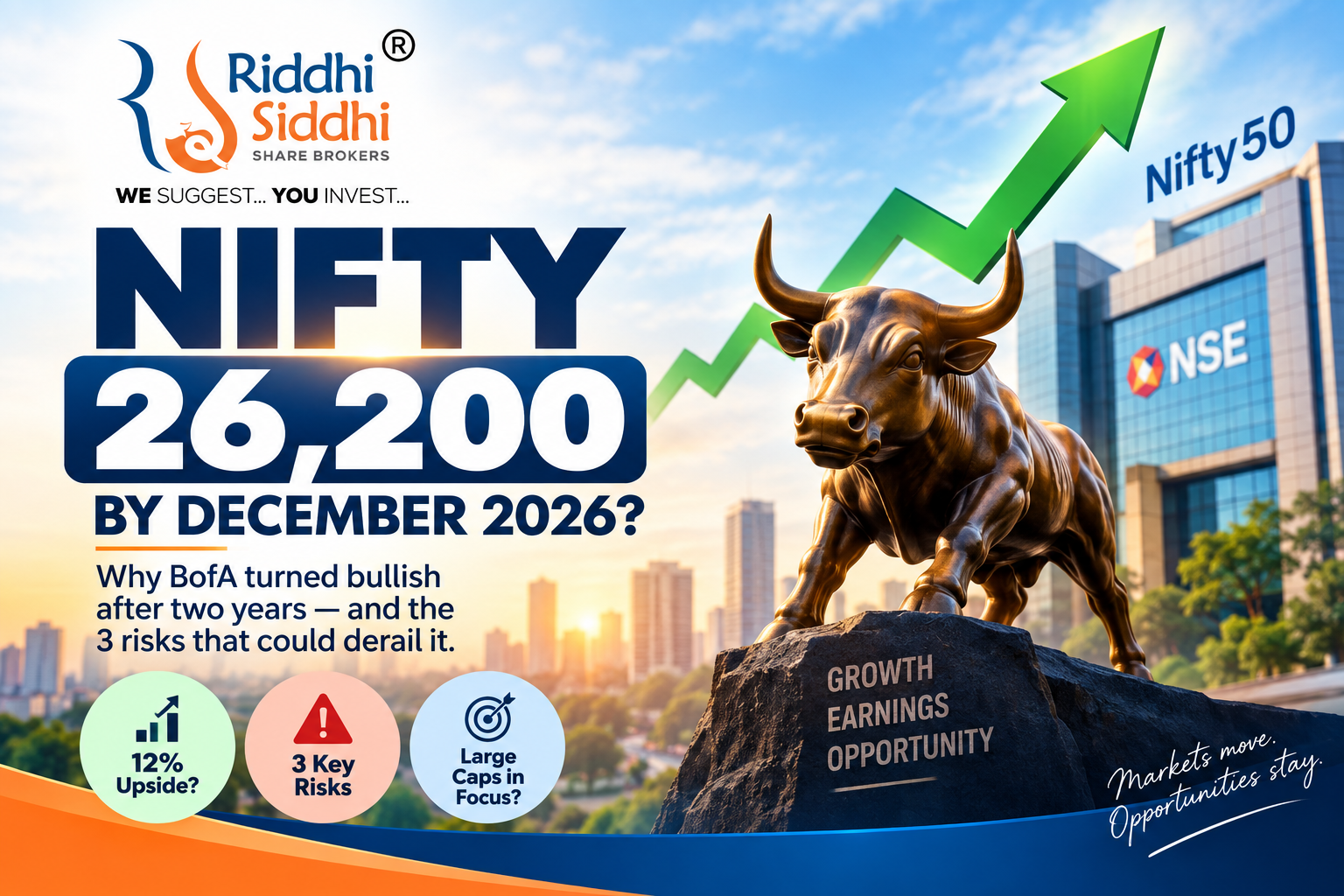
Can the Nifty really reach 26,200 by December 2026?
After maintaining a cautious stance on Indian equities for nearly two years, BofA Securities has turned constructive on the market and set a Nifty target for December 2026 of 26,200.
From the Nifty 50’s September 11 closing level of 23,398.10, that represents potential upside of roughly 12%.
That is a significant change in stance.
But investors should be careful not to interpret a brokerage target as a prediction guaranteed to come true.
The more useful questions are:
Why has BofA become bullish now?
What would need to happen for Nifty to reach 26,200?
And perhaps most importantly:
What could prevent it from getting there?
At Riddhi Siddhi Share Brokers, we look beyond the headline target to examine the earnings, valuations, liquidity, interest rates and market risks that could determine whether this bullish case actually plays out.
Nifty Target December 2026: Why Has BofA Turned Bullish?
BofA’s shift is important because it comes after an extended period of caution.
The brokerage had identified eight major risks affecting Indian equities. Its latest assessment suggests that five of those eight risks have either already materialised or are increasingly reflected in market prices.
These include:
- crude oil prices above $100 per barrel,
- weakness in the Indian rupee,
- monsoon concerns,
- commodity-price pressures, and
- expectations around RBI interest rates.
This does not mean these risks have disappeared.
It means markets may already have absorbed a meaningful part of their impact.
That distinction matters.
Markets rarely wait for every problem to disappear before recovering. They generally begin discounting what investors expect to happen next.
This is also why current market conditions need to be viewed alongside the technical picture.
In our latest analysis, The Week Ahead: Fed Decision, NSE IPO, Crude Oil & NYKAA in Focus | September 14–18, 2026, we highlighted that Nifty remains below important technical resistance levels and that the near-term structure continues to demand discipline.
The two views are not necessarily contradictory.
A market can have a constructive medium-term outlook while remaining technically vulnerable in the short term.
Nifty at 26,200: What Does 12% Upside Actually Require?
A move from approximately 23,400 to 26,200 is not simply about investor optimism.
Ultimately, equity indices tend to be influenced by two broad forces:
Earnings × Valuation
Nifty can therefore move higher if:
- corporate earnings grow,
- investors become willing to pay higher valuations for those earnings, or
- both happen together.
BofA expects Nifty earnings growth of approximately 10% in FY27 and 15% in FY28.
This makes earnings particularly important.
If corporate profits strengthen while valuations remain broadly stable, earnings growth itself can support the index.
If earnings disappoint, reaching 26,200 could require investors to pay increasingly expensive multiples—making the rally more dependent on sentiment and liquidity.
That leads to an important question:
Can Nifty reach 26,200 without meaningful earnings improvement?
It is possible, but a rally supported by earnings would arguably be more sustainable than one driven primarily by valuation expansion.
Investors should therefore watch quarterly earnings revisions just as closely as they watch the Nifty level itself.
Five Risks BofA Believes Have Largely Played Out
The change in BofA’s market stance is based partly on the belief that several risks have already been absorbed.
1. Crude Oil
Oil above $100 is particularly uncomfortable for India because the country imports a large proportion of its crude requirements.
Expensive crude can affect:
- inflation,
- the current-account balance,
- the rupee,
- corporate input costs, and
- monetary-policy expectations.
We recently examined this chain in detail in Crude Oil Above $100, Rupee Above ₹95: What It Means for Nifty, Inflation & Indian Stocks.
BofA’s argument is not that expensive oil is harmless. Rather, it believes a meaningful portion of this risk has already entered market expectations.
2. Rupee Weakness
A weak rupee can increase the cost of imports and complicate inflation management.
However, currency movements also affect sectors differently.
Export-oriented companies may receive some translation benefits, while import-dependent businesses can face higher costs.
Investors should therefore avoid interpreting rupee weakness as uniformly positive or negative for every stock.
3. Monsoon Deficit
Agricultural output, rural demand, food inflation and overall consumption can all be influenced by rainfall.
With the rainfall deficit already approaching pessimistic scenarios, BofA believes a meaningful part of this risk may now be recognised by markets.
4. Commodity Pressures
Sharp increases in commodities such as aluminium and copper can affect corporate margins across manufacturing, infrastructure and consumer businesses.
If commodity inflation stabilises rather than accelerates further, one important source of earnings pressure could reduce.
5. RBI Interest-Rate Expectations
Interest rates influence almost every part of the equity valuation equation.
They affect:
- borrowing costs,
- consumer demand,
- corporate expansion,
- bank margins,
- bond yields, and
- the discount rate investors use when valuing future profits.
But investors should distinguish between interest-rate policy and banking-system liquidity.
Our detailed explainer RBI Drains Over ₹6 Lakh Crore From Banks: What Excess Liquidity Means for Interest Rates, Bonds & Stocks explains why a large liquidity-absorption operation does not automatically mean that an RBI repo-rate hike will follow.
The 3 Risks That Could Stop Nifty From Reaching 26,200
This is perhaps the most important part of the entire forecast.
BofA’s constructive base case does not mean it believes risks have disappeared.
Three major risks remain.
Risk #1: A Huge Wave of Primary-Market Supply
BofA expects approximately $30 billion of primary-market issuance between September and December 2026, with activity potentially peaking around October.
Why does this matter for the secondary market?
Because investor capital is finite.
When large IPOs, follow-on offerings and other primary-market transactions arrive together, substantial amounts of money can move towards new issuances.
Think of market liquidity as water flowing between different pools.
If an unusually large amount flows into the primary market, less may temporarily be available elsewhere.
This does not automatically mean existing stocks must fall.
But an exceptionally busy issuance calendar can become an important liquidity variable.
The same phenomenon is already visible from the pre-IPO side of the market.
VaultStreet Advisors recently examined what India’s ₹70,000 crore September IPO rush could mean for pre-IPO investors and has also analysed how institutional capital is approaching the space in ₹700 Crore Bet on Pre-IPO: What JM Financial’s New Fund Signals for India’s Unlisted Share Market.
Together, these developments show how important the relationship between private-market capital, IPO supply and listed-market liquidity is becoming.
Risk #2: The US Federal Reserve Could Be More Aggressive Than Markets Expect
This may be the most immediate global risk.
BofA expects the US Federal Reserve to raise rates by around 75 basis points between September and December, compared with materially less tightening currently reflected in market pricing.
If the Fed turns out to be more hawkish than investors expect, the consequences could extend well beyond the United States.
Higher US interest rates can potentially influence:
US yields → Dollar → Global capital flows → FII flows → Rupee → Indian equities
Higher Treasury yields can make US assets relatively more attractive.
That can affect capital flows towards emerging markets such as India.
A stronger dollar can simultaneously create pressure on emerging-market currencies.
This is why the Federal Reserve features prominently in our September 14–18 Week Ahead market outlook.
The key issue is not simply whether the Fed changes rates.
It is whether the Fed does something materially different from what financial markets have already priced in.
Markets often handle expected bad news better than unexpected bad news.
Risk #3: AI Disruption and Indian Employment
The third risk is very different.
It is structural rather than purely financial.
Artificial intelligence is rapidly changing how companies think about:
- software development,
- customer support,
- back-office operations,
- analytics,
- content,
- finance,
- outsourcing, and
- productivity.
For India, the question is particularly important because services and technology-related employment contribute significantly to urban consumption and household income.
AI can create enormous productivity opportunities.
But if adoption also changes hiring requirements across technology and services businesses, the transition could affect employment growth and consumption patterns.
That makes AI both:
an economic opportunity
and
a potential labour-market disruption.
The ultimate impact will depend on whether AI primarily replaces existing work, augments employees or creates entirely new categories of employment.
For investors, this is unlikely to be answered by one quarter’s results.
It is a multi-year structural issue.
Why BofA Now Prefers Large Caps Over Midcaps and Smallcaps
One of the most interesting parts of BofA’s latest position is not simply its Nifty target.
It is the change in market-cap preference.
After strong relative performance in midcaps and smallcaps, valuations in parts of the broader market remain elevated.
BofA has therefore shifted its preference towards large caps while continuing to see selective opportunities elsewhere.
That does not mean:
“Sell every smallcap and buy every large cap.”
Market capitalisation alone never determines investment quality.
A better framework is:
Business Quality + Earnings Visibility + Valuation + Balance Sheet + Risk
A large company purchased at an excessive valuation can still produce disappointing returns.
A smaller company with strong fundamentals and reasonable valuation can still create value.
The important takeaway is therefore selectivity, not simply size.
What 30 Years of Nifty History Tells Us About Forecasts
Whenever investors see a target such as 26,200, it is tempting to focus exclusively on the destination.
History suggests the journey matters just as much.
Nifty has lived through wars, recessions, financial crises, inflation shocks, interest-rate cycles, political uncertainty and foreign-investor selling.
Our analysis There Has Always Been a Reason Not to Invest: What 30 Years of Nifty History Teaches Investors examines how dramatically short-term market experience can differ from long-term investment experience.
The lesson is not that markets always rise immediately after falling.
Nor is it that every stock eventually recovers.
It is that investors should be cautious about treating either extreme optimism or extreme pessimism as certainty.
A 26,200 target is a scenario, not a promise.
What Would Need to Go Right for Nifty to Reach 26,200?
Instead of asking whether one brokerage target is “correct”, investors can monitor the variables that would make the target more or less achievable.
1. Earnings Downgrades Need to Stabilise
If earnings expectations continue falling sharply, valuations become harder to justify.
2. Crude Needs to Stabilise
Persistently expensive crude would create challenges for inflation, the rupee and corporate margins.
3. The Rupee Needs to Avoid Disorderly Weakness
Gradual currency movements and sudden currency stress are very different market environments.
4. The Fed Must Not Shock Markets
If US monetary policy becomes significantly tighter than investors expect, global risk appetite could deteriorate.
5. Primary-Market Supply Must Be Absorbed
The market needs enough liquidity to digest the upcoming issuance pipeline without creating excessive pressure elsewhere.
6. Domestic Growth Must Remain Resilient
Consumption, credit growth, investment and corporate activity ultimately influence earnings.
7. Market Valuations Need Earnings Support
The stronger the earnings trajectory, the less dependent the market becomes on multiple expansion.
RSSB Market Dashboard: What Investors Should Watch Before December
Rather than watching 26,200 every day, investors may find it more useful to monitor a simple chain of indicators:
Crude Oil → USD/INR → Fed → RBI → FII Flows → Corporate Earnings → IPO Liquidity → Nifty Technical Structure
No single indicator determines the market.
But together, they can provide a much better picture of whether the environment supporting BofA’s bullish case is strengthening or weakening.
At Riddhi Siddhi Share Brokers, our approach remains focused on market structure, risk management and disciplined participation rather than treating any index target as guaranteed.
Bull Case, Base Case and Bear Case: Think in Scenarios
Investors often make the mistake of demanding one answer:
“Where will Nifty be in December?”
Markets rarely offer that certainty.
A more useful approach is scenario analysis.
Bull Case
Earnings improve, crude eases, the rupee stabilises, Fed concerns moderate, FII flows improve and domestic liquidity comfortably absorbs the IPO pipeline.
In such an environment, the market could potentially exceed current base-case expectations.
Base Case
Earnings grow broadly as expected, major macro risks stabilise and valuations remain supportive.
This is broadly the environment in which the 26,200 target becomes more plausible.
Bear Case
Oil remains elevated, the Fed tightens more aggressively, foreign flows weaken, earnings disappoint or primary-market issuance creates a larger-than-expected liquidity drain.
BofA itself sees the remaining risks as capable of producing approximately 7% downside in its bear case.
That number deserves as much attention as the 12% upside headline.
Good investing is not about predicting only what can go right.
It is also about preparing for what can go wrong.
Riddhi Siddhi Share Brokers View
BofA turning constructive after nearly two years of caution is a meaningful change in institutional market thinking.
But investors should resist reducing the entire argument to:
“BofA says Nifty will reach 26,200.”
The more important story is what has changed underneath that target.
Several macro risks have already hit markets.
Earnings expectations have been revised.
Large-cap valuations are becoming relatively more interesting compared with parts of the broader market.
And some of the biggest known risks may already be reflected in prices.
At the same time, the road ahead remains complicated.
The Federal Reserve, crude oil, the rupee, FII flows, a massive primary-market pipeline and corporate earnings can all change the equation.
That is why our view remains simple:
Treat 26,200 as a scenario to analyse—not a destination to assume.
Markets reward opportunity, but surviving volatility requires discipline.
Frequently Asked Questions
Is Nifty expected to reach 26,200 in 2026?
BofA Securities’ latest base case sees the Nifty 50 potentially reaching 26,200 by December 2026, representing roughly 12% upside from the September 11 closing level. This is a brokerage forecast and not a guaranteed market outcome.
What is the Nifty target for December 2026?
There is no single official Nifty target. Different financial institutions and analysts publish independent forecasts based on their assumptions about earnings, valuations, interest rates, liquidity and economic growth. BofA’s recently reported base-case target is 26,200.
Why has BofA turned bullish on Indian equities?
BofA believes five of the eight major risks it had been monitoring have either already occurred or are increasingly reflected in market prices. It also believes earnings downgrades may be approaching a peak and sees supportive domestic economic indicators.
What are the three biggest risks to the Nifty 26,200 target?
The three remaining risks highlighted by BofA are approximately $30 billion of primary-market issuance, potentially more aggressive US Federal Reserve rate hikes, and the longer-term impact of AI disruption on employment in India.
Does BofA prefer large caps over midcaps and smallcaps?
BofA has shifted its relative preference towards large caps after strong outperformance and elevated valuations in parts of the mid- and small-cap market. This does not mean every large-cap stock is attractive or every smaller company is unattractive; individual fundamentals and valuations remain important.
Should investors buy because Nifty has a 26,200 target?
An index target alone should never be the basis for an investment decision. Investors should consider valuations, earnings, risk tolerance, investment horizon, diversification and their own financial circumstances.
📈 Connect With Us for Assisted Trading in Equity & Futures
Market volatility can create opportunities—but disciplined execution, position sizing and risk management remain critical.
If you are looking for Assisted Trading in Equity Delivery and Index/Stock Futures, connect with Riddhi Siddhi Share Brokers.
👉 Explore our Assisted Trading & Investment Services
📲 Call / WhatsApp: +91 91379 69859
Riddhi Siddhi Share Brokers
We Suggest… You Invest.
Disclaimer
Riddhi Siddhi Share Brokers is an NSE & BSE Authorised Person of a leading broker. This content is for educational and informational purposes only and should not be construed as investment advice, research recommendation, solicitation or assurance of returns.
Market forecasts and index targets discussed in this article represent views or scenarios published by third parties and are not guaranteed outcomes or targets issued by Riddhi Siddhi Share Brokers.
Investments in securities are subject to market risks. Derivatives involve significant risk and can result in substantial losses. Past performance does not guarantee future returns. Investors should conduct their own due diligence and consult a SEBI-registered investment adviser, where appropriate, before making investment decisions.