
8 October 2026 | Riddhi Siddhi Share Brokers | Bonds & Investor Education
Imagine investing ₹5 lakh in a corporate bond because it offers 11% annual interest, while a bank fixed deposit offers considerably less.
The additional income looks attractive.
But what if the bond issuer runs into financial difficulties? What if its credit rating is downgraded? What if you need your money before maturity and cannot find a buyer?
A higher interest rate is a promise of payment, not proof of safety.
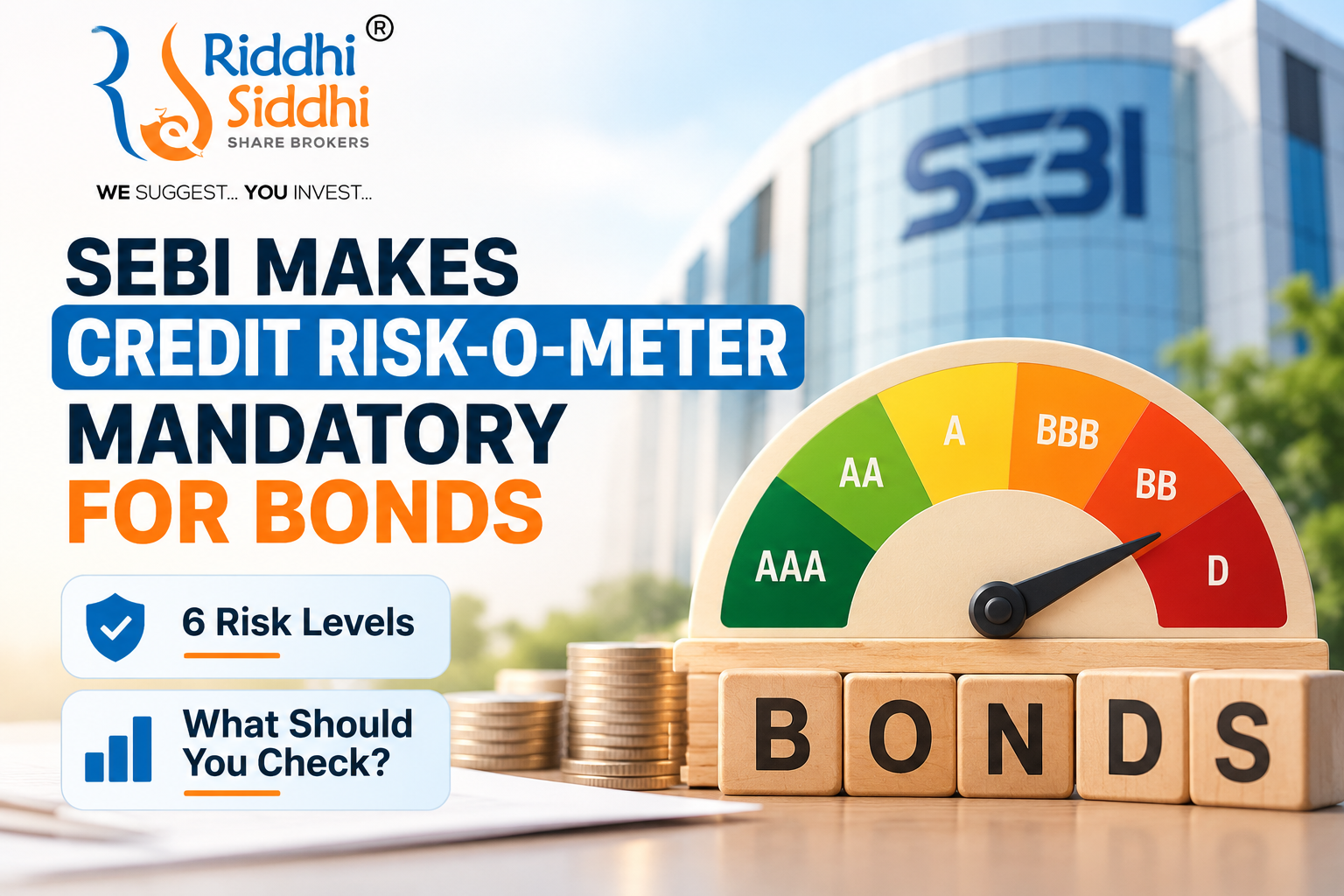
On 7 October 2026, the Securities and Exchange Board of India (SEBI) issued a circular titled Introduction of Credit Risk-o-Meter as an additional disclosure mechanism for debt securities.
The objective is to make credit risk easier for investors to recognise and compare.
For India’s growing corporate bond and non-convertible debenture (NCD) market, this is an important investor-awareness development.
But what exactly does a Credit Risk-o-Meter tell you? How should investors interpret AAA, AA, A and BBB ratings? And does a low-risk indicator mean your capital is protected?
Let’s examine the practical implications.
What Is SEBI’s New Credit Risk-o-Meter?
A Credit Risk-o-Meter is a visual disclosure mechanism designed to communicate the relative credit risk associated with debt securities.
Credit risk means the possibility that an issuer may fail to make scheduled interest payments or repay principal.
For example, an investor comparing two corporate bonds may see that one offers an 8% coupon and another offers 11%.
Without understanding credit risk, the investor may automatically prefer the higher coupon.
But the additional yield could reflect a weaker financial position, greater default risk or other characteristics of the instrument.
The Credit Risk-o-Meter aims to make this distinction easier to recognise.
The key principle is simple: A bond’s promised return and its repayment risk must be evaluated together.
The new disclosure mechanism supplements existing credit-rating information. It should not be interpreted as an independent SEBI guarantee or an assurance that the issuer will repay investors.
Primary source: SEBI Circular — Introduction of Credit Risk-o-Meter, 7 October 2026.
What Are the Six Credit Risk Levels for Corporate Bonds?
The October 2026 regulatory framework introduces six broad credit-risk bands.
The following table illustrates the rating groups described in the regulatory research brief and their general credit-risk significance.
| Credit rating | Risk category |
|---|---|
| AAA | Lowest credit risk |
| AA+, AA, AA− | Very low credit risk |
| A+, A, A− | Low credit risk |
| BBB+, BBB, BBB− | Moderate credit risk |
| BB+, BB, BB− | Moderate risk of default |
| B+, B, B−, C+, C, C−, D | High to very high risk of default |
Regulatory accuracy note: The rating-to-category mapping above is drawn from the supplied research brief. The exact prescribed colour names and formal mapping must be reconciled with the full SEBI circular before publication.
What do these ratings mean in practice?
AAA-rated bonds: Generally indicate the highest assessed credit quality and relatively lowest default risk. They are not risk-free.
AA-rated bonds: Generally indicate very strong creditworthiness, although adverse developments can still affect repayment capacity.
A-rated bonds: Indicate adequate credit quality, with potentially greater sensitivity to changes in business or economic conditions.
BBB-rated bonds: Represent the lower end of investment-grade ratings under commonly used domestic rating scales.
BB-rated bonds: Are generally speculative grade and carry materially greater credit risk.
B-rated and lower bonds: Indicate substantial credit concerns. A D rating denotes default under applicable rating definitions.
These classifications concern creditworthiness. They do not independently measure liquidity, market-price volatility or taxation.
AAA vs BBB Corporate Bonds: Why Does the Difference Matter?
Consider two hypothetical bonds.
| Particulars | Bond A | Bond B |
|---|---|---|
| Credit rating | AAA | BBB |
| Annual coupon | 7.5% | 11% |
| Investment amount | ₹5,00,000 | ₹5,00,000 |
| Annual coupon income | ₹37,500 | ₹55,000 |
| Difference in annual income | — | ₹17,500 more |
Illustrative calculation assuming the investment is made at face value, the coupon applies to that face value, and all scheduled payments are made. Figures are before tax, fees and any market-price effects.
Bond B offers ₹17,500 more in annual coupon income.
But does that automatically make Bond B a better investment?
No.
The higher coupon may compensate investors for greater credit risk.
If the issuer fails to make scheduled payments, the additional promised income may be irrelevant compared with the potential loss of principal.
The correct question is not merely, “Which bond pays more?” It is, “What risks am I accepting to earn that additional income?”
Is an AAA-Rated Bond Completely Safe?
No.
This is one of the most important misconceptions in the bond market.
An AAA rating is a credit-rating agency’s assessment of very strong relative creditworthiness. It is not a guarantee of repayment.
Even a highly rated bond can expose investors to multiple risks.
1. Credit risk
The issuing company may experience financial difficulties and fail to meet its obligations.
2. Interest-rate risk
When market interest rates rise, the price of an existing fixed-rate bond generally falls, assuming other factors remain unchanged.
An investor selling before maturity could incur a loss.
3. Liquidity risk
Some corporate bonds trade infrequently.
Finding a buyer at a reasonable price may be difficult, particularly during periods of market stress.
4. Rating downgrade risk
A bond rated AAA today may receive a lower rating later if the issuer’s financial position deteriorates.
5. Reinvestment risk
Investors receiving periodic interest payments may be unable to reinvest those payments at comparable rates.
6. Structural risk
A secured senior bond, unsecured subordinated bond and perpetual instrument may offer substantially different protections, even when issued by the same financial institution.
This distinction is especially important when comparing bonds using their advertised coupon rates.
For a broader explanation of how interest rates influence debt securities, read our earlier analysis: RBI Liquidity Withdrawal: Impact on Interest Rates, Bonds and Stocks.
What Happens If Two Credit Rating Agencies Disagree?
Different credit rating agencies may assign different ratings to the same debt security.
For example:
- Rating Agency A assigns AA.
- Rating Agency B assigns A.
The regulatory research brief indicates that the new Credit Risk-o-Meter uses the lower applicable rating for its risk classification.
In this illustration, that would mean using the A rating rather than AA.
The rationale is straightforward: a more favourable rating from one agency should not automatically obscure the more cautious assessment of another.
However, investors should go beyond the visual indicator.
They should examine why the agencies disagree, whether the ratings concern the same instrument, and whether any recent changes have occurred in the issuer’s finances.
The precise multiple-rating disclosure requirement should be checked against SEBI’s final circular.
Why Do Unsecured Bonds Deserve Additional Attention?
Corporate bonds may be secured or unsecured.
A secured bond generally has specified security arrangements, subject to the terms of its documentation and applicable law.
An unsecured bond does not benefit from the same identified asset-backed security.
This difference can matter considerably if the issuer becomes insolvent.
Unsecured bondholders may have weaker recovery prospects depending on the ranking of their claims and the issuer’s available assets.
Certain subordinated or perpetual instruments carry additional complexities, including potential loss-absorption provisions.
Investors should therefore understand:
- Whether the bond is secured or unsecured.
- Whether the claim ranks senior or subordinated.
- Whether the instrument has a defined maturity.
- Whether interest payments can be deferred or cancelled.
- What happens in a default or resolution event.
A well-known issuer’s name does not make every security issued by that institution equally safe.
Does the Credit Risk-o-Meter Measure Every Investment Risk?
No. It focuses on credit risk rather than the entire risk profile of a bond investment.
This distinction is critical.
A corporate bond can have a strong credit rating and still fall in market value.
For example, suppose an investor purchases a fixed-rate bond when prevailing market yields are 7%.
If comparable market yields subsequently rise to 9%, the existing bond may become less attractive to buyers.
Its market price could decline.
The issuer might remain financially sound throughout this period.
Therefore, a relatively low credit-risk classification does not necessarily mean low market-price risk.
Investors should evaluate credit risk, interest-rate sensitivity, maturity and liquidity separately.
Our article on US Treasury Yields and Their Impact on Indian Markets explains how changing global yields can influence financial asset valuations.
When Will SEBI’s Credit Risk-o-Meter Rules Become Effective?
SEBI issued the relevant circular on 7 October 2026.
The supplied regulatory research identifies a 45-day implementation period.
If the applicable provision requires implementation 45 calendar days after 7 October, that would point to 21 November 2026.
However, the precise operative date, covered securities, disclosure locations and transitional provisions must be read directly from the circular.
Investors should not assume that every online bond platform is required to display the new indicator immediately from 7 October.
The latest requirements should always be checked against SEBI’s official circular and subsequent amendments, if any.
Bond Credit Risk-o-Meter vs Mutual Fund Risk-o-Meter: What’s the Difference?
Both mechanisms are intended to improve investor understanding, but they assess different things.
| Feature | Bond Credit Risk-o-Meter | Mutual Fund Risk-o-Meter |
|---|---|---|
| Primary purpose | Communicate debt-security credit risk | Communicate a mutual fund scheme’s overall risk |
| Main focus | Creditworthiness and default-related risk | Portfolio characteristics and associated risk factors |
| Investment covered | Applicable debt securities | Mutual fund schemes |
| Guarantees capital? | No | No |
| Guarantees returns? | No | No |
A debt mutual fund may hold multiple securities with different maturities, ratings and issuers.
Its risk profile depends on the combined characteristics of its portfolio.
An individual corporate bond creates direct exposure to the relevant issuer and instrument terms.
For readers evaluating debt funds alongside other mutual fund categories, our article Small Cap, Mid Cap, Gold or International: Where Should Your SIP Go in 2026? also explains why debt mutual funds should be assessed according to their investment horizon and underlying risks.
Seven Questions Every Investor Should Ask Before Buying a Corporate Bond
The new Credit Risk-o-Meter may improve disclosure, but it cannot replace investor due diligence.
Before purchasing a bond, ask these seven questions.
1. Who is borrowing my money?
Understand the issuer’s business model, financial condition, profitability, cash flows and outstanding borrowings.
2. What is the latest credit rating?
Review the current instrument rating, outlook, rating rationale and recent changes.
3. Is the bond secured?
Understand the security structure, claim ranking and recovery implications.
4. What is the yield to maturity?
Coupon rate and yield to maturity are not necessarily the same.
For example, purchasing a bond below face value can increase its yield relative to its stated coupon, subject to the remaining cash flows and other terms.
5. When will I receive my money?
Review the maturity date, coupon schedule, redemption conditions and any call or put options.
6. Can I sell the bond before maturity?
Examine trading activity, available buyers, bid-ask spreads and the possibility of selling at a discount.
7. What taxes and charges apply?
Tax treatment can depend on the investor, instrument, holding period and applicable law.
The amount you ultimately retain may differ from the advertised yield.
The central lesson: Evaluate the issuer, the instrument and the price—not just the interest rate.
What Does This Mean for Indian Bond Investors?
SEBI’s new disclosure initiative has the potential to make corporate bond risks more understandable, especially for retail investors who may be unfamiliar with credit-rating terminology.
A standardised visual framework can help investors notice credit-quality differences earlier in the decision-making process.
However, better disclosure should not create false confidence.
Investors must continue examining the underlying financial position of issuers and the legal terms of debt instruments.
At Riddhi Siddhi Share Brokers, our focus is on helping market participants understand available financial products and access relevant execution-related services through the applicable broker framework.
Readers interested in debt-market products can explore our Bonds Services.
Frequently Asked Questions
Is the SEBI Credit Risk-o-Meter compulsory?
SEBI issued a circular introducing the Credit Risk-o-Meter as an additional disclosure mechanism for debt securities. The detailed applicability and compliance obligations are specified in the circular.
How many risk categories does the framework contain?
The supplied October 2026 regulatory research describes six categories, spanning ratings from AAA through D. The legally prescribed mapping should be verified against the final circular.
Is an AAA corporate bond risk-free?
No. An AAA rating reflects very strong relative creditworthiness, but repayment, liquidity and market-price risks remain.
What is the difference between AAA and BBB bonds?
AAA generally indicates substantially stronger assessed creditworthiness than BBB. BBB remains investment grade under commonly used domestic rating scales, but carries greater assessed credit risk.
Can a corporate bond investor lose principal?
Yes. Default, restructuring, recovery shortfalls or selling below the purchase price can result in capital losses.
Does a higher coupon mean a better bond?
Not necessarily. Higher coupons may reflect higher risks or different instrument characteristics.
Can credit ratings change after I invest?
Yes. Credit rating agencies can upgrade, downgrade, reaffirm or withdraw ratings based on changing circumstances.
Is a corporate bond safer than a mutual fund?
There is no universal answer. Their structures, underlying exposures and risks differ. Investors should compare specific instruments and schemes rather than assume one category is always safer.
Conclusion: A Better Risk Warning Does Not Mean a Risk-Free Investment
SEBI’s Credit Risk-o-Meter initiative highlights a principle that every bond investor should understand.
The coupon tells you what an issuer promises to pay. The credit rating helps you assess its ability to pay. Neither guarantees repayment.
Whether an investor is considering an AAA-rated corporate bond, an NCD offering a higher yield or a debt mutual fund, understanding the risks is essential.
At Riddhi Siddhi Share Brokers, we encourage informed participation in financial markets, with careful attention to product disclosures, suitability and risk.
Connect With Riddhi Siddhi Share Brokers
For information about debt-market products, visit our Bonds Services.
For investors and traders seeking execution support in eligible listed-market segments, explore our Assisted Trading Services. These services are not investment advisory or discretionary portfolio management.
Website: https://www.riddhisiddhisharebrokers.com
Call / WhatsApp: +91 91379 69859
Message +91 99875 53455 to request access to our exclusive WhatsApp community for daily prices, opportunities and market updates.
Disclaimer
Riddhi Siddhi Share Brokers is an NSE & BSE Authorised Person of a leading broker. We do not provide investment advisory services or portfolio recommendations.
This article is intended solely for educational and informational purposes and does not constitute investment advice, a research recommendation, an offer or solicitation to transact, or an assurance of returns.
Corporate bonds, NCDs, mutual funds and other market-linked instruments carry risks, including loss of capital. Credit ratings are opinions, may change and do not guarantee repayment.
Investors should independently evaluate the relevant documents, risks, taxation and suitability, and consult a SEBI-registered investment adviser where appropriate.
Regulatory information is presented as of 8 October 2026 and may be subject to subsequent amendments or clarifications.